Scientists have developed a multiphysics thermal model for panels with a natural convective cooling loop and tested it against experimental data. They also experimented with varying the thickness of the cooling channel and different coolants. The highest measured electrical efficiency reached 15.45%.
An international research team, led by the University of Manchester, studied the thermal modeling of floating photovoltaic (FPV) panels with a natural convective cooling loop (NCCL). The researchers created a new 2D multi-physics numerical model to evaluate the system using varying coolant channel thicknesses and nanofluids.
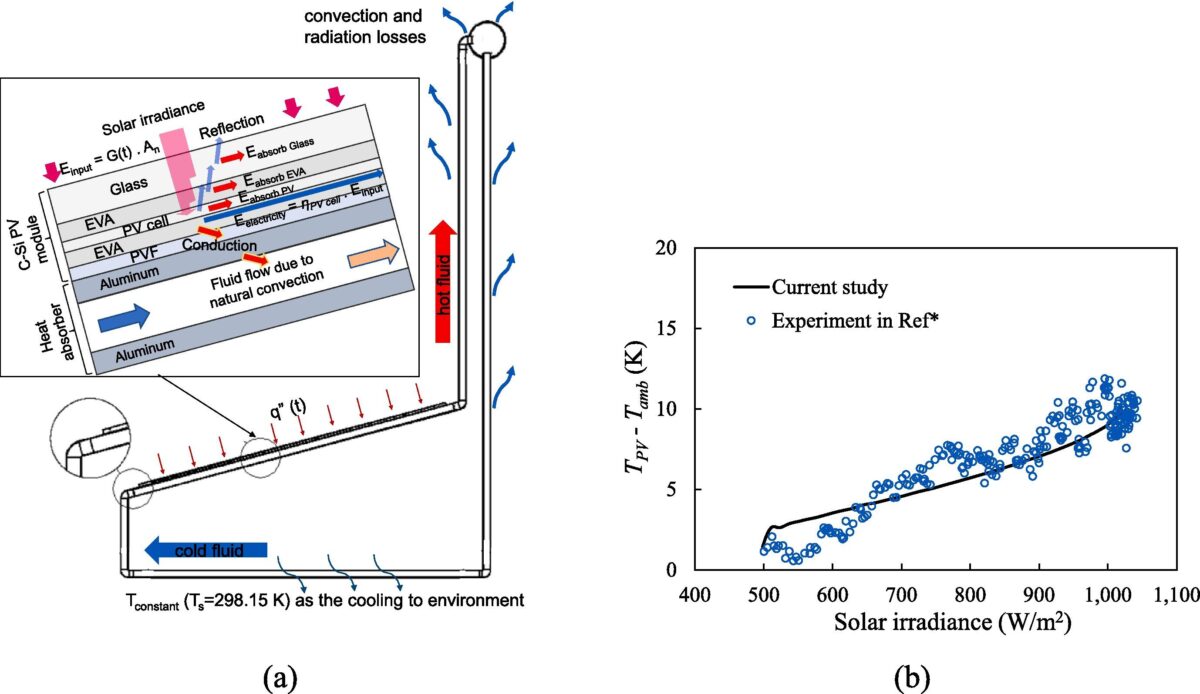
“The NCCL is a passive cooling system that removes heat from the PV panel and transfers it to a large body of water, such as a lake, river or dam,” the group explains. “It consists of three main elements: the heat sink section at the base of the loop, immersed in the body of water; the PV module, with a length of 0.75 m, above the heat sink part, which receives the solar energy; and a coolant reservoir at the very top.”
The NCCL system is 1 meter long and 1.2 meters high and uses 20mm tubes and 1mm thick copper frames. A reservoir 20 cm long and 40 cm high is located 75 cm above the PV module. Two 2mm radiation filters flank the cooling channel, which varies in thickness from 1mm, 2mm, 5mm, 10mm or 20mm.
Below this, a tempered glass PV panel, a layer of ethylene vinyl acetate (EVA), a silicon PV cell, another EVA layer and a layer of polyvinyl fluoride (PVF) are installed. The efficiency of the panel, measured without cooling, is 14.98%. Researchers simulated the reservoir fluids using pure water or 5.3 parts per million (ppm) silver (Ag)-water nanofluid.
“This reservoir receives the lower-density heated water from the solar panel below, and this fluid motion pushes water from the reservoir to the heat sink section at the base of the loop, rejecting thermal energy from the loop to the water body. which drives the PV system,” the group said.
Image: University of Manchester, Solar Energy, CC BY 4.0
Scientists have created a numerical model to describe the system, which incorporates heat convection, conduction, radiation effects, and equations for fluid flow and heat transfer. They tested the model against experimental results and found an average deviation of 8.3%. The model was further tested under 24-hour and 8-hour conditions in Bandung, Indonesia. The initial temperature was set uniformly at 298.15 K (25 °C) over the entire solution domain, consistent with standard test conditions (STC).
“Variations in the thickness of the coolant channel within the radiant filter above the photovoltaic module show that increasing channel thickness increases the buoyancy-driven coolant flow rate, resulting in lower operating temperatures,” the researchers said. “As the thickness of the cooling channel increases, the increase in coolant flow decreases. Increasing the thickness of the cooling channel also improves the absorption of solar radiation, further reducing the temperature of the photovoltaic cells, but at the cost of reducing the radiant energy available for electricity generation.”
By using pure water in the reservoir, the system achieved the highest efficiency of 15.45% with a cooling channel thickness of 2 mm and the lowest efficiency of 14.48% with 20 mm. With 5.3 ppm Ag water, the efficiency peaked at 15.08% at 1 mm and dropped to 11.85% at 20 mm.
“Although the Ag-water nanofluid results in a lower temperature, the difference in efficiency stems from the increased transmittance of pure water in the useful wavelength range of the crystalline silicon photovoltaic cell (325 nm to 1125 nm), while the Ag-water nanofluid absorbs more in the 340 nm – 510 nm range,” the academics said. “Therefore, lowering the operating temperature alone does not guarantee higher efficiency, because the permeability of the coolant within the usable wavelength range also plays a crucial role.”
They presented their results in “Efficiency improvement of floating photovoltaic panels with natural convective cooling loops: multiphysics thermal modeling”, which was recently published in Solar energy. In addition to scientists from the University of Manchester, the research group included academics from Politeknik Negeri Semarang in Indonesia, the Guangdong Technion-Israel Institute of Technology in China and Khalifa University in the United Arab Emirates.
This content is copyrighted and may not be reused. If you would like to collaborate with us and reuse some of our content, please contact: editors@pv-magazine.com.
Popular content