

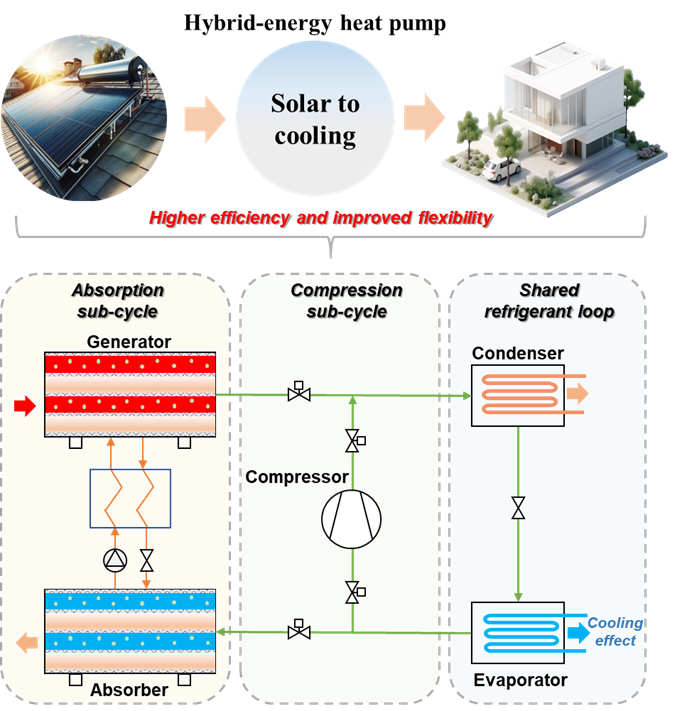
Researchers in Hong Kong have developed a hybrid energy heat pump that seamlessly combines absorption and compression cycles using crystallization-free ionic liquids, improving efficiency and reliability under different solar conditions. Simulations in multiple Chinese cities show that the system can significantly reduce electricity consumption and cooling costs, making it promising for sustainable building cooling and future commercial scale-up.
A research team from the City University of Hong Kong has designed a new hybrid energy heat pump (HEHP) system that enables a gradual transition from an absorption cycle to a compression cycle. In addition, the new system uses coolant/ionic liquids (ILs) as working fluids to eliminate crystallization limitations.
“Our research introduces a new HEHP that integrates both absorption and compression heat pump cycles, allowing seamless transitions between the two types. This flexibility makes the system adaptable to variations in solar radiation and cooling demand, maximizing energy efficiency,” said corresponding author Wei Wu. pv magazine. “Additionally, the use of crystallization-free ionic liquids as working fluids eliminates the crystallization limitations associated with traditional absorption cycles, improving energy efficiency and system flexibility over a broader temperature range.”
Wu further explained that the need for such a solution stems from problems with thermally driven absorption heat pumps. “The construction sector is responsible for 20-30% of global energy consumption and CO2 emissions, while cooling demand is responsible for over 10% of global electricity consumption,” he said. “Thermally driven absorption heat pumps can significantly reduce electricity consumption, but are hampered by issues such as low reliability, limited applicability, low efficiency and crystallization limitations.”
In their latest study, the team simulated the new system at a primary school with different ILs and in different locations in China. However, Wu said the group is currently planning further research to explore the scalability of this system for larger commercial and industrial applications. “This includes optimizing the control strategy of hybrid configurations and assessing the feasibility of integrating the HEHP with renewable energy sources in different geographic regions with varying climates. In addition, low-cost and highly reliable working fluids will be explored for scalable and affordable applications,” he said.
Image: Hong Kong City University,
The system includes two parallel sub-cycles: an absorption sub-cycle driven by a thermal compressor fed with solar heat, and a compression sub-cycle driven by an electric compressor. They share a common refrigerant circuit, allowing the refrigerant flow to be dynamically distributed between the absorption and compression subcycles to balance solar energy availability and cooling demand. The system operates in three modes: pure absorption mode when solar radiation is sufficient to meet the cooling demand; hybrid absorption-compression mode when solar energy is available but insufficient; and pure compression mode when solar radiation is low or absent.
After setting up the system, the team tested the performance of several ILs with it, namely two water (H2O)/ILs, four ammonia (NH3)/ILs, two hydrofluorocarbons (HFC)/ILs and two heavy fuel oil (HFO)/ILs. The systems with different ILs are designed to accommodate a typical primary school with an area of 4,680 m2 and operate between 8am and 6pm on weekdays. A dynamic cooling load was modeled using hourly simulations for four cities: Beijing, Shanghai, Hong Kong and Singapore. These cities have solar intensities of 0.149 kW/m2, 0.132 kW/m2, 0.140 kW/m2 and 0.186 kW/m2 respectively.
“The cycle with NH3/[DMIM][DMP] was identified as the most suitable alternative due to its high electrical coefficient of performance (COP) of 19.2 and significantly high compactness,” said Wu. “The HEHP cycle using NH3/[DMIM][DMP] is designed for Hong Kong, where the solar absorption subcycle energy efficiency ranges from 0.31 to 0.50. As the solar collector area increases, the COP increases from 6.8 to 19.8, while the cooling potential of the unit decreases from 1.75 kWh/m2/day to 0.64 kWh/m2/day.”
In conclusion, he added that levelized cooling costs initially fall before rising, reflecting the trade-off between higher initial costs and lower operating costs, with the lowest value of $0.075/kWh occurring at a solar collector area of 600 m2. “With a relative improvement in the demand-to-ratio from 27.7% to 47.5% and a reduction in electricity consumption by 39.4–110.0 MWh/year, the HEHP cycle demonstrates both high efficiency and flexible applicability for sustainable building cooling,” he concluded.
The system was presented in “A flexible hybrid energy heat pump that uses efficient ionic liquids for sustainable solar cooling”, published in Applied energy. Researchers from the City University of Hong Kong and the City University of Hong Kong Shenzhen Research Institute, Shenzhen, China, participated in the study.
This content is copyrighted and may not be reused. If you would like to collaborate with us and reuse some of our content, please contact: editors@pv-magazine.com.
Popular content

