

Japanese researchers have proposed a method for future vehicle-integrated photovoltaic route planning. It integrates environmental shadow effects based on satellite and geographic information system data.
A research team from the National Institute of Advanced Industrial Science and Technology (AIST) in Japan has proposed a method to estimate shadow effects on vehicles equipped with integrated geographic information system (GIS) models and solar PV satellite data. The estimates for the study area in Fukushima city, Japan, were found to be consistent with real-world vehicle-integrated photovoltaic (VIPV) measurements.
“While previous studies often rely on data from local weather stations, we use satellite data from Himawari-8/9 to estimate solar radiation along different geographic routes,” said the study’s corresponding author Pawita Bunme. pv magazine, referring to the Japanese weather satellite of the Japan Meteorological Agency.
The GIS data was combined with high-resolution digital surface models (DSM) and digital terrain models (DTM) at a resolution of 0.5 meters to take into account the shadows of surrounding terrain and objects that affect solar radiation on vehicles. “This allows us to assess solar radiation during vehicle use and helps plan routes to make the most efficient use of VIPV,” Bunme said.
The simulated direct and diffuse irradiance was used to calculate shading factors, and satellite-estimated irradiance data was applied to estimate total irradiance.
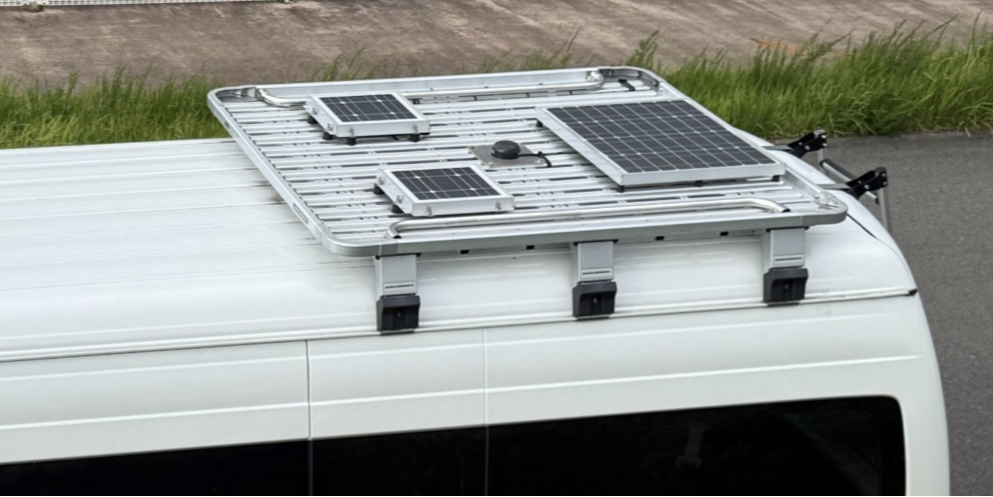
The validation portion of the study compared estimated irradiance at five-minute intervals with actual data collected along a specified route. For route measurements, a Toyota HiAce electric vehicle (EV) was equipped with solar PV modules to power a data logger and radiation measurement sensors, along with a GPS system and a speedometer to record latitude and longitude at one-second intervals.
The vehicle followed a route typical of a community car service, making three journeys per day over the same 25km, from 10am to 4pm, with a slightly different 24km route in winter to avoid slippery roads and accumulated snow. The data was collected continuously from May 2022 to January 2023, for eight months, according to the newspaper.
“The estimation results were consistent with measured data over different operation dates and routes, with a normalized mean absolute error (nMAE) of 3%-7% under clear skies and 12%-13% under partly cloudy conditions,” the scientists said. Additional error statistics were calculated, including mean bias error (MBE) and root mean square error (RMSE).
“The results highlight that shade is an important factor in reducing solar radiation during VIPV use and should be included in solar radiation estimation methods,” they concluded.
They also noted limitations of the study with examples of future research topics such as including estimates of the influence of cloud cover, using a variety of simulation tools and settings, and including simulated data on vehicle solar energy generation.
“For our next project, we want to further improve the GIS-based method for estimating solar radiation for VIPV. This includes extending simulations to cover longer operating periods in more regions and validating results with actual measured data,” Bunme said.
Other ongoing projects include integration of PV with electric vehicles, demonstration in real-world applications, and research into the long-term reliability of VIPV systems.
Their findings can be found in “GIS-based method for estimating solar irradiance in vehicle-integrated photovoltaic cells”, which was recently published in Renewable energy.
This content is copyrighted and may not be reused. If you would like to collaborate with us and reuse some of our content, please contact: editors@pv-magazine.com.
