

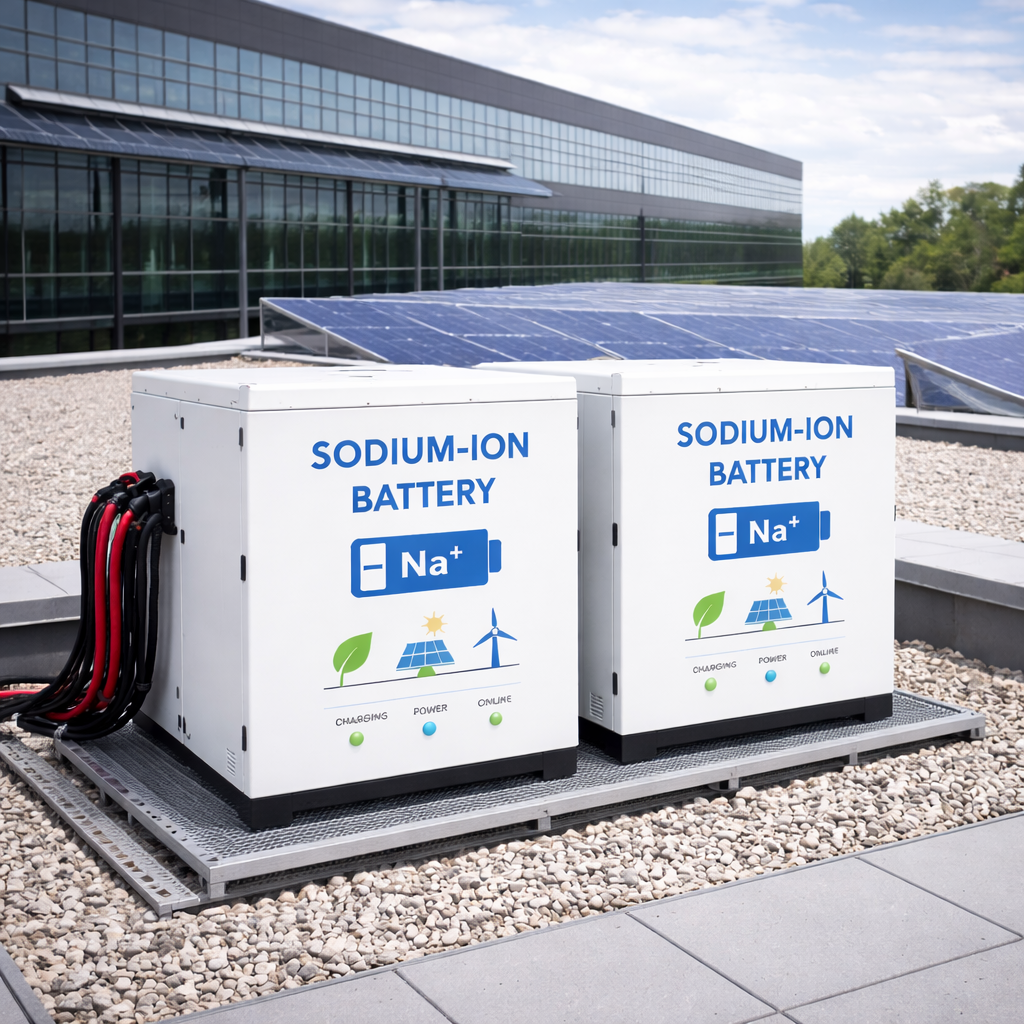
Sodium-ion batteries are emerging as a safer and cheaper alternative to lithium-ion, with a recent international study highlighting their competitiveness in stationary energy storage. The research shows that continued investment and supply chain development could enable wider adoption within the next decade.
Sodium-ion batteries (SIBs) are increasingly seen as a sustainable alternative to lithium-ion (Li-ion) storage, especially as global demand for lithium is expected to exceed supply by 2028, according to a recent report from the International Renewable Energy Agency (IRENA). Despite this potential, achieving broad commercial success, especially outside niche applications, remains a challenge.
An international research team has published a comprehensive overview of the key market trends within the SIB industry and ecosystem. Their analysis shows that sodium-ion technologies are already competitive with some lithium-ion counterparts in select market segments.
“In applications where size and weight are less important, such as stationary energy storage, sodium ion batteries are already starting to appear commercially,” said lead author Nazmul Hossain. pv magazine. “Major manufacturers, such as CATL, have announced plans to begin mass production of next-generation sodium ion cells by 2026, with the intention of expanding their use to vehicles and storage systems.”
Nevertheless, industry analysts expect it will take some time to achieve full cost and performance parity with mainstream lithium-ion, especially lithium iron phosphate (LFP), as production scale and technologies mature. Hossain estimates this could happen by the mid-2030s. “Sodium ion is currently competitive in niche markets and could become broadly competitive in stationary storage within the next five to 10 years as costs decline and supply chains mature,” he said.
According to Hossain, the ultimate competitiveness of SIB technology will depend on the balance between cost and performance. Sodium’s natural abundance and low cost make it an attractive candidate for large-scale energy storage. Unlike lithium, which is subject to price volatility and limited resources, sodium offers the path to more affordable battery systems, with potential cost savings of 30-40% compared to conventional lithium-ion cells.
However, this cost benefit comes with a trade-off. “Sodium ion batteries generally have a lower energy density, typically between 120 and 200 Wh/kg, which limits their suitability for applications where weight is a critical factor, such as electric vehicles,” said Hossain, noting that researchers are working to address these limitations, exploring new cathode and anode materials, optimized electrolyte formulations and advanced cell designs to improve performance without negating the cost benefit.
“In summary, competitiveness will be determined by the combination of cost and performance improvements,” Hossain added. “Realizing equivalent energy storage remains difficult despite the cheap raw materials.”
Sodium ion batteries are particularly suitable for stationary energy storage applications, including buffering solar and wind energy or reducing peak loads on the electricity grid. A notable advantage is safety; The sodium ion chemistry is less susceptible to thermal flooding than many lithium ion systems, giving it a robust safety profile for large installations.
Hossain also acknowledged the limitations of the technology. In addition to lower energy density, some experts argue that alternative chemicals, such as flow batteries, may prove more cost-effective for long-term storage. “Sodium ion is expected to perform very well in grid energy storage and other stationary applications; however, it may not be the most suitable option for all segments, especially those with high energy density requirements,” he said.
The sodium ion battery industrial ecosystem is gaining momentum. In addition to CATL, companies including Sinopec and LG Chem are developing materials and supply chains to support broader deployment. Both market interest and production capacity are increasing, with forecasts pointing to a potential capacity of hundreds of gigawatt hours by 2030, as demand for energy storage and certain EV applications grows.
“Market interest and production capacity are both increasing, with the potential to reach hundreds of gigawatt hours of capacity by 2030,” Hossain pointed out. “This growth is driven by the expansion of deployment in energy storage and certain electric vehicle applications.”
In the newspaper “Sodium Ion Batteries: A Sustainable Alternative to Lithium Ion Batteries with an overview of market trends, recycling and battery chemistry”, published in Next energyHossain and his colleagues identified the key barriers preventing SIB technology from achieving wider adoption.
These include low energy density, cycle life and stability, dendrite suppression, low temperature operation, industrial carbon industrialization, and system-level integration. “With continued interdisciplinary advances in materials science, electrochemistry and manufacturing processes, SIBs are poised to become not only an alternative, but also a complementary and strategically vital counterpart to LIBs,” the researchers said.
The research group included academics from the Islamic University of Technology in Bangladesh, the University of Waterloo in Canada and Idaho State University, Pocatello, in the United States.
This content is copyrighted and may not be reused. If you would like to collaborate with us and reuse some of our content, please contact: editors@pv-magazine.com.
