

December 29, 2025
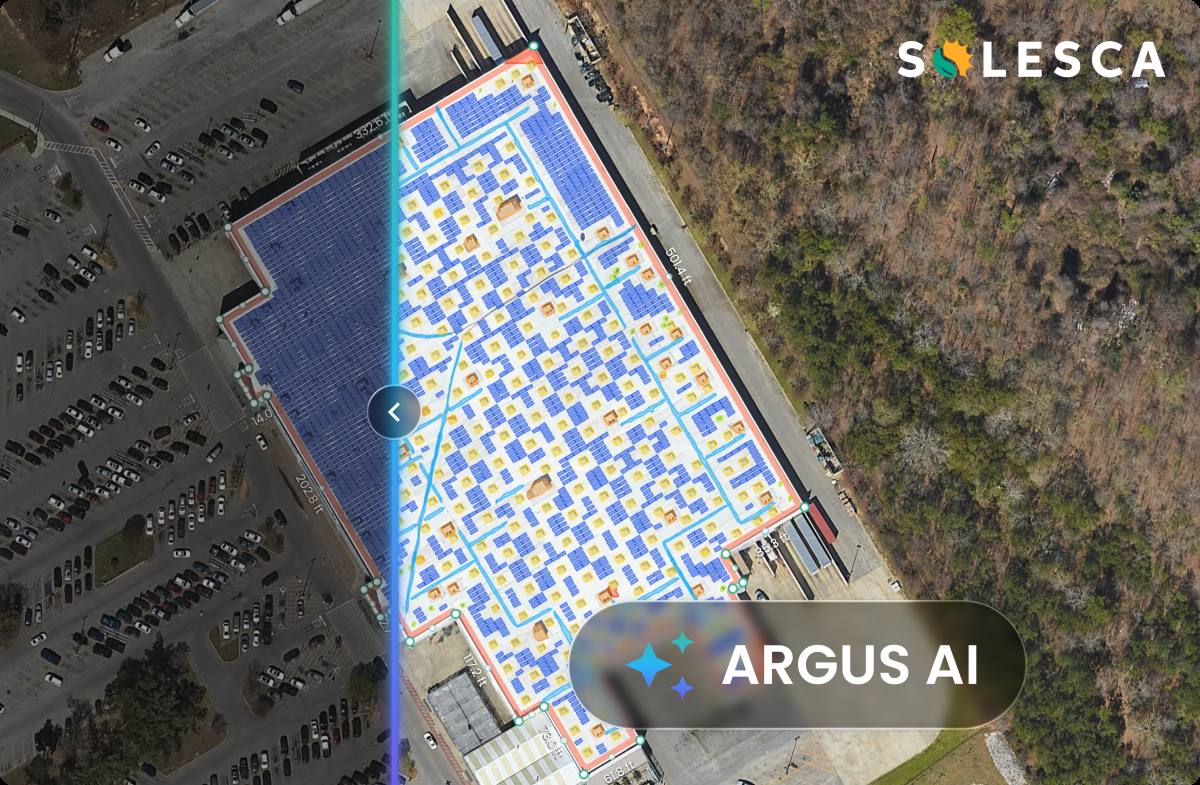
Solar design software provider Solesca has released a new AI-powered system aimed at solving technical challenges on roofs. The company’s ARGUS 1.0 (Automated Recognition and Geometric Understanding System) is an in-house computer vision engine designed to detect, classify and report on rooftop obstacles in seconds.
ARGUS brings AI automation to commercial solar. Named after a figure from Greek mythology, Argus was the giant who never slept, a symbol of ceaseless vigilance. Solesca’s ARGUS was created to bring that same ruthless precision to the design workflows of solar projects. By automatically scanning images and generating useful geometry in moments, ARGUS eliminates the heavy lifting of manual detection and drawing, so you can focus on design.
ARGUS not only sees, but understands
Instead of just locating shapes, it classifies them. This allows the system to immediately link detections to obstacle templates, automatically applying the correct heights and setbacks. What used to be a manual, repetitive process is now seamless, defining every vent, skylight and unit with perfect consistency.
ARGUS suggests, you decide
Every detection made is associated with a visible confidence score, giving you more control than ever. Adjust the confidence slider, remove low confidence obstacles, or duplicate and refine as necessary. Everything remains editable, giving you full control over the design.
A new standard for accuracy and speed. Clean, structured obstacle data from the start means faster and more accurate designs. Combined with our Automated Walkway feature, ARGUS helps engineers arrive at a feasible drawing faster than ever before.
In an opinion article, Solesca COO Rocco Fucetola explained how ARGUS puts control over AI in the hands of the end user.
“There is widespread fear that AI aims to replace human judgment and meaning,” Fucetola wrote. “I aim for a different approach, using AI to increase our capabilities.”
He explained how he helps the project designer avoid errors that could affect construction.
“As a solar energy engineer, I hated drawing obstacles manually,” Fucetola wrote. “The zooming, the clicking, and then doing it all again; it was tiring, boring, and robotic. I longed for the ability to return to difficult problems.”
Tags: commercial and industrial, rooftop solar, software
