

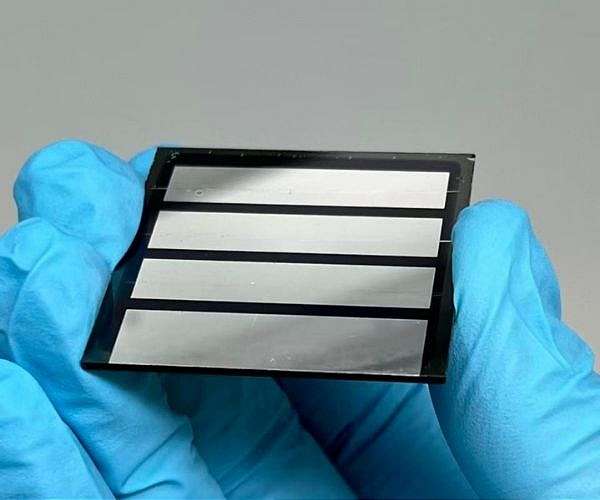
Scientists have reported a new way to make perovskite solar cells both highly efficient and significantly more stable, directly addressing one of the key obstacles to large-scale deployment of this emerging photovoltaic technology.
Perovskite semiconductors are being widely promoted as candidates for the next generation of solar energy because they can be processed at low temperatures into thin, lightweight and potentially flexible devices that could be cheaper to manufacture than conventional silicon panels. However, leading perovskite formulations tend to degrade under sustained heat or illumination, causing rapid efficiency losses and limiting their practical lifespan in real-world conditions.
A team led by Professor Thomas Anthopoulos from the University of Manchester has now shown that carefully designed surface chemistry can significantly boost device stability without sacrificing power. The researchers focused on the ultrathin molecular layers that form at the interface between the traditional three-dimensional perovskite absorber and its surrounding environment, a region that plays a crucial role in both charge transport and environmental protection.
In the new work, the group used specially designed small molecules known as amidinium ligands, which act like a molecular glue to hold the perovskite lattice together at the surface. By tuning the chemical structure of these multivalent ligands, they were able to direct the growth of a low-dimensional perovskite phase on top of the three-dimensional bulk material, creating a highly ordered interfacial architecture.
These low-dimensional surface layers form a smooth, continuous and robust protective coating that suppresses the formation of small defects and traps, which otherwise serve as starting points for decomposition and non-radiative recombination. The improved structural order and passivation of defects allows electrical charges generated by sunlight to move more freely through the device, while protecting the underlying perovskite from damaging thermal and photochemical stresses.
Using this dimensional engineering strategy, the team fabricated inverted perovskite solar cells that achieved an energy conversion efficiency of 25.4 percent, making them among the most efficient devices reported for this architecture. Crucially, the cells retain more than 95 percent of their original performance after 1,100 hours of continuous use at 85 degrees Celsius in full sunlight, a demanding test condition that simulates prolonged field exposure.
Professor Anthopoulos said these stability advances could help solve one of the last major challenges for perovskite photovoltaics as it moves towards commercialization. He noted that while state-of-the-art perovskite devices already rival silicon in power, their long-term reliability lags because many material compositions are intrinsically unstable when exposed to high-intensity heat or light for extended periods.
According to Anthopoulos, the amidinium ligands developed in this project, together with the fundamental insight gained into how they regulate interfacial structure, now provide a route to grow high-quality and resilient perovskite layers in a controlled and reproducible manner. He suggested that integrating such tailored surface chemistry into scalable manufacturing processes could ensure perovskite modules last long enough to compete directly with established photovoltaic technologies in rooftops, integrated and utility-scale applications.
The full research report, published in the journal Science, describes how the multivalent nature of the ligands enables precise control over the dimensional engineering of the perovskite interface and links these structural changes to measured gains in efficiency and stability. The authors also discuss how the concepts demonstrated here can be adapted to other perovskite compositions and device architectures, potentially increasing the impact of this approach in the rapidly evolving field of perovskite optoelectronics.
Research report:Multivalent ligands regulate dimensional engineering for inverted perovskite solar panels
