

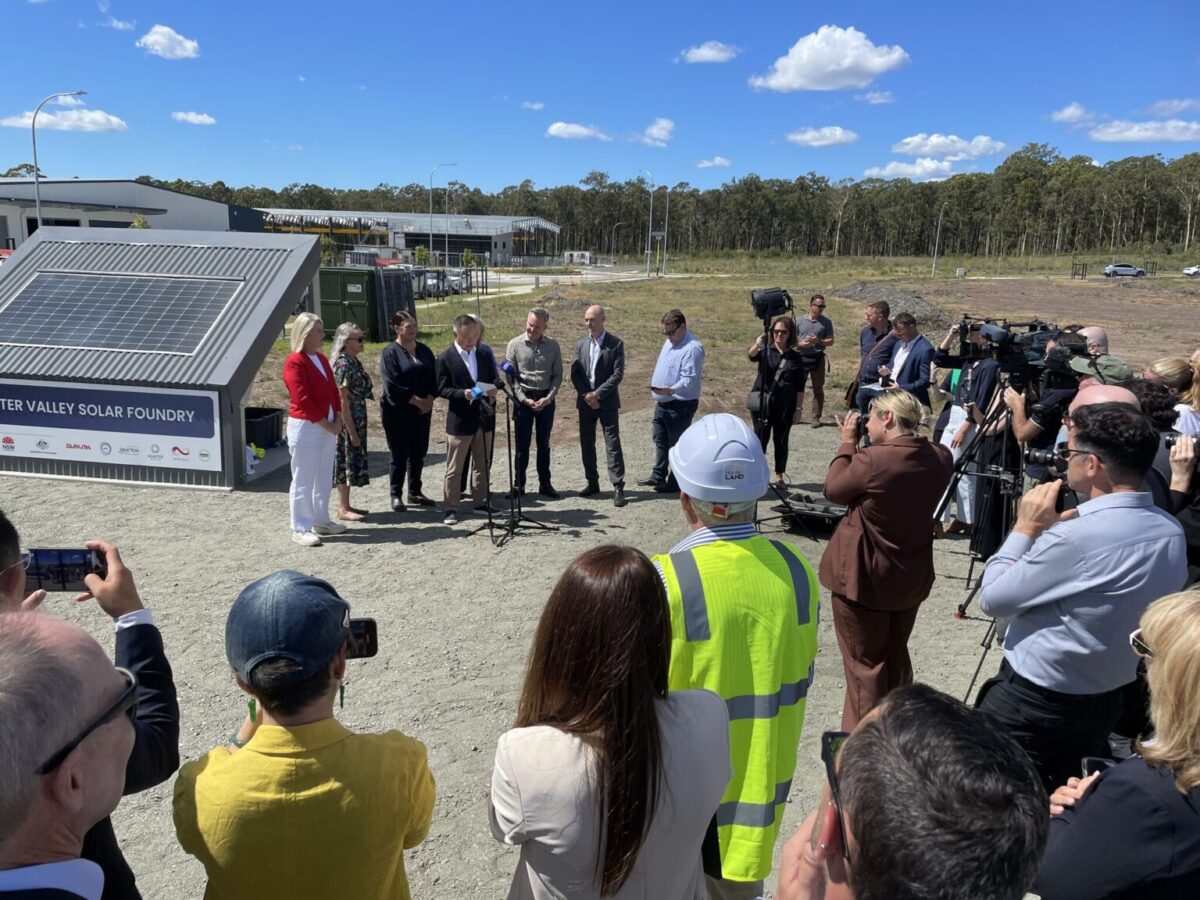
Chinese manufacturer Sunman is to build a 500MW-per-year solar panel manufacturing facility in New South Wales’ Hunter Valley after receiving funding from both the state and federal governments.
The Sunman Group, founded by solar energy pioneer and University of New South Wales (UNSW) alumnus Zhengrong Shi, has announced it will develop Australia’s largest solar module manufacturing plant in the Hunter Valley, after securing AUD171 million ($111.92 million) in federal and state government funding.
The Australian Renewable Energy Agency (ARENA) has committed up to AUD 151 million in conditional funding through the Federal Government’s AUD 1 billion Solar sun baffle program to support the development of the Hunter Valley Solar Foundry, while the NSW Government has invested $20 million.
Sunman already has two production facilities: a 1 GW factory in China and a 500 MW factory under construction in the United States.
The proposed Hunter Valley facility, to be built at Black Hill near Maitland, will build on Sunman’s established technology and track record as an innovator in lightweight solar energy to produce 500 MW of solar modules annually for use in the Australian and international markets. The facility will initially produce 300 MW of panels per year before scaling up to its full annual capacity of 500 MW.
“Once established, the Hunter Valley Solar Foundry will be the largest manufacturer of photovoltaic solar panels in Australia, and the only one in NSW, supplying industry-leading products to residential, commercial and utility customers across the country,” Shi said.
Tindo Solar is currently recognized as the only manufacturer of Australian-made solar panels. The South Australia-headquartered company is in the process of scaling up annual output at its Mawson Lakes plant in Adelaide’s northern suburbs from 20 MW to 180 MW and is also exploring the potential of setting up a factory that can produce 1 GW of solar panels annually.
Sunman’s Hunter Valley Solar Foundry is expected to produce a range of solar modules, including the company’s proprietary enhanced Architecture Ready Composite (eArc) modules, which replace traditional glass with sustainable polymers. The flexible eArc modules are 70% lighter than conventional glass panels and can be cast and glued onto surfaces.
The facility is also expected to produce glass solar panels, develop a solar innovation center to support the commercialization of new solar energy technologies and operate as a solar manufacturing foundry with the ability to supply production capacity to original equipment manufacturers, further strengthening Australia’s domestic solar supply chain.
“This is an important milestone in Australia’s energy transition,” Shi said. “It has long been my ambition to establish solar panel manufacturing in Australia, and I hope that over time the foundry will support the establishment of a vertically integrated solar supply chain in Australia.”
ARENA Chief Executive Officer Darren Miller said the new Hunter Valley facility will help build Australia’s solar energy manufacturing capacity, reduce dependence on imports and expand the country’s role in global clean energy supply chains.
“The deployment of solar photovoltaics at scale is critical to achieving our long-term emissions goals,” he said. “Building our manufacturing capabilities will ensure our supply chains are resilient and support Australian innovations as we accelerate the rollout of solar.”
Construction of the facility is expected to create up to 200 jobs, with a further 100 ongoing jobs created once it is operational.
The funding announcement comes after the local Sunman subsidiary Energyearlier this year received AUD 1.3 million in funding through the Solar Sunshot program to support a feasibility study for a 50,000 tonne per annum solar polysilicon production facility in the Hunter Valley.
The study aimed to assess the technical, commercial and environmental feasibility of high-purity polysilicon production in Australia.
This content is copyrighted and may not be reused. If you would like to collaborate with us and reuse some of our content, please contact: editors@pv-magazine.com.
