

Swissolar’s “Solar Monitor 2025” report predicts annual PV additions of about 1.5 GW through 2027 and urges policymakers to maintain steady growth amid policy uncertainty and lower rates.
Swissolar says PV deployment in Switzerland is likely to average 1.5 GW per year until 2027, as the sector adapts to policy uncertainty and lower feed-in tariffs. It presented three scenarios in its ‘Solar Monitor 2025’ report, which outlined possible market developments and urged policymakers to support a steady expansion of photovoltaics.
The industry association expects around 1.5 GW of new photovoltaic capacity to be installed in Switzerland this year, compared to around 2 GW in 2023 and 2024, marking record growth. Swissolar president Jürg Grossen said maintaining installations at 1.5 GW per year would be enough to meet the country’s 2050 climate targets.
The ‘Solar Monitor 2025’ report indicates that new systems are already influencing the electricity market. By 2025, Swissolar expects solar energy generation of more than 8 TWh, accounting for approximately 14% of annual consumption. “The total amount of solar energy generated will be equal to that of a nuclear power plant,” Grossen said during a media briefing this week.
Matthias Egli, CEO of Swissolar, described the report’s three scenarios. The “medium scenario” foresees a photovoltaic addition of 1.5 GW in both 2026 and 2027, rising to 1.8 GW in 2030. The “braking scenario” expects 1.2 GW by 2030, while the “express scenario” expects 2.7 GW, depending on policy and market conditions.
“Electricity is a money-consuming business,” Grossen said, referring to the uncertainty in the PV market. “There is a lot of uncertainty at the moment. The new photovoltaic models have not yet been adopted.” He attributed this partly to low feed-in tariffs and unclear demand prospects, including the upcoming blackout initiative that could lift the ban on new nuclear power plants and further disrupt investment prospects.
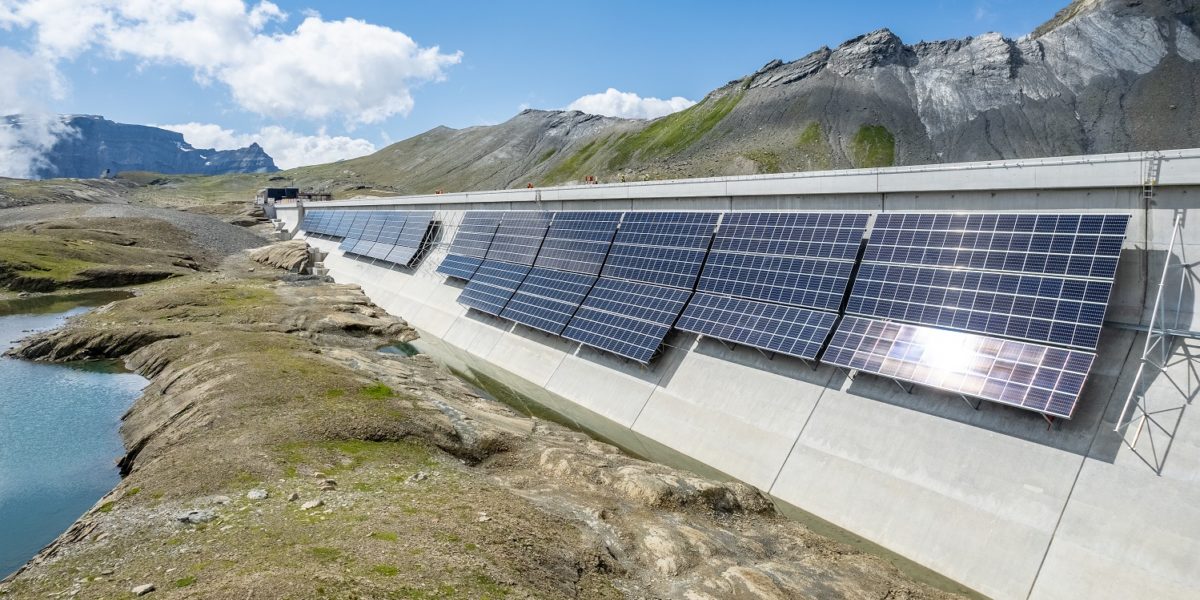
Prices are falling across all segments and system sizes. Most new installations remain rooftop systems, while agricultural voltaic power plants, Alpine power stations and infrastructure projects contribute marginally to annual production.
Despite these challenges, Swissolar has highlighted a number of positive trends. Solar photovoltaics and hydropower remain a “dream team” for stable electricity supply, and the use of battery storage is increasing, the association said. It plans to publish its first comprehensive storage report in spring 2026, forecasting battery capacity at 1.25 GWh by the end of 2025 – an increase of around 50% from 2024.
The 8 GW of installed PV capacity in Switzerland is already impacting wholesale electricity prices, especially during summer. Swissolar said flexibility measures such as battery storage and shared solar models – including Zero Energy Communities (ZEV) and Local Energy Communities (LEG) – can mitigate price and grid voltage declines. It urged the Federal Council to adjust network tariff regulations to promote sharing and reduce the need for network expansion.
Swissolar also said it is optimistic about the rollout of dynamic electricity tariffs by six distribution network operators next year and continues to advocate for wider adoption of energy management systems.
This content is copyrighted and may not be reused. If you would like to collaborate with us and reuse some of our content, please contact: editors@pv-magazine.com.
