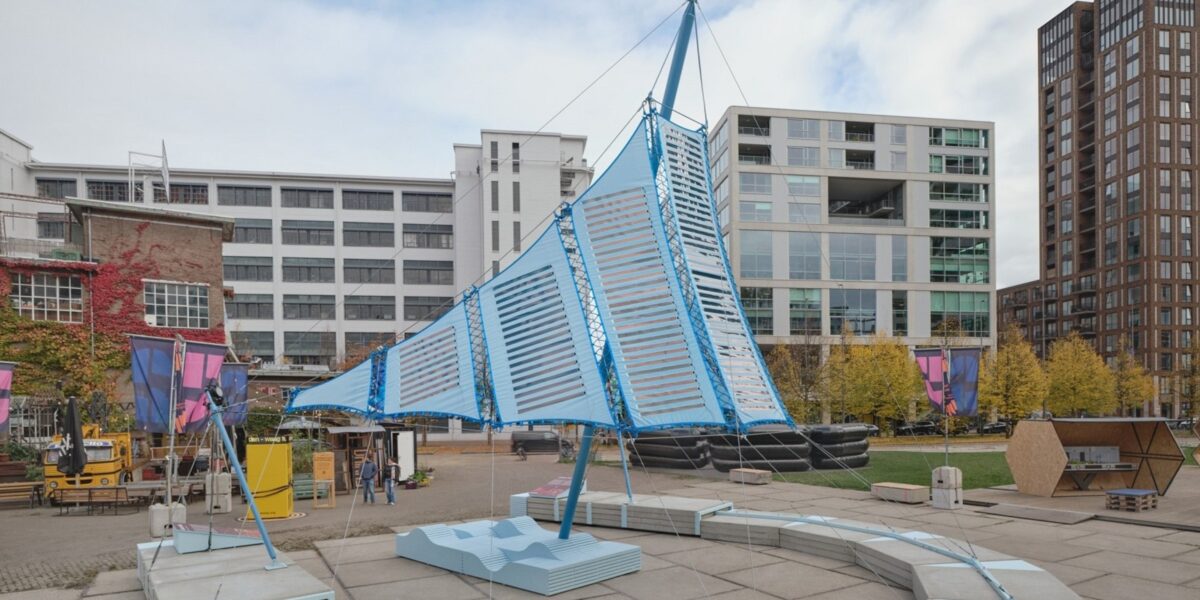
Image: Ronald-Smits, Studio Pauline van Dongen
On display during Dutch Design Week 2025 in Eindhoven, Netherlands, the Umbra Pavilion, which provides cooling shade during the day and atmospheric lighting at night, features heliotex, a new technical textile that integrates flexible organic photovoltaic (OPV) solar cells.
The heliotex technology, previously known as Suntex, emerged from a four-year collaboration between Studio Pauline van Dongen and textile technology company Tentech, both based in the Netherlands.
The Umbra Pavilion is a covered structure measuring 40 m² and 9.6 meters high. It integrates 150 ASCA GmbH & Co OPV modules over 8 m² with a power of 53 W/m2. It includes a 3 kWh battery energy storage unit supplied by Dutch company Wattsun, dozens of white light-emitting diodes (LED) and four programmable spotlights in different colors.
The heliotex material is said to be a high-strength architectural textile made from weather- and UV-resistant recycled polyester (rPET) yarn. According to the developers, it can be used for festival tents, shade canopies, temporary shelters and textile facades.
With a weight of 500 g/m², the size and shape, yarns, colors and weave patterns are customizable. It also allows easy separation of the solar panels in case of a module upgrade.
An industrial production process for heliotex is under development in a Eurostars-funded project involving Danish and German partners, Studio Pauline van Dongen said in a statement.
Earlier this year, a research team from Cornell University in the US announced a dual-axis canopy project with integrated PV devices for large areas such as tents and stadium canopies.
This content is copyrighted and may not be reused. If you would like to collaborate with us and reuse some of our content, please contact: editors@pv-magazine.com.
Popular content