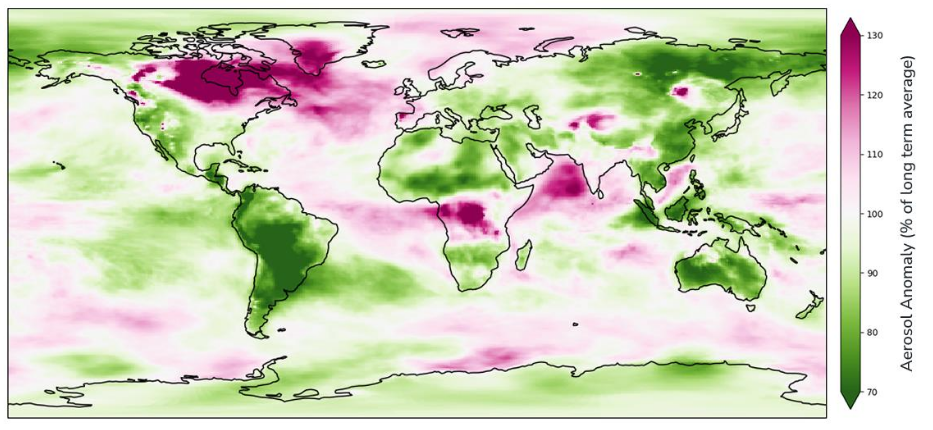
In a new weekly update for pv magazineSolcast, a DNV company, reveals that extreme Canadian wildfires last year pushed aerosol levels about 30% above normal, sharply reducing solar radiation across Canada and even affecting Europe, while the Congo Basin also experienced worsening aerosol conditions. In contrast, China and South America experienced unusually low aerosol levels, supporting stronger solar radiation due to cleaner air, fewer fires, and favorable climate and policy conditions.
Aerosol anomalies in 2025 reveal the massive impact of Canadian wildfires on solar conditions, with smoke and particulates from one of the worst fire seasons in the country’s history causing major reductions in solar radiation across Canada and beyond. While Canada saw a marked increase in aerosol loads, China and South America experienced abnormally low levels, supporting stronger irradiation conditions. Meanwhile, the Congo Basin recorded worsening aerosol conditions, underscoring growing concerns about solar energy prospects in Central Africa, according to analysis using the Solcast API. Aerosols affect solar radiation by scattering and absorbing solar radiation as it passes through the atmosphere. Calculated, this effect is called ‘aerosol extinction’.
Across Canada, aerosol extinction values in 2025 were approximately 30% above climatological norms, indicating significantly higher levels of sunlight absorption and scattering by particles. This spike is directly related to the extreme wildfire season, with the total area burned reaching twice the 10-year average in 2025. The timing of the peak of fire activity, which corresponded to the high insolation months of May and June, exacerbated the impact on solar conditions.

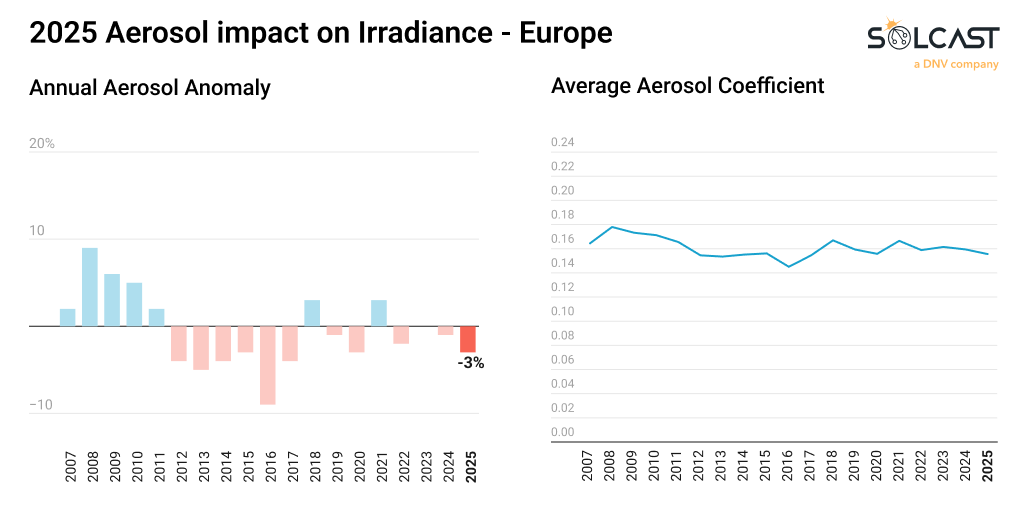
Smoke plumes from Canada were transported across the Atlantic Ocean by prevailing westerly winds, impacting solar production as far away as Western Europe, where they overlapped with Spain’s worst wildfire season in more than a decade, further amplifying the regional aerosol burden.
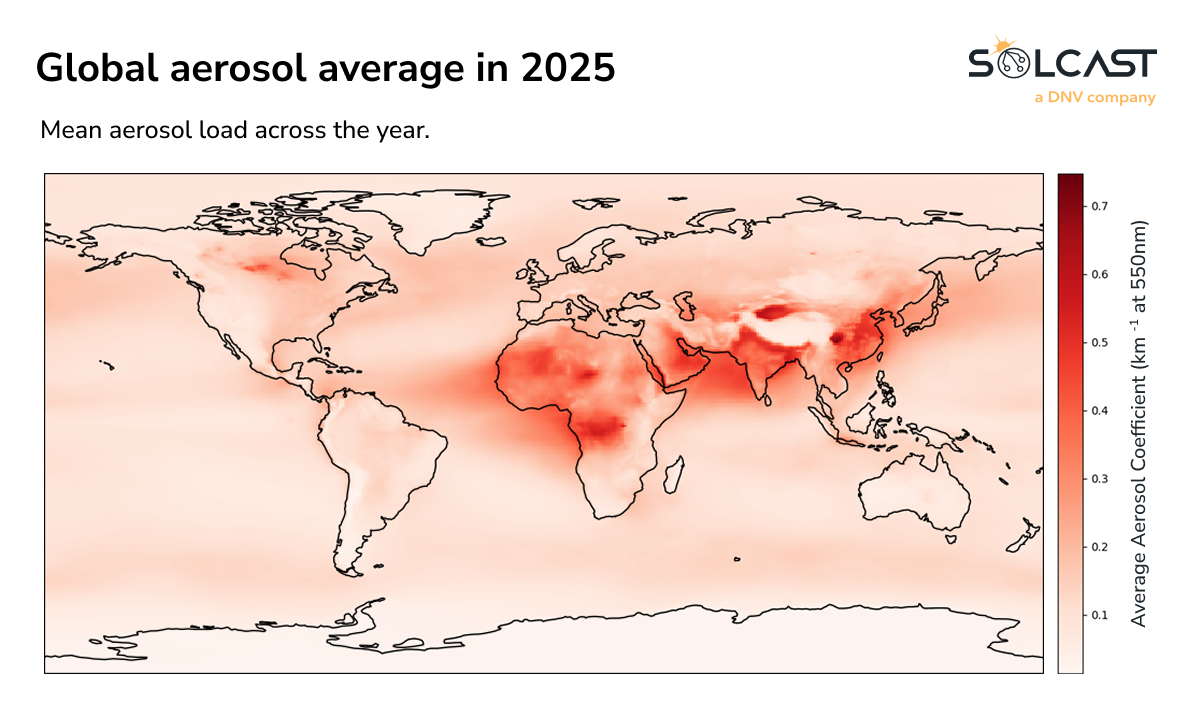
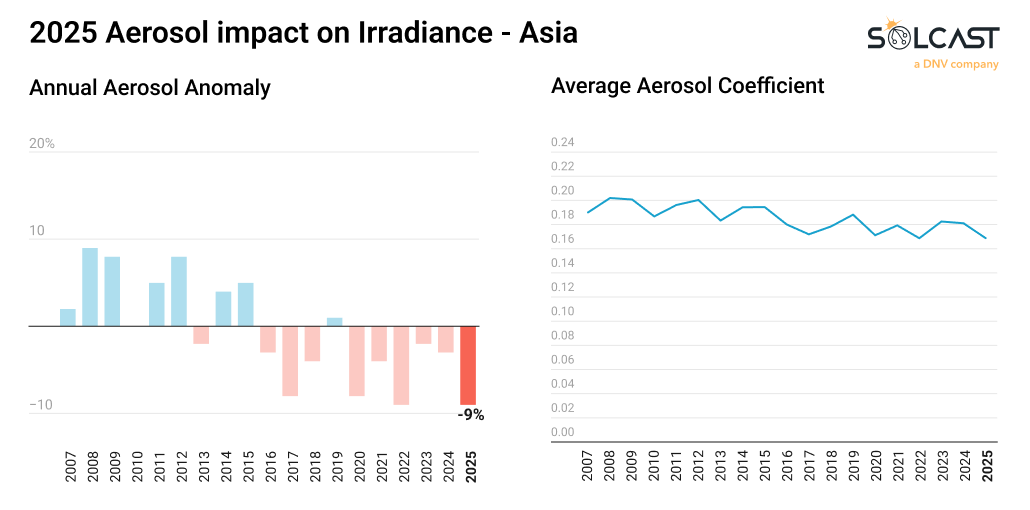
Despite having a higher aerosol load than other regions for solar energy, China experienced one of the cleanest atmospheric years in recent history. The aerosol extinction biases were approximately 20% below recent climatology, driven by a combination of favorable meteorological patterns and continued reductions in industrial emissions. These conditions supported a strong irradiation performance over the past year, when irradiance was already 30% above average.

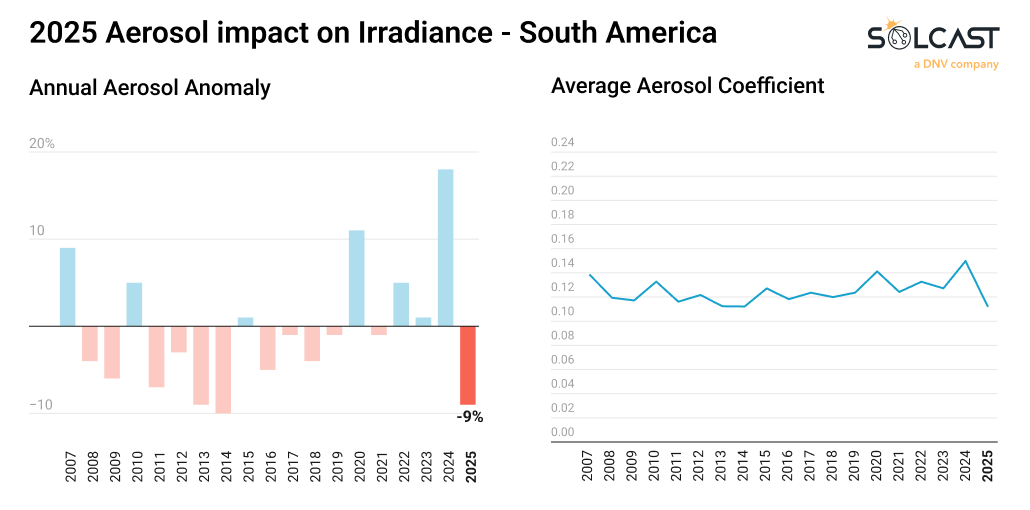
South America also recorded a notable improvement in aerosol conditions after a turbulent 2024. Anomalies in 2025 were generally 20% to 30% below average, allowing for clearer skies across the region. Solar production in Brazil benefited from reduced smoke, which was associated with a 45% reduction in the number of burned areas in the Amazon, as detected by the DETER satellite system. This significant decline is part of a broader post-Bolsonaro shift in environmental management, further supported by La Niña-associated wetter conditions that helped suppress fire activity.
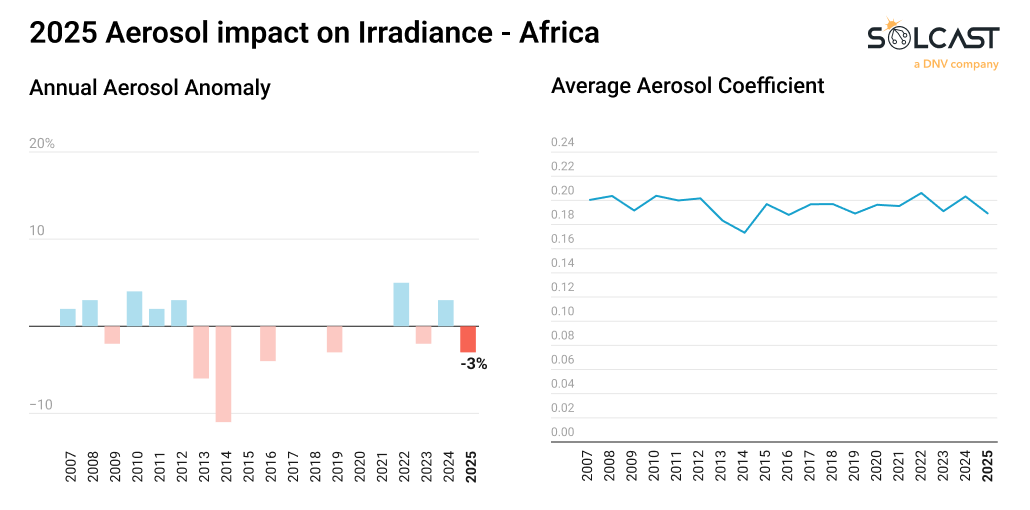
Meanwhile, the Congo Basin experienced deteriorating aerosol conditions, with extinction anomalies 20% to 30% above climatology. In contrast to the downward trends in Saharan dust seen across North Africa, this spike in aerosols is attributed to increasing fire activity in wet forest areas. The number of active fires in these forests has doubled over the past two decades, largely due to a combination of warmer and drier weather and anthropogenic factors such as conflict or agricultural deforestation
Solcast produces these figures by tracking clouds and aerosols worldwide at a resolution of 1-2 km, using proprietary satellite data AI/ML algorithms. This data is used to drive irradiance models, allowing Solcast to calculate high-resolution irradiance, with a typical deviation of less than 2%, as well as cloud tracking predictions. This data is used by more than 350 companies that manage more than 300 GW of solar energy worldwide.
The views and opinions expressed in this article are those of the author and do not necessarily reflect those of the author pv magazine.
This content is copyrighted and may not be reused. If you would like to collaborate with us and reuse some of our content, please contact: editors@pv-magazine.com.
Popular content