A report from marketplace operator EnergySage shows that average system costs are falling and payback times are improving. It highlighted Tesla’s recent market share gains in the inverter and energy storage market.
EnergySage operates an online solar comparison marketplace, providing quotes to solar buyers in 50 states and Washington DC. The company has released its October 2024 Marketplace Insights reportwith data through the first half of 2024 on prices, design trends and more for the residential solar and energy storage sector.
The report notes that residential solar prices on the platform averaged $2.69/W in the first half of 2024, down 4% from the second half of 2023. This is only 1% higher than the all-time low of $2.67/W in the United States. first half of 2021, when US residential solar experienced one of the largest growth cycles in history. This marks the second consecutive six-month period of declining costs, following 2.5 years of cost increases amid pandemic-related supply chain restrictions, EnergySage said.
EnergySage estimates that the average U.S. customer has a break-even point on return on investment after 7.5 years, based on an average system size of 10.9 kW. This is an improvement compared to the second half of 2023, when the average payback period was estimated at 8.1 years.
“Stable supply and cooling demand, driven by policy changes such as California’s Net Billing Tariff and high interest rates, are likely the drivers of the latest price reductions,” EnergySage said.
Despite cost savings being one of the main motivations for solar installations, EnergySage said more than 60% of customers did not choose the lowest price quote they received. The report notes that the price range is narrowing, with average minimum prices around $2.54/W and maximum average prices around $3.08/W. Based on average system size, the average minimum and maximum prices were about $6,000, EnergySage said.
The four largest solar markets also have lower than average system costs. Florida averages $2.20/W, Texas $2.10/W, California $2.39/W and Nevada $2.18/W. Regionally, solar prices remain highest in the Northeast and lowest in the West.
Home battery storage prices also fell, to a record low of $1,133/kWh stored.
Browse pv magazine USA 50 States of Solar dashboard to see how much solar energy your state has installed.
In terms of technological changes, the profile of a residential solar system continues to evolve. In 2020, 98% of all quotes on EnergySage included solar panels rated under 400 watts, and 340W panels were typical. During the first half of 2024, 97% of all quotes included solar panels with a capacity of up to 400 W or more. On average, homeowners are now offered about 20% more electricity per panel than four years ago.
The most frequently mentioned solar panel brands on EnergySage were REC Group, Qcells, Panasonic, Silfab, LA Solar Factory and Hyperion Solar.
The most important inverter brands mentioned were Enphase, Tesla, SolarEdge, Hoymiles and AP Systems. Enphase represented about two-thirds of all quotes on the platform, and Tesla string inverters grew rapidly from 2% of quotes in the first half of 2023 to over 12% in the first half of 2024. The report noted that Tesla inverter packages the quotation prices were reduced. prices by about 15% compared to the average.
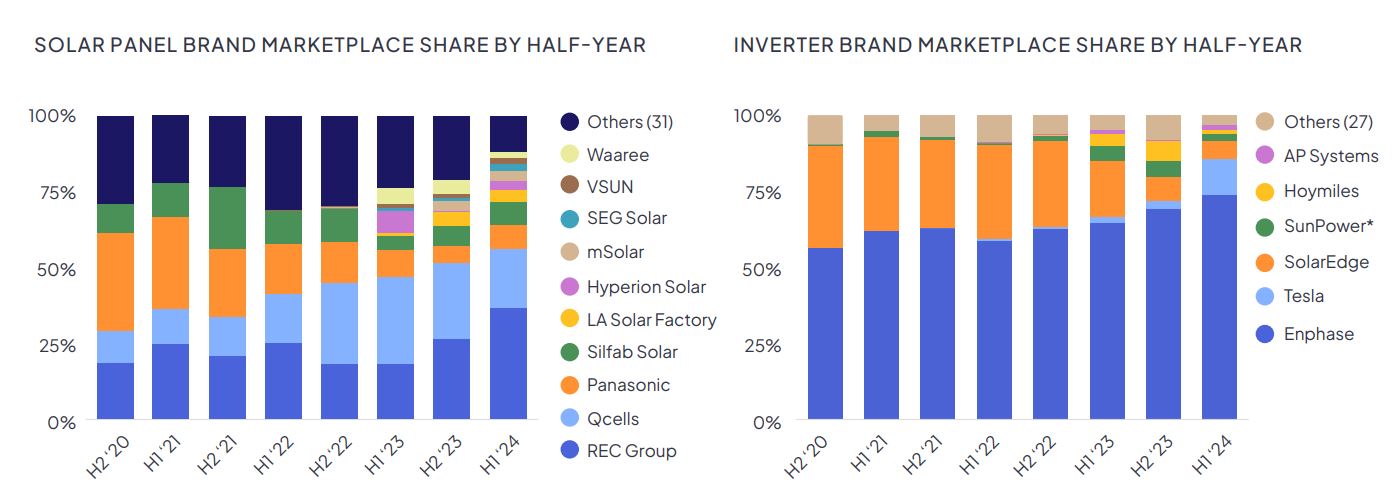
Enphase also historically dominates the EnergySage marketplace for energy storage quotes, although Tesla is starting to gain market share here as well. The two have historically consistently represented around 50% of all quotes on the marketplace, and have now grown to represent 75% of quotes on the marketplace. Tesla has driven most of this growth 22.5% of quotes in the second half of 2023 to 33.5% in the first half of 2024. Low prices for the Powerwall 3 are driving Tesla battery adoption, according to EnergySage.
Battery energy storage is now connected to a record 34% of systems on the platform. California’s Net Billing Tariff is a major driver of this jump, with 70% of California homeowners purchasing batteries with their solar panels, according to EnergySage. Lower battery prices and increased demand for backup power and energy independence are driving battery attachments to unprecedented levels.
This content is copyrighted and may not be reused. If you would like to collaborate with us and reuse some of our content, please contact: editors@pv-magazine.com.
Popular content