

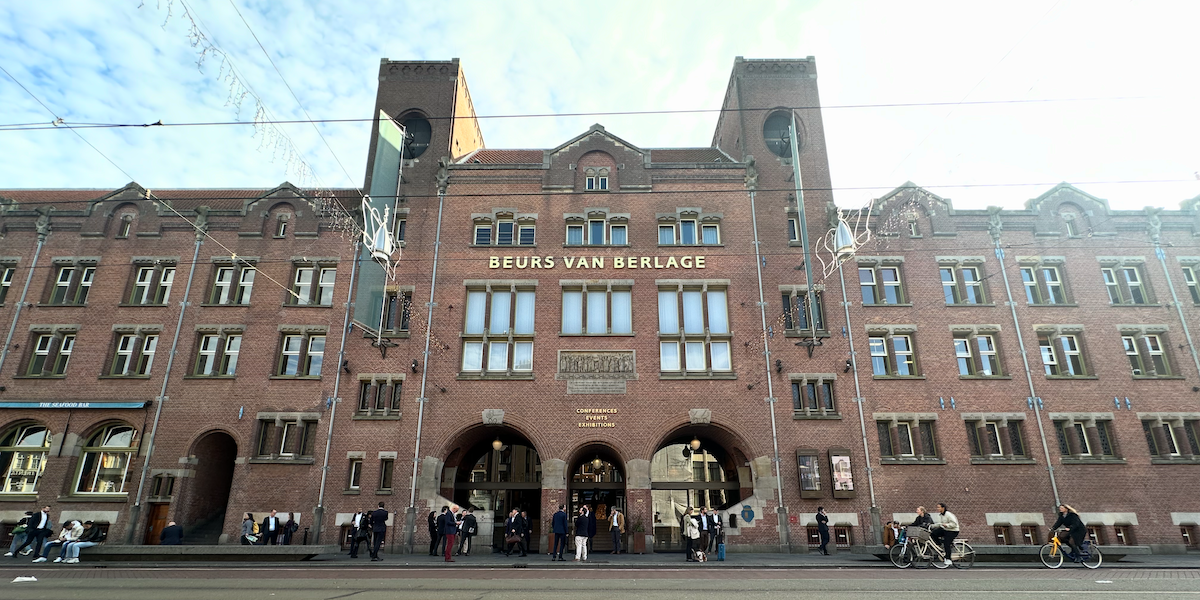
The market for PPAs – contracts through which utilities or industrial companies purchase electricity from renewable energy projects on fixed terms – is weakening dramatically and undergoing a major transition. These were the two main conclusions of RE-Source, held this week at the historic Amsterdam Stock Exchange, which brought together 1,450 experts in energy trading, sustainable generation and industrial energy consumption.
Guy Brindley, head of market intelligence at WindEurope, estimated that in Europe around 60 GW of capacity is traded under PPAs, including 25 GW of solar, representing around 130 TWh – almost a quarter of Germany’s annual electricity consumption. Nearly a third of this volume is contracted by IT suppliers, mainly data centres, another third by energy-intensive industries, and the remainder by sectors such as retail, pharmaceutical and automotive, or via consortia in multi-buyer PPAs.
Deal volume has fallen from a peak of about 230 in 2024 to roughly 115 this year, and has been steadily declining since summer 2024. This is significant as PPAs are an important financing tool for subsidy-free renewable energy projects. A continued contraction could increase the need for public financial support to stay on track with climate goals.
Market transition
However, the sold-out RE-Source event suggests the market remains active and should not be written off too quickly. Organizers said attendees included 300 industrial and commercial energy buyers, as well as a large contingent of property developers, independent power producers (IPPs) and utilities. Matchmaking remains an important part of the event.
Daniel Dang, business development director at SolarPower Europe, one of the event’s organizers, said the participant mix now reflects a broad cross-section of the economy. In addition to global IT companies with ambitious climate goals, energy-intensive industries such as chemicals, aluminum, steel and cement were also present. Automotive and medium-sized companies are also increasingly joining.
Dang said he doesn’t interpret the decline in deal volume as a response to sustainability. Companies remain committed to sourcing renewable energy, he said, but market conditions – declining wholesale prices, high volatility, financing costs and regulatory uncertainty – are complicating price agreements.
He said he believes official statistics may underestimate actual market activity because many smaller, aggregated or privately negotiated PPAs are not made public. “With faster licensing, improved network access and supporting market frameworks, the European corporate PPA market can continue to grow and mature,” he said optimistically.
To strengthen the sustainable corporate PPA market, Dang and other industry representatives are calling for expanding risk-sharing mechanisms to help mid-market companies and smaller buyers and developers participate. He pointed to a new PPA guarantee product from the European Investment Bank. Other measures include promoting cross-border PPAs, multi-buyer models and increasing flexibility to integrate more renewable energy sources and alleviate regional bottlenecks.
Hybrid PPAs
The market is becoming significantly more complex in many respects. Price is no longer the only factor – PPAs must also address cannibalization and regulatory uncertainty, says Adrien Coudurier, head of global account management at Enel. Many participants noted that simple pay-as-produced contracts are no longer sufficient and that flexibility on the part of buyers must be integrated.
The main trend is towards hybrid PPAs, combining solar energy with storage, wind energy with storage, or all three technologies together. However, the development of how hybrid PPAs can be structured is still at an early stage – a topic that provided ample material for discussion at the conference.
Asked about the biggest blocker for hybrid PPAs, Natasha Luther-Jones, a partner at law firm DLA Piper and in the PPA business for 17 years, said both parties must first fully understand the concepts.
When flexibility needs to be incorporated into the system, things become even more complicated. One way to promote and develop this is through timestamp guarantees of origin, as required by Google. They ensure that renewable generation matches data center consumption at 15-minute intervals, rather than just on an annual basis. This still does not apply to all of Google’s consumption, but increasingly it does. The IT giant uses different ways to purchase electricity. In some cases, contracts are based on specific profiles that sellers must meet, for example with a reliability of 95%.
However, this is a concept that probably not many sellers or buyers can implement yet. It is therefore expected that – as is already the case – electricity traders will continue to play a key role. Whether it is crucial for them to take out a hybrid PPA including a battery with the generator remains to be seen. In principle, they can also contract the batteries separately.
Negative prices
As a short-term solution to current deals, it is critical to how pure solar PPAs handle hours of negative energy prices. A fair approach, says Phil Dominy – director of corporate finance, energy and infrastructure at EY – is when the risk is shared. For example, if a PPA costs €70/MWh and the market price drops to – €15/MWh, the buyer pays €70 for the volume generated, while the generator absorbs the €15 loss due to the negative electricity price.
It is in everyone’s interest that a power station no longer supplies to the electricity grid if prices become negative. However, this is only possible if the PPA contract contains a clause specifying how the assumed volumes are determined in such cases. In principle, it should remain the producer’s decision whether or not to cut back. If the buyer decides, an audit accountant might conclude that the buyer, through the contract, actually exercises control over the asset. In that case, the buyer would have to include the factory on its balance sheet under international accounting standards.
This content is copyrighted and may not be reused. If you would like to collaborate with us and reuse some of our content, please contact: editors@pv-magazine.com.
