

Since its passage, the One Big Beautiful Bill Act (OBBBA) has introduced new restrictions on companies seeking clean energy tax credits, requiring projects to meet both domestic content thresholds and restrictions on purchasing foreign entities of concern (FEOC). Together, these provisions have compressed eligibility timelines, created new cost considerations related to more expensive non-FEOC equipment, and created procurement, supply chain, and system design challenges.

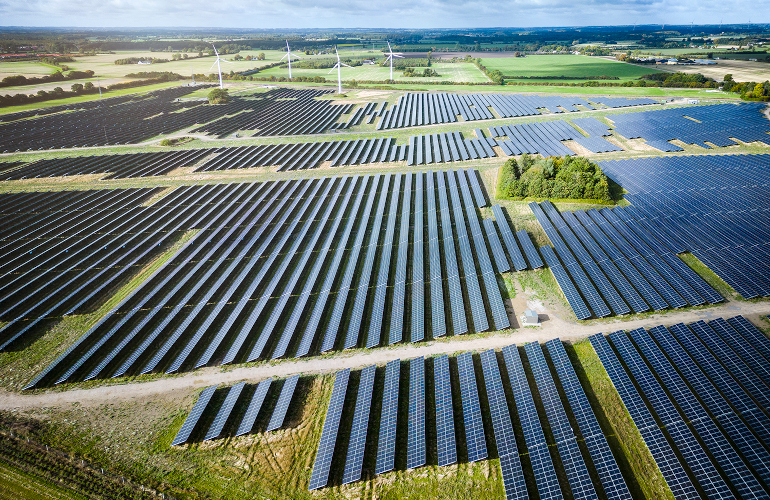
Credit: iStock
FEOC restrictions primarily target modules and components sourced from Chinese manufacturers, which have historically supplied the majority of utility-scale PV equipment in the U.S. market.
With the July 4 start of construction and the safe harbor deadline approaching, developers and EPCs are scrambling to find approaches that remain compliant with the new law while still capturing as much of the FEOC cost benefit and meeting project timelines as possible. One strategy that is gaining traction is combined module purchasing, which combines FEOC and non-FEOC modules within the same project.
Done properly, this approach will improve supply flexibility, reduce cost pressures and pave the way to achieving FEOC compliance, domestic content and full Investment Tax Credit (ITC) eligibility. If done incorrectly, it can eliminate tens of millions of dollars in credit value.
Two important considerations that need to be addressed
The OBBBA introduced two separate compliance considerations for projects seeking to secure §48E ITC and §45Y PTC. Both are important and must be addressed properly to obtain full credit value, but if not followed, they have different consequences.
The FEOC limitation on material assistance completely disqualifies a project from claiming tax credits if the cost of products produced from prohibited foreign entities (PFEs) exceeds a statutory threshold. The compliance calculation, known as the material assistance cost ratio (MACR), requires non-PFE costs to represent at least 40% of total production costs by 2026, increasing annually to 45% in 2027 and 50% in 2028. For energy storage, the threshold increases from 55% in 2026 to 60% in 2027, and then to 65% in 2028.
The domestic content bonus adds 10 percentage points to the base credit rate for projects that source sufficient manufactured products from U.S. suppliers. The current 2026 threshold is 50% costs originating in the US, which is expected to rise to 55% in 2027. If this threshold is not met, the sum will expire, but not the basic credit.
The importance of testing per inverter
Most developers have remained focused on project-level FEOC and domestic content calculations. However, the regulatory text points to something more stringent.
The final IRS regulations under §45Y and §48E define a qualified facility unit as all solar panels connected to a common inverter. The MACR statute refers to the same definition. This means that in a utility-scale project with dozens or hundreds of central inverters, each inverter block is its own compliance unit, and not the project as a whole.
“A unit of energy ownership for solar ownership consists of all solar panels connected to a common inverter.”IRS/Treasury Regulatory Preamble, Final §48 Regulations, December 2024
The material assistance provisions of the OBBBA apply to any “qualified facility” as defined under §48E, which uses the same unit definition. IRS Notice 2026-15key FEOC compliance guidance issued under the OBBBA confirms that a separate MACR calculation is required for each qualified facility, meaning per-inverter block compliance is the operating standard. Compliance per inverter block should also mean compliance at the project level, so designing for the former is critical. If you design for compliance at the project level and are inaccurate, any non-compliant inverter block is exposed to credit disqualification. This creates an asymmetry that strongly argues for immediately treating the inverter block as a compliance unit.
In practice, this poses a problem for mixed purchasing strategies. Without a solution that allows mixing FEOC and non-FEOC modules on the same inverter block, the only two viable architectures are:
- FEOC modules only on special inverter blocks, making a location ineligible for full tax benefits.
- A zero percent FEOC module design, which would completely eliminate the costs and schedule benefits of FEOC purchasing.
The technical challenge of blending
Combining FEOC and non-FEOC modules from different manufacturers on the same inverter is not easy in a conventional central inverter system. Two technical problems arise:
First, a string mismatch arises because modules from different manufacturers have different electrical characteristics, including current output, temperature coefficients, and degradation profiles. In a central inverter system, mismatched parallel strings force the inverter’s single MPPT to find a compromise operating point, reducing energy output across all strings.
Second, reverse current damage can occur when a higher amperage string drives current back through a lower amperage string in a parallel-connected configuration, potentially damaging bypass diodes and cells. This risk increases as the two module populations age at different rates over the life of the asset. It can also jeopardize module guarantees.
Addressing these issues is necessary to maintain long-term system performance, reliability, and project economics while navigating FEOC and domestic content requirements.
How to overcome Ampt string optimizers
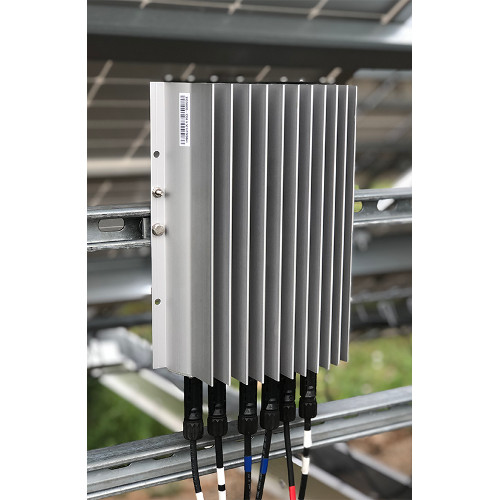 Ampt string optimizers are DC/DC converters that are deployed between the module strings and the combiner box. Each optimizer performs independent MPPT (Maximum Power Point Tracking) on its input strings, conditioning the output of each string before combining it with others on the DC bus. This eliminates the direct parallel electrical connection between dissimilar strings, eliminating mismatch losses and reverse current risk.
The result is that FEOC and non-FEOC modules can be placed on the same central inverter block without sacrificing electrical performance, regardless of differences in manufacturer specifications or long-term degradation profiles. Each converter block can be designed to simultaneously meet both the per-inverter MACR threshold and the domestic content bonus threshold.
Optimizers can be deployed across all strings to enable combining FEOC and non-FEOC modules on each inverter block, achieving per-inverter FEOC compliance and full ITC and Domestic Content Bonus eligibility. Full implementation also delivers additional system-level benefits, including reduced system electrical balance costs, savings on inverter and transformer capital expenditures, improved lifetime energy yield, and O&M savings from detailed string-level monitoring data that also supports compliance documentation efforts. A partial implementation, for example only on the strings carrying non-FEOC modules, can also achieve the mixing capacity required for compliance per inverter.
The value at stake
Ampt has modeled the economic impact of these design decisions in four scenarios for a representative 130 MWdirect current utility-scale project. The scenarios evolve from a 0% FEOC baseline to a full implementation of optimizations with the purchase of 70% FEOC modules.
| Scenario | Description | Total tax credit value + system benefits | |
| A | 0% FEOC, no optimization | All non-FEOC modules, no optimizer. Conforming baseline. | $53.5 million |
| b | 70% FEOC, no optimizer | FEOC modules on special inverter blocks. Blocks fail per converter MACR and domestic content tests. | $12.0 million (domestic content bonus lost; ITC on non-FEOC blocks only) |
| c | 70% FEOC, partial use of optimizations | Ampt optimizers only on non-FEOC strings. Full ITC and Domestic Content Bonus retained. | $75.1 million |
| D | 70% FEOC, full use of optimizations | Ampt optimizers on all strings. Full ITC, Domestic Content Bonus and all system benefits captured. | $81.1 million |
Based on a capacity of 130 MWdirect current/100MWAC project, construction start 2026, $1.10/W installed cost, 30% base ITC, 93.5¢ transfer price, $0.08/W FEOC module price benefit. The Scenario B result reflects the ITC on non-FEOC blocks only, with the domestic content bonus lost due to a per-inverter test failure on FEOC-specific blocks.
Together, the four scenarios outline a range of economic outcomes. Scenario A – all non-FEOC modules, no optimization – makes you fully eligible for ITC and domestic content bonuses, but loses the acquisition cost benefit that FEOC modules provide. On a large scale, those forgone savings represent millions of dollars in higher module costs compared to a blended purchasing strategy. Scenario B captures the FEOC module cost advantage by having FEOC and non-FEOC modules on separate inverter blocks, but ends up with ITC qualification only on the non-FEOC inverter blocks and loses the domestic content bonus altogether, yielding the worst result of the four. Scenarios C and D use string optimizers to combine modules on each inverter block, qualifying for full ITC and domestic content bonuses, while also realizing savings on FEOC module purchases. In the case of full deployment of optimizers in scenario D, there are additional cost savings at the system level and benefits in terms of energy production. Both optimization scenarios generate a significantly higher total value than the other.
A full technical document describing the compliance framework, technical basis for the blending solution and full value analysis in four scenarios is available by contacting Ampt or download online. Developers with specific project configurations can contact Ampt for a project-specific compliance and value analysis.
A new reality: embrace it or sacrifice big time
As the July 2026 safe harbor and construction deadline approaches, utility-scale developers can no longer treat FEOC compliance, domestic content strategy, and system design as separate workflows. The regulatory framework connects all three, and the financial consequences of misalignment could be worth tens of millions of dollars. Still, proactive design strategies that enable a cost-effective combination of FEOC and non-FEOC modules without compromising performance, reliability, or compliance are the practical path to maintaining full tax credit eligibility and maximizing project value.
Aaron Gomolak is CEO of Ampt, a manufacturer of direct current energy management products for utility-scale solar energy and energy storage systems. Ampt has direct experience with this deploying mixed module PV system designs at scale.
