

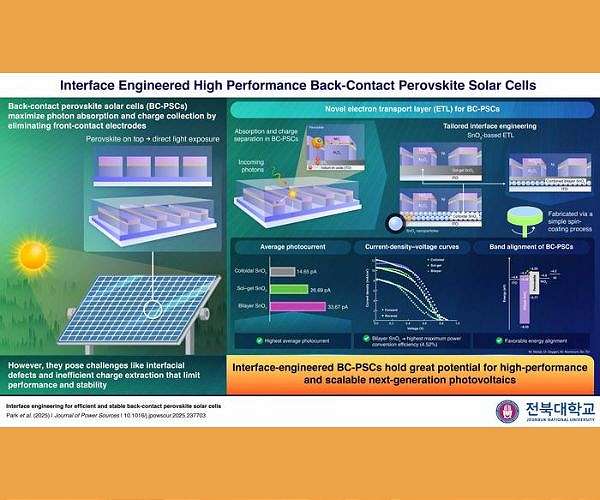
Researchers in South Korea have shown that a double-layered tin oxide electron transport layer can increase the efficiency and stability of back-contact perovskite solar cells while addressing important interfacial loss mechanisms.
Back-contact perovskite solar cells place the perovskite absorber at the top of the device stack so that incoming light reaches the active layer directly, while electron and hole collection contacts and charge transport materials are located on the back. In conventional front-contact perovskite cells, light must pass through these transport and contact layers before reaching the perovskite, leading to optical losses and reducing the amount of useful light absorbed by the device.
In the back-contact architecture, sunlight generates electrons and holes in the perovskite layer, which then travel to their respective backside transport layers to form photocurrent. This geometry reduces optical losses and can increase charge collection and energy conversion efficiency, but it also forces charge carriers to move over longer paths, increasing the likelihood that they will encounter interfacial defects and undergo recombination that reduces efficiency and stability.
To reduce these losses, a team led by Associate Professor Min Kim of Seoul University and PhD student Dohun Baek of Jeonbuk National University developed a double-layer tin oxide electron transport layer deposited by spin-coating. The tin oxide structure combines a nanoparticle SnO2 layer with a sol-gel SnO2 layer to improve the interfacial contact and electronic properties at the perovskite-ETL interface in back-contact devices.
The work, published online on July 4, 2025 and appearing in Volume 654 of the Journal of Power Sources on October 30, 2025, investigates how this double layer changes interface quality and charge extraction. The researchers report that this strategy addresses recombination at interfaces and band alignment issues that have limited performance of back-contact perovskite devices.
“We selected SnO2 for the ETL because of its favorable conduction band alignment with perovskite and its superior electron mobility compared to conventional titanium oxide. As a result, our double-layer ETL improves interfacial contact, reduces recombination losses and optimizes energy alignment for electron charge carriers,” explains Dr. Kim out.
To clarify the role of electron transport layer engineering, the team fabricated three types of back-contact perovskite devices using different tin oxide-based ETLs: a colloidal SnO2 composed of nanoparticles, a sol-gel SnO2, and a bilayer SnO2 combining a nanoparticle layer with a sol-gel layer. Each ETL was spin-coated onto indium tin oxide substrates and patterned by photolithography, providing a consistent platform for performance comparison.
Experimental measurements showed that the device using the double-layer tin oxide ETL provided the strongest photocurrent, with an average of 33.67 picoamps, compared to 26.69 picoamps for the sol-gel SnO2 device and 14.65 picoamps for the colloidal SnO2 device. The dual-layer device also achieved the highest power conversion efficiency among the three architectures, with a maximum efficiency of 4.52 percent, while exhibiting improved operational stability due to stronger suppression of charge recombination.
“BC-PSC devices hold promise for a variety of applications, including flexible devices and large-area solar panels, due to their high efficiency, improved stability and scalable design. We believe our findings will help accelerate the development of practical BC-PSC technologies for real-world applications while advancing sustainable energy solutions,” concludes Mr. Baek.
Research report:Interface engineering for efficient and stable back-contact perovskite solar cells
