

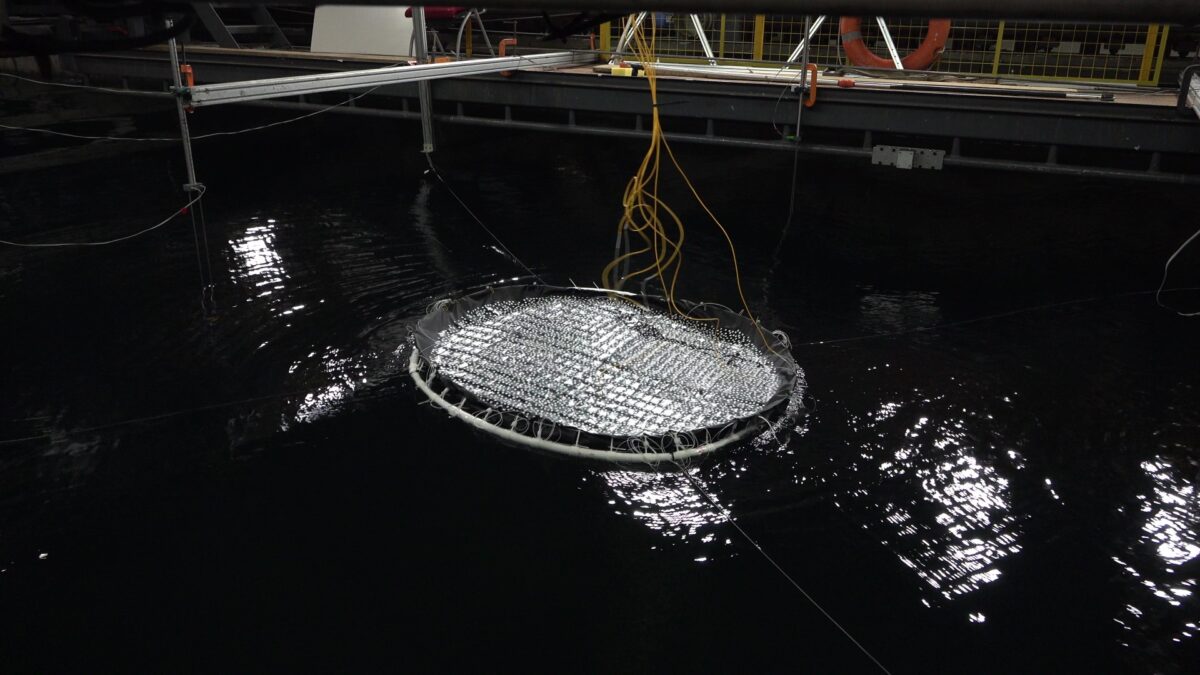
A research group in China has tested how membrane-based floating PV platforms can work in off-grid scenarios. Their analysis showed that, especially at high wave frequencies, these types of floating PV installations may suffer from the bending stiffness of the floater, which could limit both the in-plane and out-of-plane movement amplitude.
A team of scientists from Shanghai Jiao Tong University in China has assessed the wave and mechanical stress resistance of a membrane-based floating photovoltaic platform for applications in offshore waters.
“Our work could provide, for the first time, a powerful and efficient numerical method for evaluating the dynamic response of offshore floating membrane-like photovoltaic platforms under waves and currents,” said the study’s lead author Xiantao Zhang. pv magazine. “This will significantly promote the rational design and safety evaluation of this new ultra-flexible floating structure, thereby promoting the development of offshore photovoltaic technologies.”
The research group explained that the PV membrane that went through the testing process had a diameter of 1 m, a float cross-sectional diameter of 0.032 m, a thickness of 0.0 to 11 m, a mass of 1.3 kg and a total island mass of 2. 18 m. kg, and a floating bending stiffness of 0.11 N/m2.
Through the tests, the academics specifically evaluated the overall hydroelastic response of the membrane in the frequency domain under regular waves. Their analysis was based on potential flow theory and 3D hydroelasticity theory. The latter is often used to predict the hydroelastic effect due to wave-induced loads on a floating body, and the former is also a model of fluid flow that describes incompressible, inviscid, and non-rotating flow.
“The analysis starts with a convergence study focusing on the number of modes for both in-plane and out-of-plane motion,” they explained, highlighting that they also assumed a completely asymmetric model without mooring influences and wave direction scenarios with different mooring possibilities. point orientations. “Next, the response amplitudes of each mode, as well as the results at different test points, are presented.”
They also applied the Lagrange multiplier method to assess the connection conditions between the membrane and the float. This method is typically used in mathematical optimization to identify the local minima or local maxima of a constrained function.
The scientists said the tests showed that at low wave frequencies the float and membrane move with the waves. At high wave frequencies, on the other hand, the stiffness of the float increases, as does the three-dimensional interaction of the platform.
“This shift raises concerns about wave overtopping and out-of-water impacts on the operational performance of the PV platform,” they stated. “Both in-plane and out-of-plane movements are crucial for floating PV systems. In-plane movement affects the design of the mooring system and influences the voltage distribution of the membrane and solar panels.”
The group said the results highlighted the crucial influence of wave characteristics, especially at high wave frequencies.
The new system was introduced in the study “A frequency domain hydroelastic analysis of a membrane-based offshore floating photovoltaic platform in regular waves”, published in the Journal of fluids and structures. “Our future work will develop a more complete time-domain model that can provide a more detailed and accurate representation of the platform’s behavior under different conditions,” the academics said, referring to the future direction of their work.
This content is copyrighted and may not be reused. If you would like to collaborate with us and reuse some of our content, please contact: editors@pv-magazine.com.
