

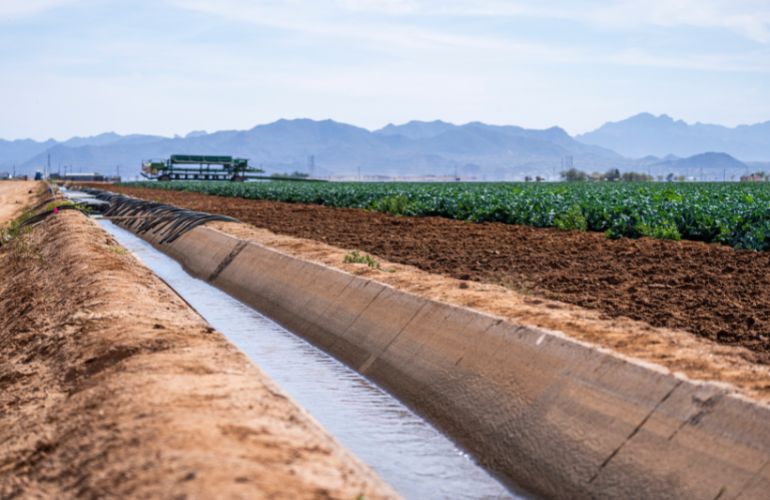
U.S. Rep. Jared Huffman (CA-02) announced $19.5 million from President Biden’s Investing in America Agenda to install solar panels in irrigation canals as part of an initiative to accelerate gains in water efficiency and the amount of clean water produced to study energy for future implementation on a larger scale. $15 million of this funding has been awarded to the San Luis & Delta-Mendota Water Authority for the Delta-Mendota Canal Floating Solar Project.
The projects in California, Oregon and Utah are funded by the Inflation Reduction Act (IRA), which provides $25 million for the design, study and implementation of projects to cover reclamation-related water transportation facilities with solar panels. Representative Huffman drafted the provision in the IRA that made this funding possible.
“This announcement is an important milestone in our efforts to combat climate change and transition the country to clean, green energy. Deploying solar panels on our canal systems is a smart solution to our growing water and energy dilemmas – it uses clean energy technology to increase efficiency while reducing our carbon footprint and water loss through canal evaporation,” said Representative Huffman. “Thanks to the visionary work of stakeholders, engineers, climate experts and the many other partners I have worked with on this over the years, I have been able to make provision to secure this financing that will make our vision a reality.”
The announced projects include:
- The San Luis & Delta-Mendota Water Authority, Delta-Mendota Canal Floating Solar Project (California), $15 million. The Authority, Reclamation and the University of California-Merced will work together through a public-private-academic partnership to assess the impact of floating photovoltaic solar panels on the Delta-Mendota Canal. The pilot is intended to potentially deploy three floating solar technologies to assess the viability, costs and benefits of floating solar over canal technologies on major transportation facilities such as the Delta Mendota Canal. The initiative will also validate the design of floating solar photovoltaics for moving water, identify and address issues associated with the maintenance of a canal with panels on it, investigate the potential for energy generation and develop methods to reduce the impact on water quality to quantify.
- North Unit Irrigation District, Main Canal Floating Photovoltaic Project (Oregon), $2.55 million. The district will build floating photovoltaic solar panels on the main canal of the Deschutes Project near Bend, Oregon. The project will evaluate the impact of floating solar panels on water efficiency and the amount of clean energy produced.
- Weber Basin Water Conservancy District, solar panels over the Layton Canal Project (Utah), $1.5 million. The district will cover existing canals with canal-spanning solar panel structures in the upper portion of the Layton Canal near West Haven, Utah. The project will serve as a five-year demonstration of data collection and monitoring to evaluate technical capabilities, economic feasibility and feasibility for full implementation for both Reclamation and the district. The project expects to improve water quality by reducing algae blooms along the canal, produce renewable energy to offset pump station use or sell back to the utility, and significantly reduce water loss through evaporation.
In 2015, Representative Huffman released a “discussion draft” of his comprehensive legislation to address America’s growing water crisis. After unprecedented public input, he introduced the Drought Mitigation and Resilience Act (HR 2983) based on ideas and feedback from nearly 1,000 Californians. Provisions of this legislation supporting floating solar panel projects were eventually included in the Inflation Reduction Act, which funded these projects.
Installing solar panels in irrigation canals can provide several benefits, including:
- Reduction of evaporation losses from the channel
- Increasing solar energy efficiency and production
- Creating land savings for open space and agricultural use
- Minimizing canal maintenance by slowing the growth of aquatic plants
- Reducing the energy footprint and carbon emissions required to operate and maintain the facility
Through the Bipartisan Infrastructure Law, Reclamation is also investing $8.3 billion over five years in water infrastructure projects, including rural water, water storage, conservation and transportation, nature-based solutions, dam safety, water purification and reuse, and desalination.
News report from Congressman Jared Huffman’s office
