

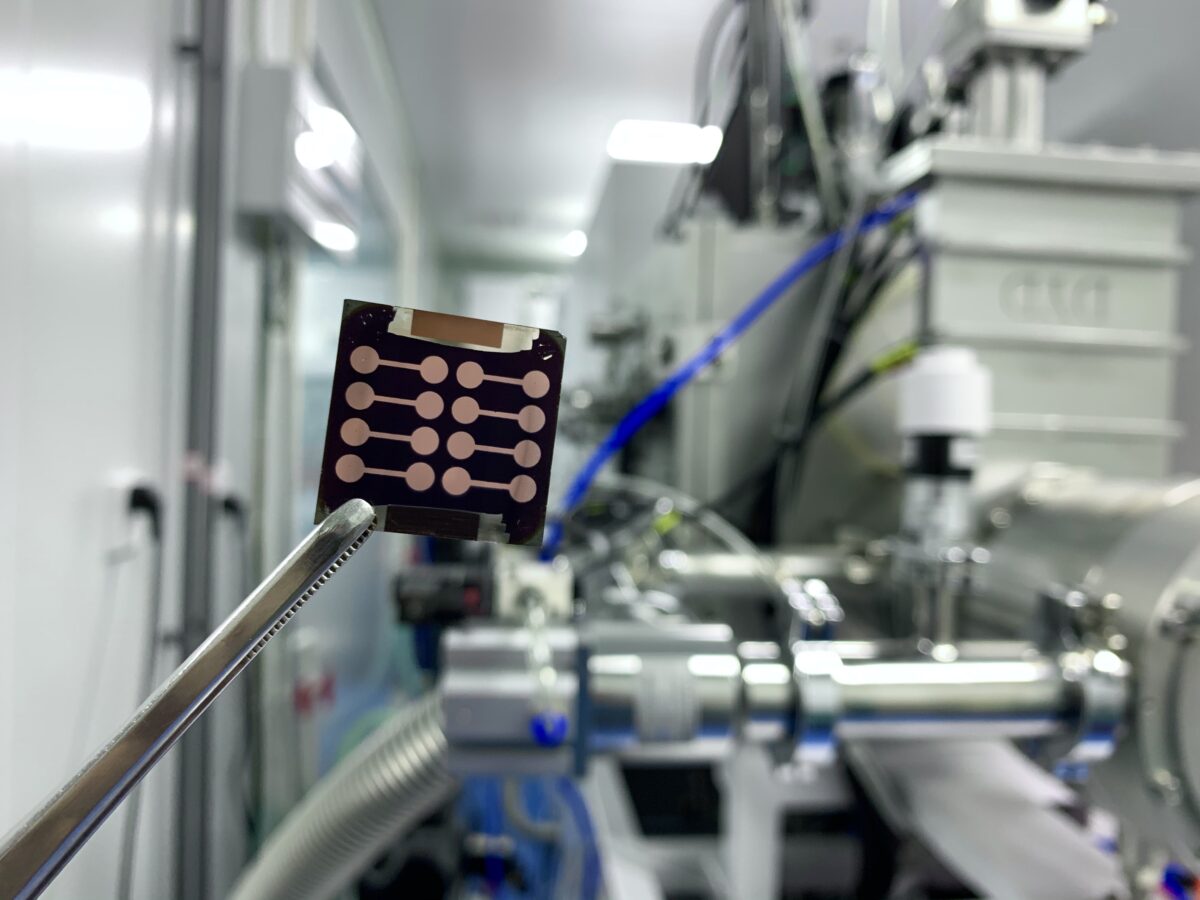
Researchers in China have developed a dipolar passivation method that reduces defects and improves charge transport in solar cells based on tin-lead perovskite with a narrow band gap. The approach has enabled the fabrication of all-perovskite tandem solar cells with an efficiency of approximately 30% and improved stability.
A group of researchers led by Nanjing University in China has done just that developed a perovskite solar cell based on a dipolar passivation strategy that reportedly reduces the defect density at the buried interface of narrow bandgap mixed tin-lead (Sn-Pb) perovskites while enabling precise energy level alignment at the interface between the hole transport layer (HTL) and the perovskite absorber.
“This dipole-induced passivation strengthens the ohmic contact, promotes efficient hole injection into the HTL, and repels electrons from the HTL/Pb-Sn perovskite interface,” said the study’s lead author, Renxing Ling. pv magazine. “With this approach, the carrier diffusion length increases to 8.3 μm, as characterized by terahertz probing.”
In particular, the scientists used a dipolar passivation molecule known as sulfanilic acid (SA), commonly used as a cross-linking agent and dopant in chemical synthesis, to reduce the defect density of the mixed Pb-Sn perovskite surface. Moreover, they used a sulfonic acid group at the interface between the perovskite absorber and the hole transport layer based on PEDOT-PSS.
It is claimed that this strategy allows efficient hole injection into the HTL while pushing apart electrons from the HTL/Pb-Sn perovskite
interface, thereby suppressing non-radiative recombination and avoiding transport losses. “The dipolar passivation strategy
allows a trade-off between minimizing carrier recombination and improving carrier transport,” they further explained.
Image: Nanjing University
The group fabricated the cell with a substrate made of glass and indium tin oxide (ITO), the PEDOT:PSS HTL, the dipolar passivation layer, the perovskite absorber, an electron transport layer (ETL) based on buckminsterfullerene (C60) and tin (IV) oxide (SnO2) deposited by atomic layer deposition (ALD), and a copper (Cu) metal contact.
Under standard lighting conditions, the mixed Pb-Sn perovskite cell achieved an energy conversion efficiency of 24.9%, an open-circuit voltage of 0.911 V, a short-circuit current density of 33.1 mA/cm² and a fill factor of 82.6%.
The researchers integrated the cell into two all-perovskite tandem devices with a surface area of 0.049 cm² and 1.05 cm², respectively. The larger device achieved an efficiency of 29.4% and the smaller device 30.1%, with both results certified by the Japan Electrical Safety and Environment Technology Laboratories (JET).
“These results suggest that dipolar passivation suppressed the recombination of non-radiative carriers while maintaining good electrical contact quality,” they further explained, noting that the cell was also able to maintain about 87% of its initial efficiency after 1025 hours. “After 216 hours of thermal stress, we observed that degradation was slower in dipolar passivation-based devices than in control devices.”
Looking ahead, the team plans to improve the proposed dipolar passivation with new stabilization strategies and a better understanding of the degradation mechanisms that can affect the long-term stability of tandem devices.
The new cell design was introduced in “All-perovskite tandem solar cells with dipolar passivation”, which was recently published in nature.
This content is copyrighted and may not be reused. If you would like to collaborate with us and reuse some of our content, please contact: editors@pv-magazine.com.
Popular content

