The global PV market faces uncertainty due to fluctuating module prices and evolving energy policies. Changes in Chinese export taxes could further increase module costs, impacting European and Asian markets.
Few topics generate as much discussion in the sector as the near-term direction of the photovoltaic market, the energy transition and the path to achieving climate goals – especially amid conflicting political signals. Yet everyone agrees that change is inevitable. It remains unclear whether these changes will accelerate or hinder the rapid expansion of renewable energy, a topic explored in more detail later in this article.
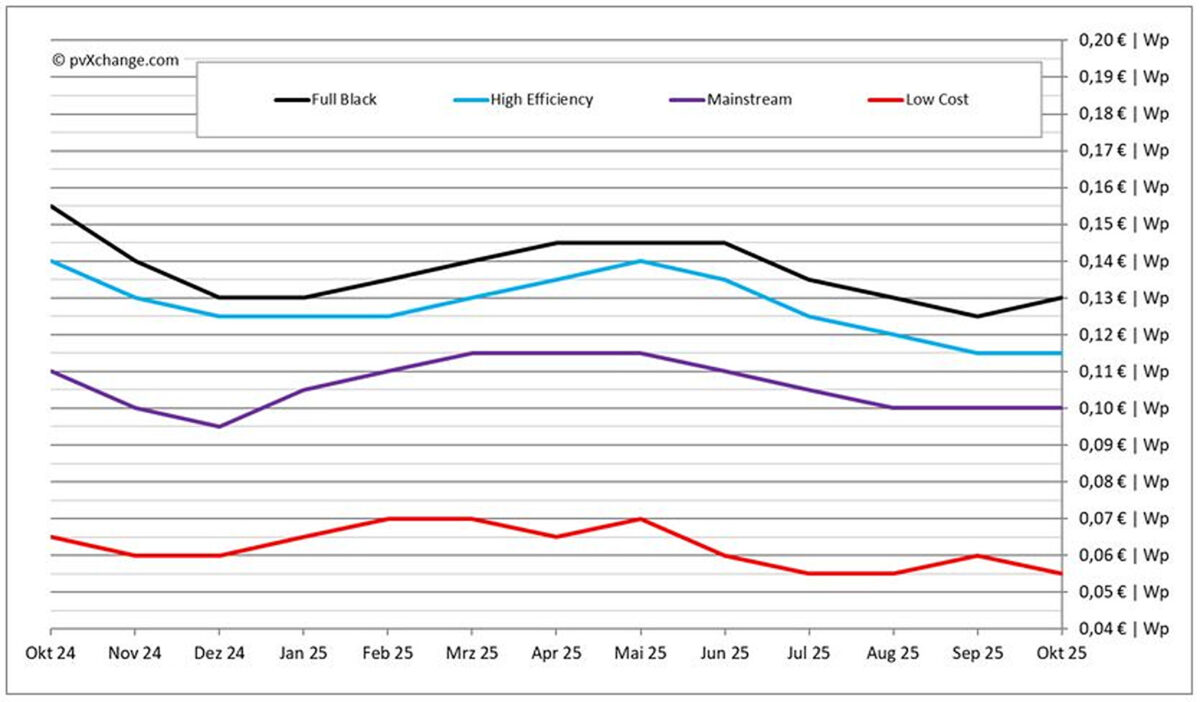
Module prices across all technology classes show slight increases and decreases, with no clear long-term trend. Price fluctuations largely reflect current demand dynamics: the small installation sector is shrinking, leading to declining sales of all-black modules. EPC companies and manufacturers are increasingly focusing on medium and large-scale photovoltaic projects, with high-efficiency modules gaining popularity, although price competition remains fierce.
Looking ahead to the coming months and especially next year, demand is expected to cool further due to uncertainty over future energy policies and a more challenging market environment, as previously viable business models and investment opportunities disappear. Normally this would indicate a continued price decline. However, this trend is offset by the Chinese government’s decision to eliminate export tax benefits for all manufacturers, which would increase export prices by nine percentage points if fully passed on by producers.
Chinese module manufacturers are likely to reflect this cost increase in prices, as European market prices have long since reached their upper limits. Long-term supply contracts already take the expected cost increase into account. For now, the timing of this impact remains uncertain, although its inevitability is clear. Asian inverter and storage manufacturers will also be affected, although cost pressures in this segment are not yet critical. Many can absorb the increase or have already incorporated it into their pricing, as there are no known public contractual obligations to pass on the costs.
Public and political attitudes towards climate change remain complex. While most citizens support the energy transition and stronger climate protection, debates about costs are gaining importance again. In response, some governments are returning to fossil-nuclear strategies that appear illogical, short-sighted and driven more by vested interests than by scientific rationale. Even expert recommendations are sometimes ignored in favor of predetermined plans – most recently illustrated by the actions of the German Minister of Economy and Energy, Katherina Reiche (CDU).
Some political leaders are going further, advocating abandoning climate protection measures and even limiting research and information – an approach increasingly associated with US policy trends. As the European Union continues to actively combat climate change, certain German policy announcements are raising concerns about a possible shift in priorities. Economic recovery and growth opportunities are often cited as justification for supporting the monopolistic structures of the traditional energy industry – a strategy that seems both retrograde and counterproductive.
The rapid growth of the renewable energy sector has exposed imbalances: conventional energy infrastructure has not evolved at the same pace and essential adjustments – such as expanding the electricity grid and deploying smart meters – have been postponed, either through oversight or deliberate neglect.
Companies that have adapted to a dynamic, decentralized energy market risk being sidelined and essentially ‘thrown off their high horse’. For example, the debate about capacity markets seems redundant: the cost-effective model should already prevail. Instead, such measures disproportionately benefit conventional energy suppliers, while decentralized producers with variable output face structural disadvantages. Viable technologies and approaches already exist to enable a cost-effective transition without relying on gas-fired power plants or prohibitively expensive network upgrades.
In the meantime, the guaranteed feed-in tariff is likely to be reduced or abolished, especially for small rooftop PV installations in Germany. Setting a reasonable threshold – for example 30 kW – would protect larger installations that require financing, ensuring continued market stability.
Promises of reduced bureaucracy remain largely rhetorical, while decentralization and dynamic energy models are often dismissed as too complex and costly. The responsibility appears to be shifting to the big energy companies, who are expected to revive older strategies with minimal adjustments.
There are also concerns that funds from the Climate Protection and Transformation Fund could be deployed to support gas-fired generation combined with carbon capture and storage (CCS). Research shows that this approach is far from environmentally sustainable: injecting CO₂ into depleted oil or gas fields can release significant methane – which is even worse for the climate – and prolong fossil fuel extraction. Using renewable energy subsidies to finance these methods benefits traditional energy interests at the expense of the photovoltaic and wind energy sectors. Presenting such practices as climate protection is not only misleading, but potentially disastrous for the sector.
Price overview per technology as of October 12, 2025, including changes from the previous month:
 About the author: Martin Schachinger studied electrical engineering and has been active in the field of photovoltaics and renewable energy for almost 30 years. In 2004, he founded the online trading platform pvXchange.com. The company has standard components in stock for new installations and solar panels and inverters that are no longer produced.
The views and opinions expressed in this article are those of the author and do not necessarily reflect those of the author pv magazine.
This content is copyrighted and may not be reused. If you would like to collaborate with us and reuse some of our content, please contact: editors@pv-magazine.com.
Popular content