

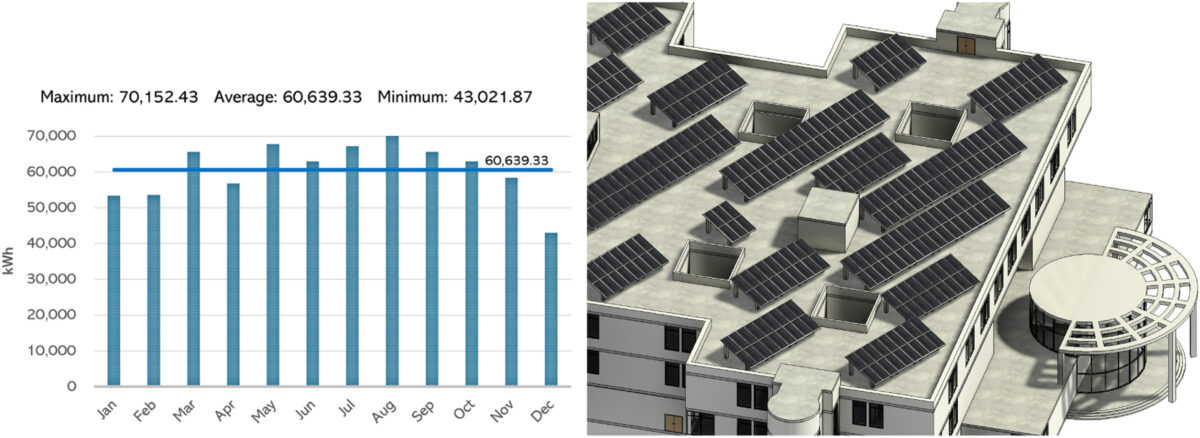
Researchers in Saudi Arabia ran a year-long simulation of fixed-tilt PV panels at different azimuth angles, finding that south-facing panels (180°) maximize energy production, while eastward shifts of up to 45° cause minimal losses.
Researchers from Imam Abdulrahman Bin Faisal University in Saudi Arabia conducted a one-year simulation study of a fixed-tilt PV system at different azimuth angles to determine the optimal configuration for solar energy production under local conditions.
“We aimed to systematically quantify the optimal annual energy production for azimuth angles of 180°, 150°, 135° and 120° for a fixed-tilt system in Dammam, Saudi Arabia, and evaluate the economic implications of this flexibility,” said lead author Bashar Alfalah. pv magazine. “The study contributes to the field of renewable energy by focusing on optimizing the performance of PV systems in arid climates. The study extends the analysis to a medium-sized system in a hyper-arid climate and provides data relevant to Saudi Arabia’s solar expansion under Vision 2030.”
Alfalah also plans to expand the research to evaluate how extreme summer temperatures in a hot desert climate affect PV performance. “Additionally, the study will vary both tilt and azimuth simultaneously to find optimal pairs for this climate. The impact of pollution is another factor to investigate in the context of how azimuth affects dust accumulation,” he further explained.
Join us on April 22 for the 3rd SunRise Arabia Clean Energy Conference in Riyadh.
The event will spotlight how solar and energy storage solutions are powering sustainable and reliable infrastructure, with a particular focus on powering the country’s fast-growing data center sector.
The researcher used his university’s College of Architecture and Planning as a case study. The building has a total area of approximately 8,000 m² and consists of three floors with a roof area of 3,600 m². According to the building’s facility management department, the average monthly energy consumption was 150,480 kWh. The average annual temperature in Dammam is 26.4 C. The highest shortwave radiation occurred during the summer/bright period, up to 8 kWh/m², while the lowest occurred during the winter/dark period, with radiation as low as 3.7 kWh/m².
Currently, the building has 704 panels of 580 W, tilted at 30° and oriented to the south-southeast (azimuth 150°). Using Autodesk Revit 2025 and DesignBuilder, the scientists simulated the same number of panels with the same capacity and tilt at different azimuths. Namely, the simulated azimuths were oriented at 180◦ (facing south), 135◦ (facing southeast) and 120◦ (facing southeast).
“My findings differ from those reported in previous studies on temperate or cloudy regions. The results show no significant difference in PV energy production between south-facing panels (180°) and panels facing up to 45° east (135°),” Alfalah said. “A panel shift can only cause a 3.4% loss in energy production, while a 120◦ (60◦ east) shift results in a 10.55% loss. Because south-facing (180°) PV panels can generate 727,672 kWh of electricity, an eastward orientation of 30° (150°) reduces production to 719,304 kWh, a decrease of about 1%.”
According to the results, panels facing south (180◦) are estimated to save over USD 1.30 million in energy bills over their lifetime, while panels facing 120◦ save approximately 12.31% (USD 1.14 million) less. “Analyses of a daily cycle at 180◦ and 150◦ azimuths show the highest energy yield, capable of covering 69% of the building’s demand in March, 46% in April and 22% in August, respectively. In contrast, the 120◦ azimuth results in 9%, 8% and 4% lower energy production in the same months,” the researcher said.
The research work was presented in “Analysis of the effect of changing the azimuth angles of photovoltaic solar panels on energy production”, published in Results in technology.
This content is copyrighted and may not be reused. If you would like to collaborate with us and reuse some of our content, please contact: editors@pv-magazine.com.
Popular content
