

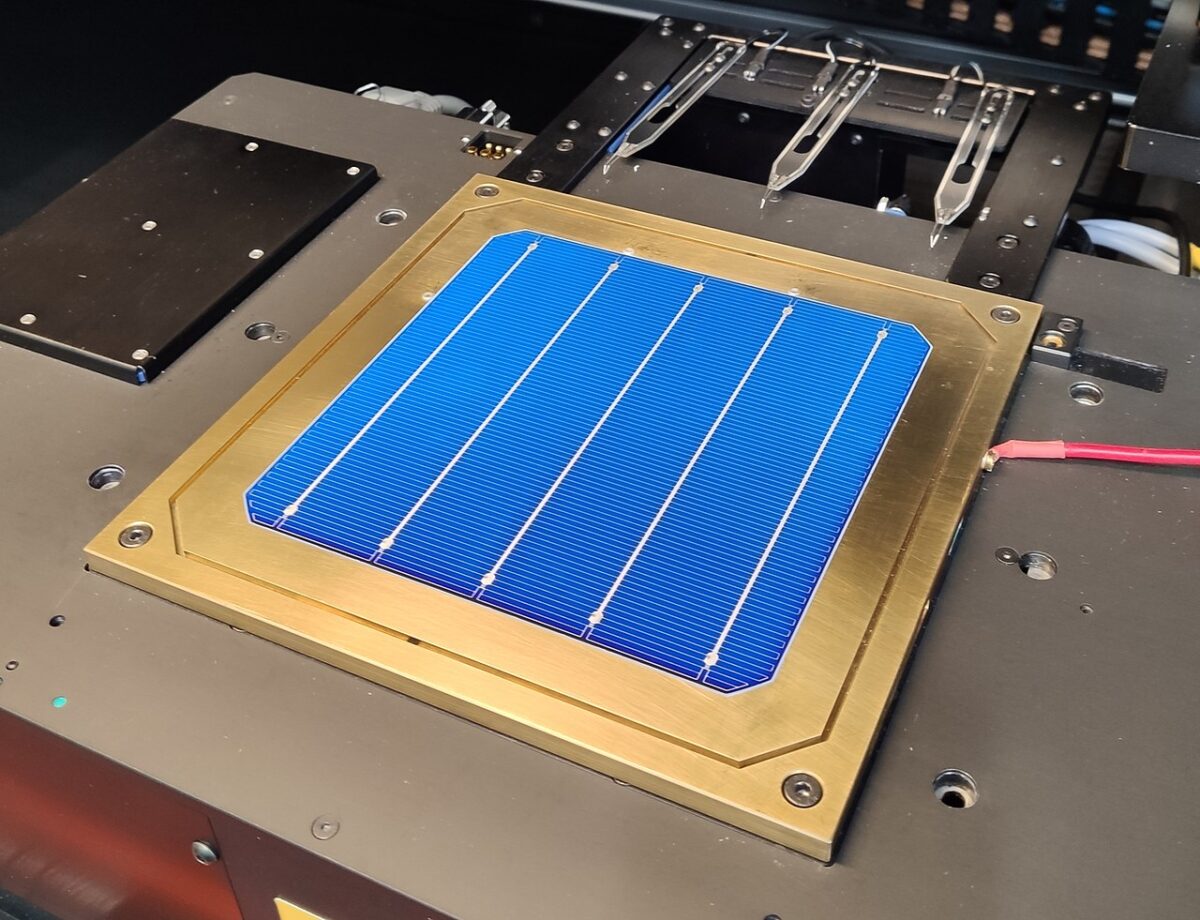
Researchers in France investigated the reliability of heterojunction solar panels in a humid, warm environment and found that sodium ions are the main source of degradation.
A group of researchers from the French research center Institut Photovoltaïque d’Ile-de-France (IPVF) and EDF R&D, a division of French energy giant EDF, have conducted a series of tests to test the reliability of heterojunction (HJT) solar panels in a humid, warm environment. environment and has determined that sodium ions are the most important degradation factor.
“Our research shows that sodium ions cause the breakdown of cell passivation, especially at the leading edge,” said the study’s lead author, Lucie Peirot-Berson. pv magazine. “We also determined this with the help of sodium-free glass significantly reduces module degradation.”
In the study “Failure modes of photovoltaic silicon heterojunction modules in a humid, warm environment: sodium and moisture effects”, published in Solar energy materials and solar cellsthe researchers explained that they investigated six HJT module cover configurations, each based on 160 µm thick M2 n-type wafers and half-cut cells connected in pairs with electrically conductive adhesive (ECA) ribbons and pads.
All modules were encapsulated with thermoplastic polyolefin, which the scientists said had a high water absorption coefficient. “This material was chosen to promote the migration of moisture and ions and to better highlight the degradation mechanisms,” they pointed out.
The six module cover architectures were: soda-lime glass-glass; glass-glass with low sodium content; sodium-free glass-glass; front cover-back cover; glass back plate; and cover glass. In the proposed configurations, opaque aluminized backsheets and transparent films were used as frontsheet or backsheet.
A total of 17 bifacial modules and one monofacial panel were fabricated in a 3S laminator at 160 C. They were then led to an ESPEC DH85 chamber with standard aging parameters of 85 C and 85% relative humidity (RH). A Spire 5600 SPL flash was used to measure module degradation and photoluminescence (PL) and electroluminescence (EL) images were used to analyze IV curves.
“For EL, carrier waves are generated by injecting current into the module. In this case, a dark area may correspond to different types of degradation. It could arise from resistive losses that limit the injected current, or it could be depassivated regions that favor non-radiative recombinations rather than radiative recombinations,” the academics explained. “For PL, the carriers are generated by exposure to light thanks to the photovoltaic effect. In this case, a dark zone only corresponds to a lower passivation quality.”
The tests showed that the modules with a soda-lime glass-glass configuration suffered the highest voltage and short-circuit current losses in open circuit conditions, due to the depassivation of the cell by the action of sodium ions from glass leaching.
The analysis also showed that the effect of sodium ions in inducing cell passivation breakdown are particularly strong at the leading edge, while mIt was found that moisture induces degradation of the transparent conductive oxide (TCO) and contacts and leads to fill factor losses.
“The study shows greater sensitivity to sodium-induced degradation of the front of the cell compared to the back, with significant recombination of the front surface visible at the front.” Peirot-Berson said. “This difference could be explained by the nature of the amorphous silicon layers and the morphology of the TCO layers, as already shown in previous literature.”
Looking ahead, they say their findings need to be validated by testing other HJT module architectures.
This content is copyrighted and may not be reused. If you would like to collaborate with us and reuse some of our content, please contact: editors@pv-magazine.com.
