

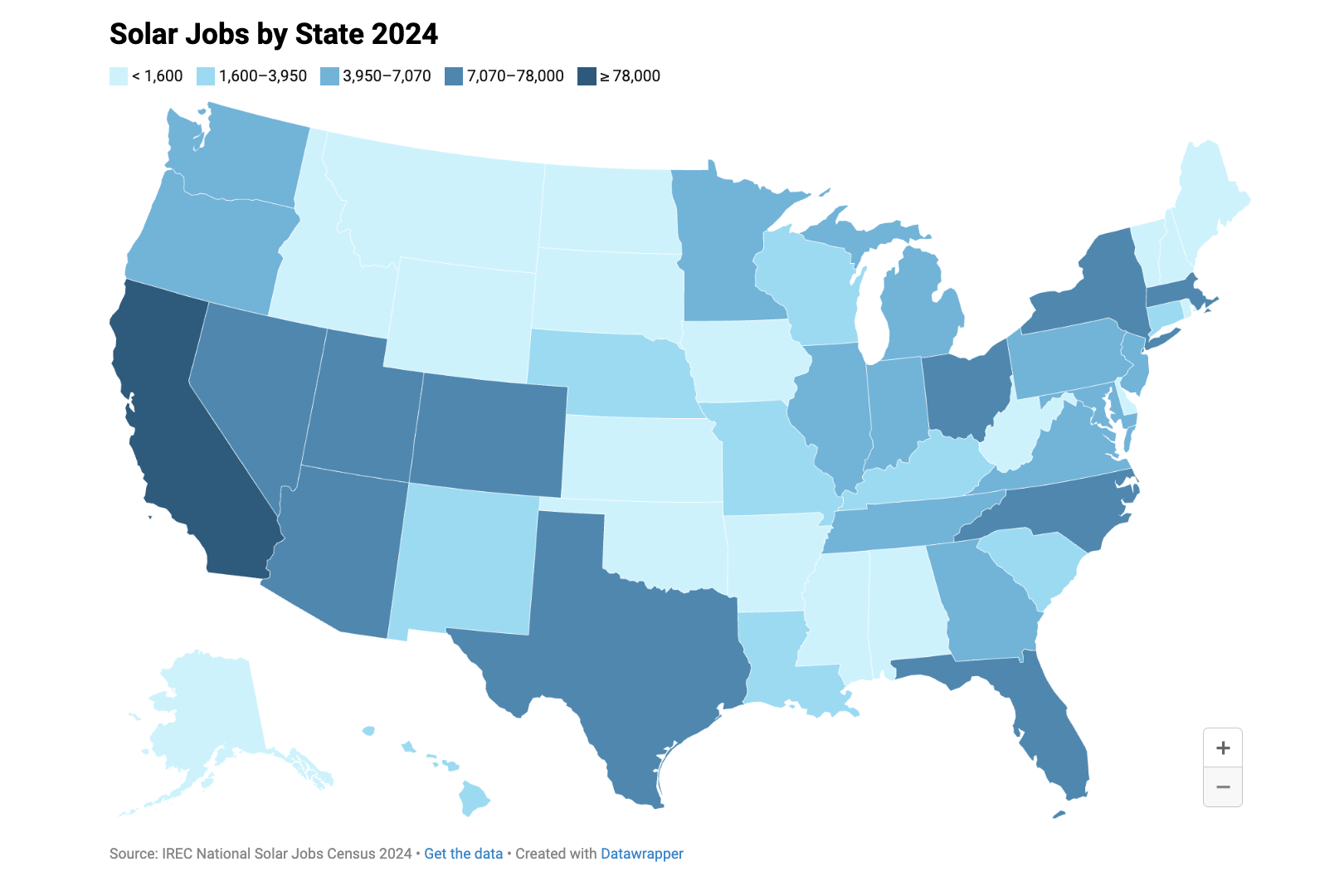
This was announced by the Interstate Renewable Energy Council (IREC). 15th Annual National Solar Jobs Censusshowing that the U.S. solar industry employed 280,119 workers in 2024, about the same as the industry’s employment in 2023.
While these 2024 data do not reflect the impact of major changes in federal energy policy implemented since the new administration took office in January 2025 – such as the cancellation of key tax credits as part of the repeal of the Inflation Reduction Act – they provide a critical basis for measuring the effects of these policies on solar and other clean energy employment in the coming years.
The National Solar Jobs Census is the annual count of solar and solar plus storage jobs in the United States. It has been published since 2010. The 2024 Census includes employment data from all 50 states, as well as employment rates across all sectors and functions.
“This year’s Census gives industry and policymakers something they desperately need: a clear baseline,” said Chris Nichols, Interim CEO of IREC. “Federal policy changes are reshaping the landscape. This Census will serve as a foundation for understanding the impacts on workers, communities and the industry’s ability to deliver reliable, affordable clean energy in the years ahead.”
“The solar and storage industry provides good-paying jobs to communities across the country,” said Abigail Ross Hopper, president and CEO of the Solar Energy Industries Association (SEIA). “States like Ohio, Georgia, Utah and Texas are seeing tremendous economic benefits and job growth from solar and storage projects that lower costs for households and businesses and strengthen the electric grid. Using data from the Solar Census can help employers and policymakers address these challenges.”
Complete picture of solar and storage employment
The Census counts workers who spend most of their time on solar energy-related activities, resulting in a core figure of 280,119 solar energy jobs. If we include workers who have spent a large portion of their time on solar energy, total solar employment increases to 370,556 jobs.
The Census also tracked employment in battery energy storage. The expansion of the use of energy storage has led to significant job growth. The number of workers in clean storage occupations increased by 3,905 jobs in 2024, a 4% year-over-year growth to 93,497 workers. In the five-year period between 2019 and 2024, the clean storage sector created a net 13,798 jobs, representing a growth of 17%.
In total, the solar and storage industries employed 464,053 U.S. workers in 2024. Solar energy continued to employ more people than any clean energy sector, excluding energy efficiency, and more than three times as many workers as the coal industry.
Job trends by state and industry segment
California remained the top state for solar jobs in 2024, despite losing about 1,000 jobs after changes in state policies affected the housing market. Florida, Texas, New York and Massachusetts followed as the second largest employers of solar workers. For the fourth year in a row, Nevada ranks first in solar jobs per capita. View an interactive map of solar energy jobs by state here.

States with notable increases in solar jobs by 2024 included Ohio (5%), Georgia (4.5%), Utah (3.5%), and Texas (3%) – all Republican-leaning “red” states, underscoring the deployment of solar energy across the political spectrum. Of the 33 states where the solar workforce grew, 25 voted for President Trump in the 2024 presidential election.
Employment varied across the major industrial segments of the solar sector. There were 178,713 jobs in installation and project development, almost two-thirds of all solar jobs. There were 34,625 jobs in wholesale and distribution; 32,491 in production and 21,833 in operation and maintenance. These roles include construction, electrical works, engineering, sales, software, marketing, finance and management.
The National Solar Jobs Census is based on data originally collected for the U.S. Department of Energy’s United States Energy and Employment Report. The findings are based on IREC’s analysis of a rigorous survey conducted by BW Research of 42,800 U.S. energy companies in the fourth quarter of 2024 and the first quarter of 2025, with 10,900 companies providing complete survey responses.
News item from IREC
