

An international research group led by the Slovenian University of Ljubljana has conducted a study on emerging ultra-high temperature heat pump technologies based on solids or gases.
All these technologies, which have the potential to reach temperatures up to 1,600 K (1,326.85 C), were assessed in their current state. The team delved into their challenges, described potential solutions, applications, scalability and technology readiness level (TRL) and further presented a roadmap for future development.
“The main advantage of these technologies is that they can operate at high temperatures, which not many heat pumps can do,” says Katja Klinar, co-author of the paper. pv magazine. “At around 1,200 K, conventional heat pump solutions are typically replaced by direct fuel combustion or electric resistance heating, both of which effectively have a coefficient of performance (COP) of 1. In contrast, new technologies can achieve a COP of more than 1, making them inherently more energy efficient. This has been demonstrated through numerical simulations.”
According to Klinar, “There are currently no high-temperature solid-state and gas-cycle heat pumps on the market. Although room-temperature solid-state and gas-cycle heat pumps are not yet on the market, they are in the prototype phase.” She emphasized that all these new technologies that require electrical energy can get it from renewable sources such as solar energy and wind energy.
“Our team does the first to claim that solid-state electrocaloric heat pumps can be used for high temperatures – no one has described this idea in scientific papers before,” Klinar added. “We have done some simulations and now we will start planning the prototype. We estimate the Technology Readiness Level (TRL) of electrocaloric heat pumps at 2.5.”
The TRL measures the maturity of technological components for a system and is based on a scale of one to nine, with nine representing mature technologies for full commercial deployment.
Electrocaloric heat pumps are a subset of caloric heat pumps. These systems transfer heat by utilizing reversible thermal effects in solid materials when an external field is applied and removed. Depending on the field type, they are classified as electrocaloric (electric field), magnetocaloric (magnetic field) or mechanocaloric (mechanical stress). Thermoelectric heat pumps also belong to the solids category, which use electric current to pump heat across semiconductor compounds.
Unlike conventional heat pumps, which rely on vapor compression cycles, solid-state systems utilize entropy changes in solid materials. “High-temperature solid-state heat pumps offer advantages due to the use of solid refrigerants, which eliminate leakage risks and have recycling potential,” the research team said. “Technologies such as magnetocaloric, electrocaloric and thermoelectric (Peltier) heat pumps can operate without moving parts.”
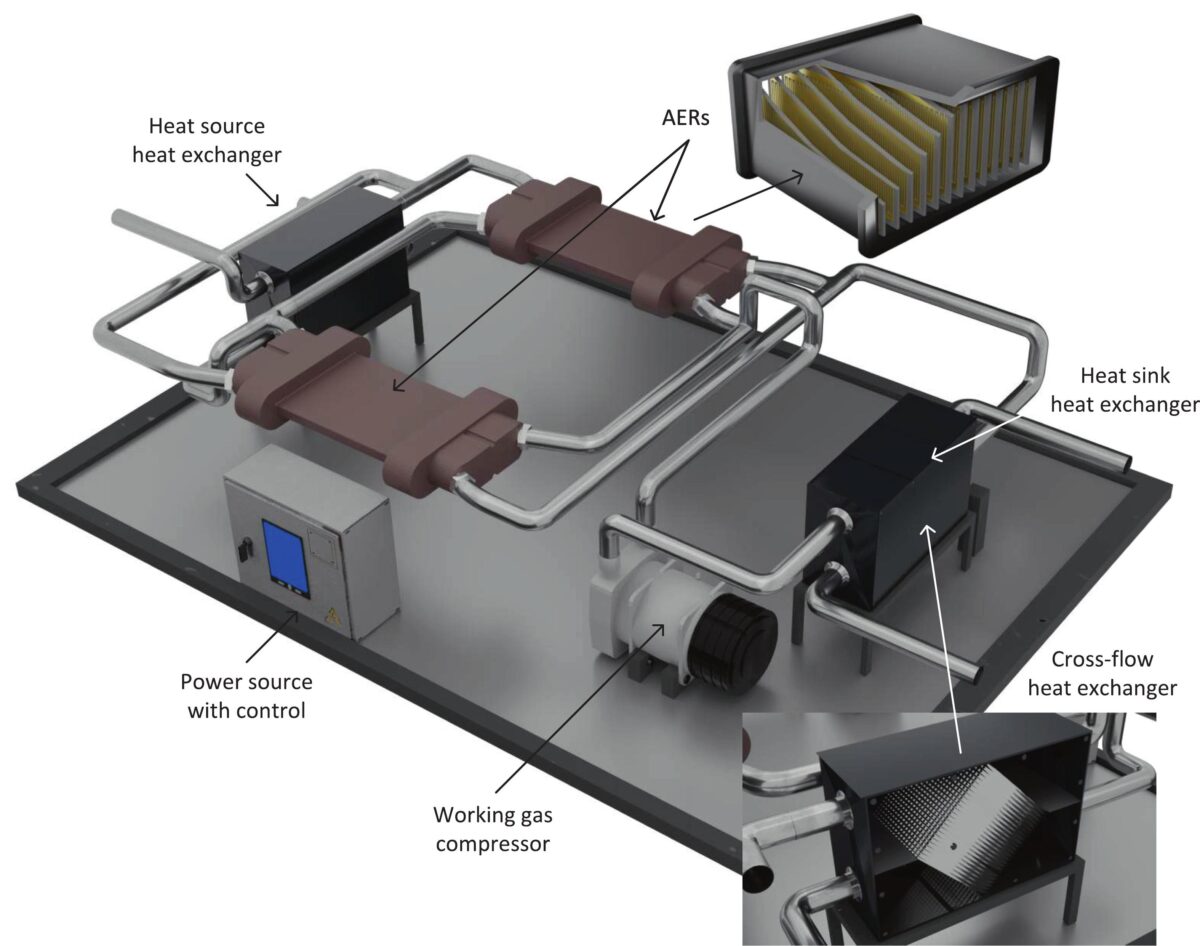
The researchers also assessed gas cycle heat pumps for high-temperature applications. These systems use a gas as the working fluid. The technologies evaluated include thermoacoustic heat pumps, which use sound waves to compress and expand gas, thereby generating hot and cold areas; mechanical Stirling heat pumps, which use pistons to compress and expand gas in a Stirling cycle; and reverse Brayton heat pumps, which use compressors to circulate gas and transfer heat.
Based on a qualitative assessment of device performance and technology maturity, the authors assigned technology readiness levels (TRLs) to each concept. The mechanocaloric heat pump received a TRL 2 classification, defined as ‘technology concept formulated’ according to EU guidelines. Magnetocaloric and electrocaloric systems were each rated at TRL 2.5, between TRL 2 and TRL 3. Thermoelectric and thermoacoustic systems achieved TRL 4, meaning “technology validated in a laboratory.” Mechanical Stirling and inverted Brayton heat pumps were assigned TRL 6, or ‘technology demonstrated in a relevant environment’.
The researchers also proposed a development roadmap until 2040. If implemented, they expect power density per unit mass to reach 15–20 W/kg for magnetocaloric systems, 15–20 W/kg for mechanocaloric systems, 100–150 W/kg for electrocaloric systems, 400–500 W/kg for thermoelectric systems, 200 W/kg for thermoacoustic systems, 300 W/kg for mechanical Stirling, and 150 W/kg for Brayton inverted heat pumps. These projections are comparable to current power densities of 3 W/kg, 1.5 W/kg, 30 W/kg, 300 W/kg, 75 W/kg, 60–100 W/kg and 45 W/kg, respectively.
According to the same roadmap, the expected second law efficiencies in 2040 are 60% for magnetocaloric, mechanocaloric and electrocaloric systems; 20% for thermoelectric; above 60% for thermoacoustic and mechanical Stirling; and above 40% for Brayton inverted heat pumps. The current efficiency is 30%, 30%, 55%, 5-20%, 55%, 55% and 33% respectively.
At the same time, the maximum output power at the device level is expected to increase significantly. Current values of 15 kW (magnetocaloric), 1.5 kW (mechanocaloric), 0.01 kW (electrocaloric), 10 kW (thermoelectric), 500–1,000 kW (thermoacoustic), 500–1,000 kW (mechanical Stirling) and approximately 200 kW (reverse Brayton) are expected to increase to application ranges of 0.5–50 kW, 1–50 kW, 0.1–10 kW, 0.1–100 kW, 50–1,000 kW, 50–1,000 kW and 100–1,000 kW, respectively, in 2040.
The study findings are presented in “Emerging Opportunities for High Temperature Solid State and Gas Cycle Heat Pumps”, published in Nature energy. Researchers from the Slovenian University of Ljubljana, the Chinese Academy of Sciences, the Spanish National Research Council (CSIC), the Dutch University of Twente, the Croatian University of Zagreb and the British University of Cambridge took part in the study.
This content is copyrighted and may not be reused. If you would like to collaborate with us and reuse some of our content, please contact: editors@pv-magazine.com.
