

UNSW researchers have discovered that annealing copper-plated contacts in heterojunction solar cells only produces localized voltage. Their analysis also showed that at typical annealing temperatures around 200 C, the chance of silicon fracture is very low.
A research team from the University of New South Wales (UNSW) and Sydney-based solar technology company SunDrive investigated the impact of annealing copper (Cu) contacts in heterojunction (HJT) solar cells and found that this process is unlikely to cause small fractures.
“We assessed the thermomechanical stress induced by the annealing of the Cu-plated contacts on the pyramidal surface of HJT solar cells,” the study’s lead author Pei-Chieh Hsiao said. pv magazine. “The finite element analysis showed that the Cu contact width is the most critical factor determining the silicon stress, and not the surface area or volume of plated Cu. This means that the inherently narrow Cu fingers are beneficial in both reduced optical shadow and lower thermal stress.”
The scientists also evaluated the influence of the relative location of the Cu contact edge to the pyramid tip and size. “Importantly, high stresses in silicon are induced locally at the Cu-plated contact edge, which is experimentally confirmed with the relative stress measured by Raman spectroscopy. The Weibull diagram obtained from four-point bending tests shows that annealed Cu contacts introduced surface-limiting defects. However, a very low probability of fracture of silicon is estimated for the typical annealing process at 200 C.”
The tests were performed on M12 half-cut n-type HJT cells with a size of 210 mm × 105 mm and a thickness of 120 μm. The devices were coated with indium tin oxide (ITO) and exposed to Cu plating via a proprietary process developed by SunDrive using an acid-based copper plating solution. They were then rinsed in deionized water for 2 min and air dried with a fan-driven infrared dryer.
In a next step, the research team placed the cells on a flat aluminum (Al) heating platform at a constant temperature of 200 C. Raman spectroscopy was used to identify potential stress areas caused by annealing on the structured ITO/silicon surfaces next to the busbar lines and fingers.
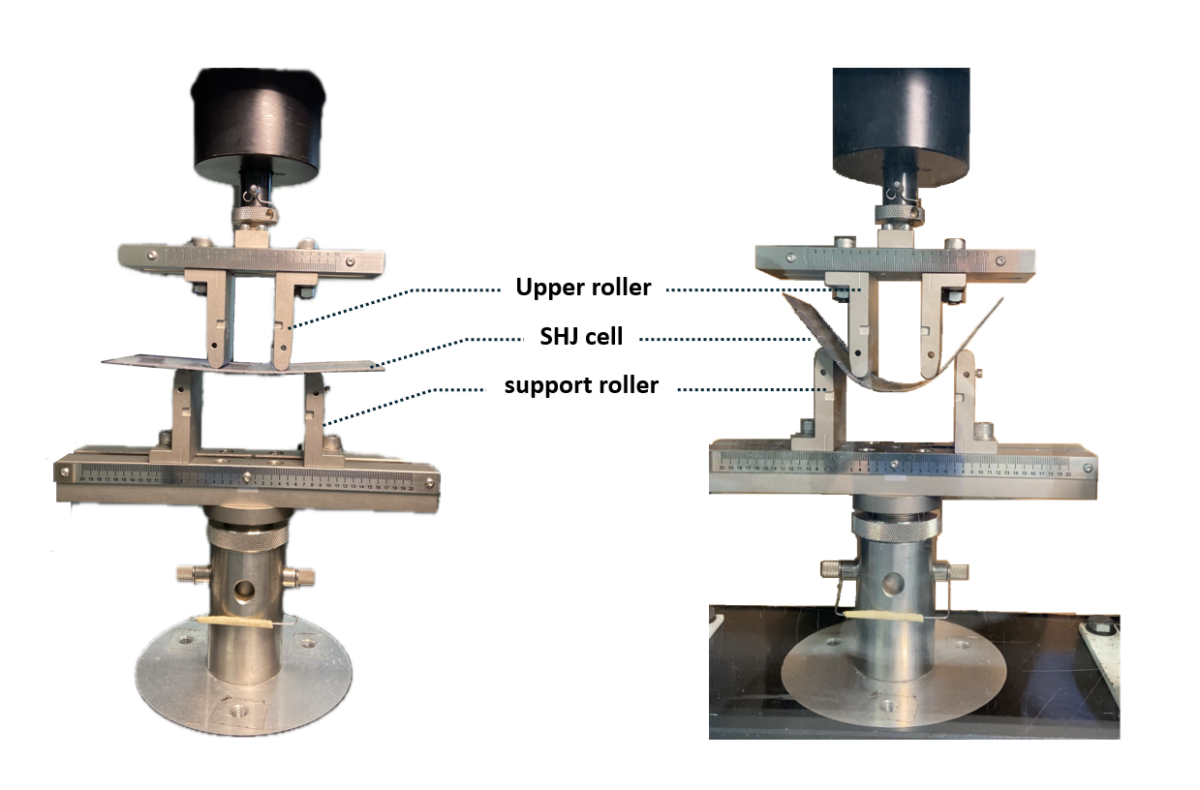
In addition, the group performed a four-point bending test (4PF). a standard mechanical test to determine the flexural strength and stress-strain behavior of a material, to measure the mechanical stress caused by the Cu contacts.
The analysis identified the contact width of plated Cu as the main factor causing stress in silicon. “The Cu volume or contact area are not relevant in this regard,” says Hsiao. “The silicon stress increased with Cu width and stabilized when the contact width was greater than 50 μm. The Cu contact edge can be placed at different distances from the pyramid tops.”
The scientists also warned that exceeding the 200 C threshold during annealing could increase the risk of low fractures, noting that a spatial temperature inhomogeneity of about 20 C across the cell was found when using both conductive and radiant heating for cell annealing at 400 C.
Their findings are available in the article “Investigation and simulation of thermomechanical stress induced by plated Cu contacts on Si heterojunction solar cells”, published in Progress in photovoltaics.
Another research group led by UNSW recently measured the impact of sodium-induced degradation in heterojunction solar cells under accelerated moist heat tests. They considered three different types of sodium salts and identified the degradation mechanisms attributed to each contaminant.
Other UNSW researchers investigated failure modes in HJT solar modules with glass backplate configurations in 2023. They identified four failure modes caused by moist heat in heterojunction solar panels with a glass-back configuration.
More recently, a group of researchers from the French research center Institut Photovoltaïque d’Ile-de-France (IPVF) and EDF R&D, a unit of French energy giant EDF, conducted a series of tests to assess the reliability of HJT solar panels in a humid, warm environment and identified sodium ions as the main degradation factor.
This content is copyrighted and may not be reused. If you would like to collaborate with us and reuse some of our content, please contact: editors@pv-magazine.com.
