

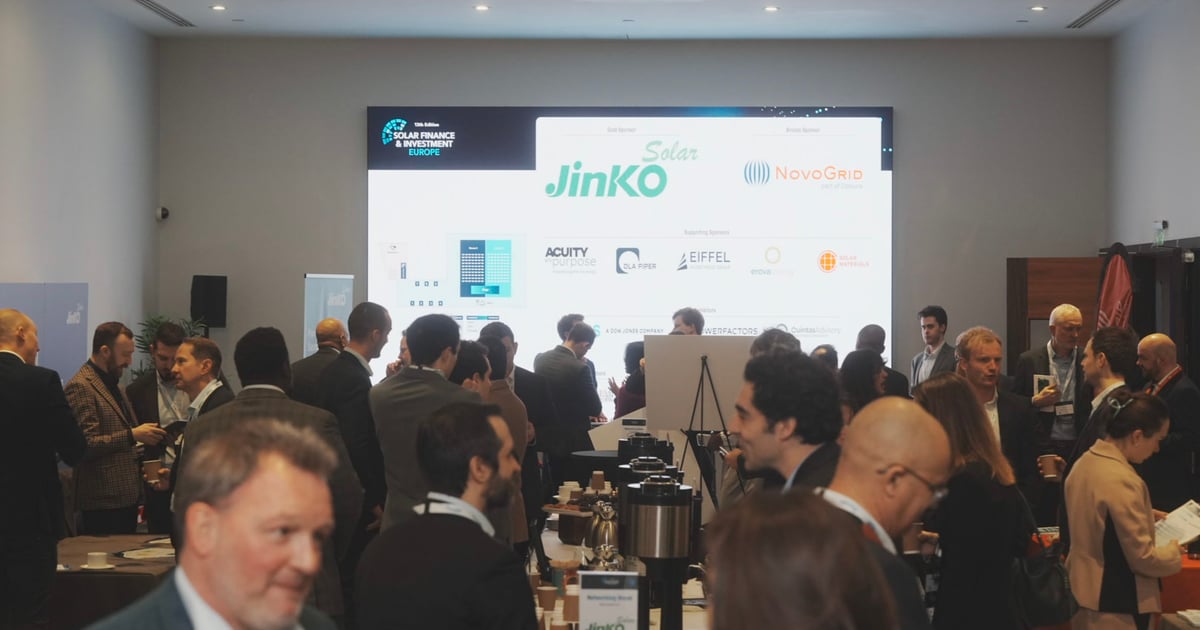
The UK Contracts for Difference (CfD) market is the “gold standard” for investment opportunities, according to Bob Psaradellis, CEO of Island Green Power.
Speaking on a panel at the Solar Finance & Investment Summit, held in London, this afternoon, he discussed the importance of including a mix of CfD, purchase agreement and power purchase agreements (PPA) in an investment portfolio. Fellow panelist Kari Tikkanen, head of revenue at AUKERA Energy, noted that “not all CfDs are equal”, to which Psaradellis said the UK CfD scheme is the ideal balance between trading opportunities and guaranteed income for renewable energy investors.
“We are only present in the UK, but we have very large projects in the UK – our solar projects are 500MW and over and they are all on the same site [with battery energy storage systems (BESS)]” he said, saying that the current 20-year offtake agreements his company has in place are more attractive than purely market-based PPAs.
“The next best option behind a solar CfD is a corporate PPA or a utility PPA, but they are not as attractive.”
Tikkanen added that these types of complex arrangements, combining the commercial potential with the long-term security offered, add sophistication to a power generation portfolio, which may not be suitable for all investors.
“It depends on the type [risk] the exposure you are looking for,” says Tikkanen. “Managing a combination of CfDs from different technologies requires sophistication, so that is not necessarily the right path to follow in a volatile energy market for all players. It’s not as easy as it sounds; there must surely be more [of a mix]but it’s not for everyone.”
“We like to work in some places,” agrees Steve Hunter, Associate Partner at CVC DIF. “In other markets we could say ‘no, we want to capture some of that’, perhaps through a virtual or physical toll with a battery.”
Batteries offer more benefits than ‘trading advantage’
Psaradellis also talked about the potential for batteries, as an investor in the solar-plus-storage space. He said there is no “trade advantage” to co-locating BESS with solar in Britain, but that more efficient use of sites and grid connections could bring other financial benefits.
“The real benefit is that you can socialize the grid costs across the two assets,” he said. “The grid costs… are quite high, so you get two for the price of one, so that’s quite attractive.”
This is especially important given rising network costs across Europe; during an earlier panel discussion, covered by our colleagues at PV technologyPanelists suggested that Europe could need up to €585 billion (£504.55 billion) of new network investment over the next five years to meet growing demand for network connections during the energy transition. Securing a supportive legislative framework and a range of financial arrangements to enable more battery deployments could be a key component of Britain’s energy transition.
In his address to Britain’s legislative environment, Psaradellis described this government as “the most pro-renewable energy government in the world, and I say that with confidence.”
“The regulatory environment is world class [but] This Labor Party may not be in power forever, so what should we do?” he continued, highlighting some of the long-term questions that UK renewable energy investors still face. “Will there be an AR10? It is no longer axiomatic, as it used to be, so that is a problem.”
Solar energy portal publisher Solar Media organizes the 13th edition of the Solar financing and investments Europe event in London this week, on 3 – 4 February 2026. This event annually attracts infrastructure funds, institutional investors, asset managers, banks and development platforms at the forefront of European renewables. For more details, visit the website.
