

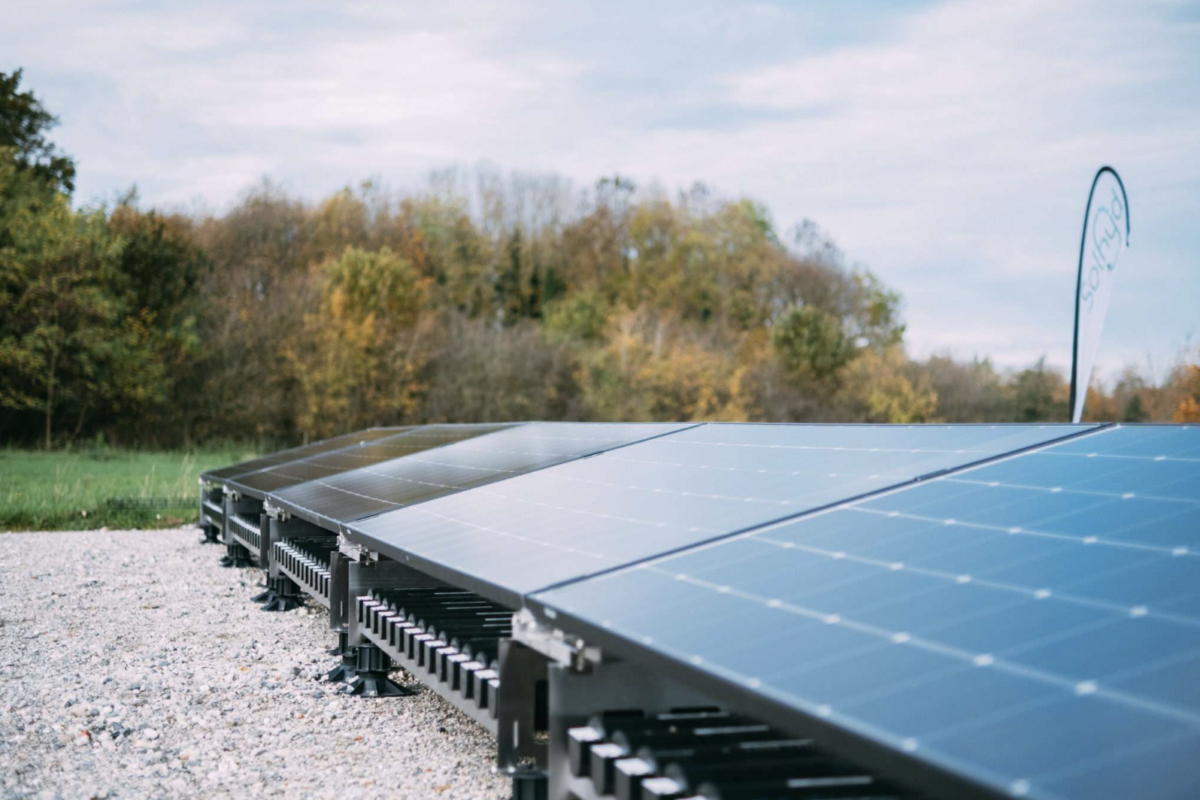
A 2 MW solar farm in Wallonia, Belgium, will use 50 kW hydrogen-producing solar panels developed by Solhyd, a spin-off of KU Lueven. The installation will be the first demonstration of Solhyd’s technology on a commercially relevant scale.
A consortium of Belgian companies has signed a Memorandum of Understanding (MoU) to build an energy system with hydrogen-producing solar panels in Wallonia. Belgium.
The installation, billed as the world’s first solar-powered hydrogen park, will integrate 50 kW of hydrogen-producing solar panels developed by Solyhd into a traditional 2 MW solar farm connected to battery storage.
The location, which will be put into use next year, will be able to produce both electricity and hydrogen from solar energy. It is intended to operate for five years.
Under the terms of the MoU, Brussels-based Ether Energy will own and operate the project, while Solhyd will supply and maintain its hydrogen modules. SunBuild is responsible for designing and building the solar-plus-storage system, while Nippon Gases is responsible for hydrogen post-processing, storage and distribution.
Solhyd started developing its hydrogen-producing modules at KU Leuven more than ten years ago. The technology, which consists of a modular design, produces hydrogen directly from sunlight and air, without the need for liquid water, rare materials or a heavy grid connection. It is said to be able to produce 250 liters of hydrogen per day, with a peak efficiency of 15%.
A statement from Solhyd explains that in future installations the share of Solhyd modules will increase compared to the capacity of conventional solar panels. The company has ambitions to become one project with 2 MW of its modules by 2028, followed by further rollout in Europe and sunny regions around the world.
It is argued that by also producing green hydrogen, solar farms can create new revenue streams, reduce grid congestion and increase their value during periods of low or negative electricity prices.
“This project is the first demonstration on a commercially relevant scale and serves as a reference for further rollout,” said Jan Rongé, CEO of Solhyd. “We prove that green hydrogen can be approached in a pragmatic and scalable way. By harnessing the sun directly, we reduce costs and drastically simplify the system.”
This content is copyrighted and may not be reused. If you would like to collaborate with us and reuse some of our content, please contact: editors@pv-magazine.com.
