

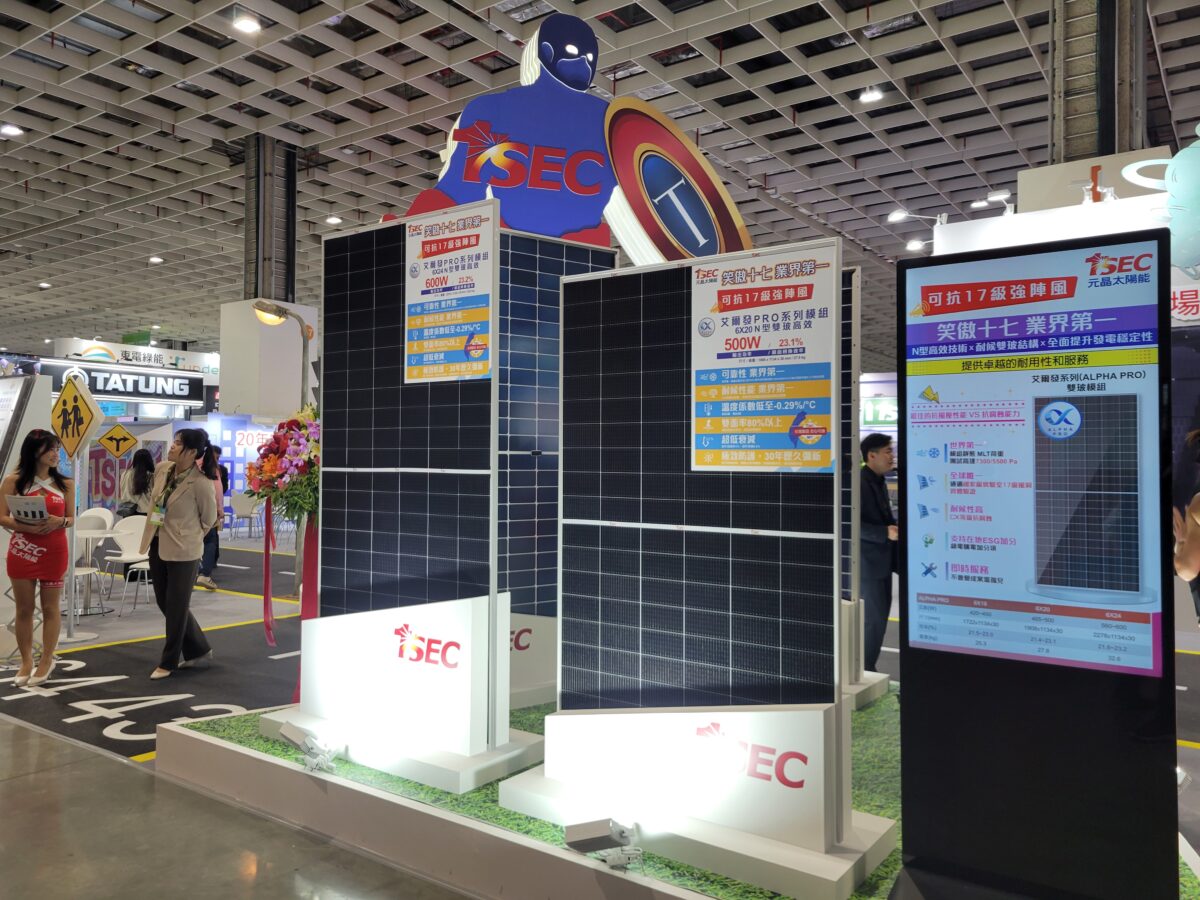
The Taiwanese manufacturer presented the new module range at the Energy Taiwan fair. Two modules in the series have a wind resistance of 17 on the Beaufort scale, making them typhoon ready, according to the company.
TSEC launched three double-sided glass-glass modules at the Energy Taiwan trade fair, two of which are built to handle typhoon-level wind loads. The new TSEC Quantum and TSEC Alpha Pro modules have a wind resistance rating of 17 on the Beaufort scale – the highest level – while the Alpha model has a level 14 rating.
Alpha Pro is an n-type bifacial module manufactured in Taiwan using Southeast Asian cells, a company representative said pv magazine. Efficiency figures for the monocrystalline modules vary by panel size, ranging from 21.5% to 23.2% according to TSEC. The range consists of three variants with the dimensions 1,722 mm x 1,134 mm x 30 mm, 1,908 mm x 1,134 mm x 30 mm and 2,278 mm x 1,134 mm x 30 mm. They are available with powers from 420 W to 450 W, 465 W to 500 W and 560 W to 600 W respectively.
TSEC launched the typhoon-resistant module in the wake of Typhoon Danas, which made landfall in Taiwan in July 2025 and damaged more than 135,000 solar panels belonging to more than 30 companies. In addition to the high wind load, Alpha Pro has corrosion resistance at salt spray grade 8 under IEC 61701:2020 test conditions and an operating temperature of -40 C to 85 C.
The new Quantum module is available in the same sizes and power levels as Alpha Pro, but the module is made in Taiwan using TSEC’s own locally manufactured cells, ensuring compliance with US customs regulations for module imports.
The Alpha variant is also manufactured in China for export and is available in four sizes: 1,722mm x 1,134mm x 30mm (420W to 450W), 1,908mm x 1,134mm x 30mm (470W to 500W), 2,278mm x 1,134mm x 30mm (550W to 600W), and 2,465mm x 1,134mm x 35mm (615W to 650W). It can withstand wind on Beaufort scale 14.
Many of the thousands of modules damaged during Typhoon Dana were installed in floating solar power plants, and the government in Taiwan is expected to issue new technical guidelines in the future.
A TSEC representative at Energy Taiwan said pv magazine that this is not a problem for the manufacturer, as the company has proven that its modules are non-toxic. He added that the module range can withstand extreme weather conditions, in part because “our frame is a little different than the competition.” This includes an anti-corrosive coating for the frame and module glass.
This content is copyrighted and may not be reused. If you would like to collaborate with us and reuse some of our content, please contact: editors@pv-magazine.com.
