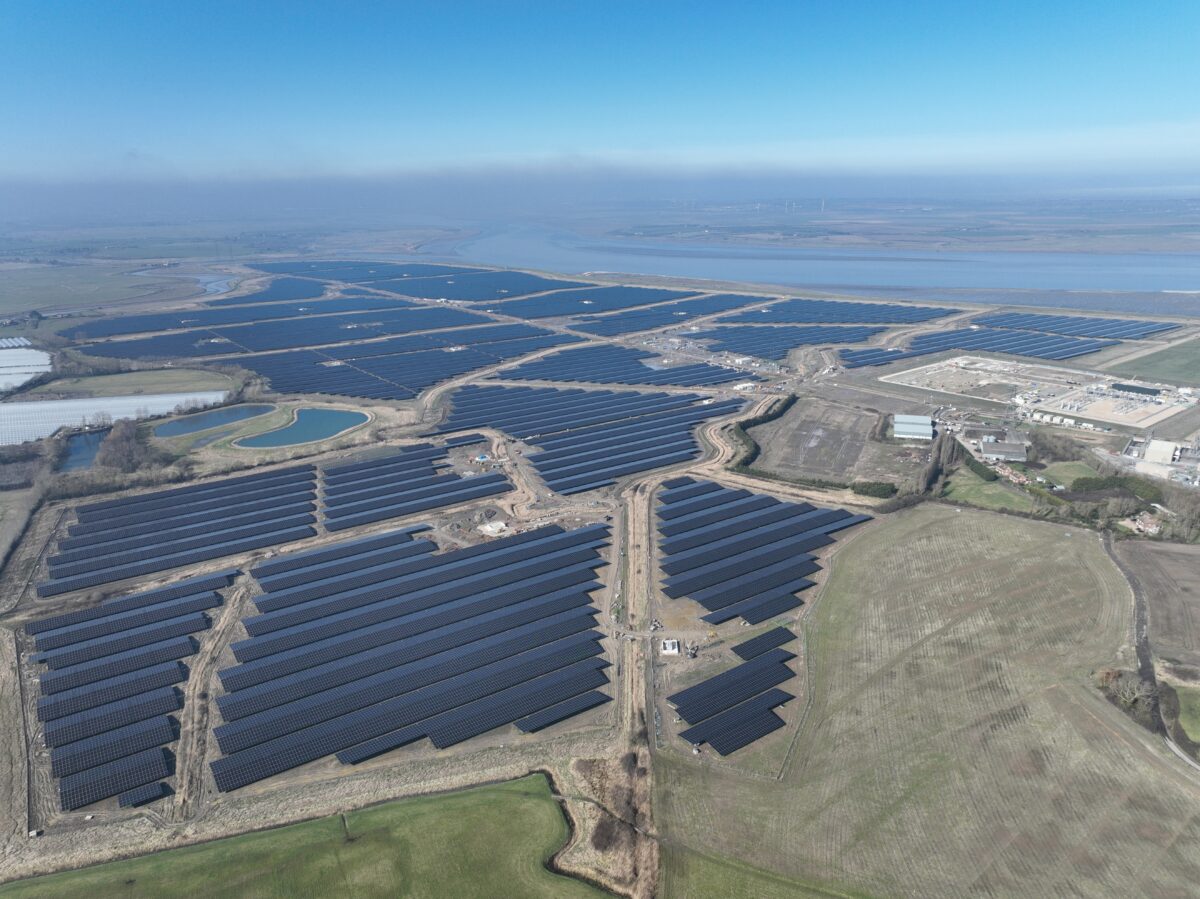
Cleve Hill is the largest UK solar power plant commissioned to date and one of fifteen CfD-backed projects due to come online in 2025.
Image: Quinbrook
According to the latest government figures, Britain has broken the 20 GW barrier for solar energy deployed, adding 1.4 GW since the start of 2025, including 106 MW in September.
The UK Department of Energy Security and Net Zero (DESNZ) solar capacity figures are provisional and subject to revision as new data is added, but show growth of at least 1.9 GW over twelve months, an increase of 10.7%.
New capacity in 2025 includes the inauguration of the 373 MW Cleve Hill solar farm in July, the UK’s largest solar power plant to date. Cleve Hill is one of fifteen Contract for Difference (CfD) solar farms due to come online in 2025, out of a total of seventeen supported by the government-backed program to date.
According to DESNZ, domestic installations still account for the lion’s share of PV installations. However, at least 40% of capacity comes from ground-mounted or standalone solar installations. When assessing “non-accredited” capacity, the government estimates that ground-based solar actually accounts for approximately 58% of total capacity. About 520 MW of new installed capacity, registered in the first three quarters of 2025, came from plants of 5 MW or more.
The number of large-scale PV installations is expected to grow further, following a wave of planning permission orders granted by the UK government under its Nationally Significant Infrastructure Projects (NSIP) process. These include the recently approved 500 MW Tillbridge Solar Project, which is part of a cluster of proposed utility-scale solar projects in Lincolnshire, England.
More utility-scale projects will need to come quickly before the UK government can achieve its target of at least 45 GW of solar capacity by the end of 2030. Success will likely depend on the amount of capacity purchased in the next two CfD allocation rounds, AR7 and AR8. Wind industry leaders have already expressed disappointment at a lower-than-expected CfD budget for offshore wind, announced on October 27, and a similar outcome for solar could hamper progress.
This content is copyrighted and may not be reused. If you would like to collaborate with us and reuse some of our content, please contact: editors@pv-magazine.com.
Popular content