

University of Houston scientists solve meteorological mysteries on Mars
A groundbreaking achievement by University of Houston scientists is changing our understanding of Martian climate and weather, while also providing critical insights into Earth’s atmospheric processes.
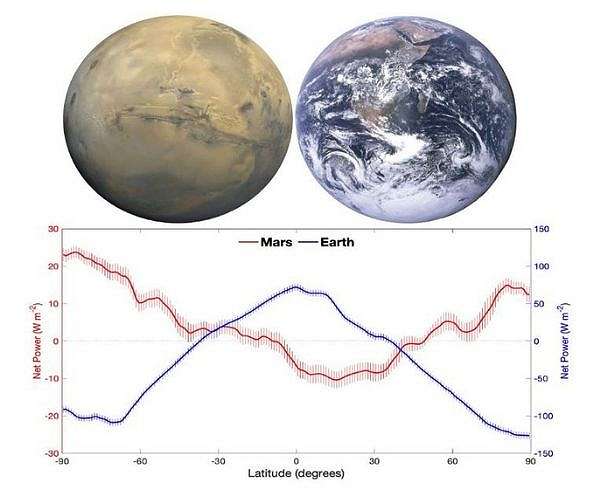
The study, led by Larry Guan, a graduate student in the Department of Physics in the UH College of Natural Sciences and Mathematics, was led by his advisors, Professor Liming Li of the Department of Physics and Professor Xun Jiang of the Department of Earth and Mathematics. Atmospheric Sciences and several world-renowned planetary scientists have generated the first-ever meridional profile of Mars’ radiant energy budget, or REB, which represents the balance or imbalance between absorbed solar energy and emitted thermal energy around the globe. latitudes. On a global scale, an energy surplus leads to global warming, while a shortage leads to global cooling. Furthermore, the meridional profile of Mars’ REB fundamentally influences weather and climate patterns on the red planet.
The findings are in a new paper just published in AGU Advances and will be featured in AGU’s prestigious scientific journal EOS.
“The work in establishing the first meridional radiative energy budget profile of Mars is remarkable,” Guan said. “Understanding Earth’s large-scale climate and atmospheric circulation relies heavily on REB profiles, so having one for Mars allows critical climatological comparisons and lays the foundation for Martian meteorology.”
The profile, based on long-term observations from spacecraft in orbit, provides a detailed comparison of Mars’ REB with that of Earth, revealing striking differences in the way each planet receives and radiates energy. While Earth shows an energy surplus in the tropics and a deficit in the polar regions, Mars shows the opposite configuration.
“On Earth, the tropical energy surplus causes warming and upward motion in the atmosphere, while the polar energy deficit causes cooling and downward motion in the atmosphere,” Jiang explains. ‘These atmospheric movements have a significant impact on the weather and climate on our home planet. However, on Mars we see a polar energy surplus and a tropical energy deficit.’
That excess, Guan says, is especially pronounced during spring in Mars’ southern hemisphere and plays a crucial role in driving the planet’s atmospheric circulation and causing global dust storms, the most prominent feature of Martian weather. These massive storms, which can envelop the entire planet, significantly change the energy distribution and form a dynamic element that influences the weather patterns and climate of Mars.
“The interaction between dust storms and the REB, as well as with polar ice dynamics, reveals the complex feedback processes that likely determine Martian weather patterns and long-term climate stability,” Guan said.
It has recently been discovered that there is an energy imbalance on a global scale, which is significantly contributing to global warming, on a scale comparable to that caused by increasing greenhouse gases. Mars presents a distinct environment due to its thinner atmosphere and lack of anthropogenic effects. The research team is now investigating potential long-term energy imbalances on Mars and their implications for the planet’s climate evolution.
“The REB difference between the two planets is truly fascinating, so continued monitoring will deepen our understanding of Mars’ climate dynamics,” Li said. “This research not only deepens our knowledge of the red planet, but also provides critical insights into planetary atmospheric processes.”
Research report:Different energy budgets of Mars and Earth
