

UNSW researchers identified a novel moist heat degradation mechanism in TOPCon modules with laser-controlled contacts, driven primarily by backside recombination and open-circuit voltage drop rather than series resistance increase. The study highlights that magnesium in white EVA encapsulants accelerates degradation, leading to better encapsulant and backsheet selection for more reliable modules in humid environments.
A research team from the University of New South Wales (UNSW) has novel moist heat-induced degradation pathway in TOPCon modules manufactured with laser assisted contacts.
“Unlike previous studies that were dominated by the increase in series resistance, the main degradation factor here is a reduction in open-circuit voltage, coupled with enhanced backside recombination,” said Bram Hoex, the study’s lead author. pv magazine. “The new relegation mechanism developed under prolonged exposure to moist heat (DH).
The scientists conducted their analysis on 182mm x 182mm TOPCon cells manufactured in 2024 with laser-assisted firing.
The TOPCon solar cells used a boron-doped p⁺ emitter, along with a front passivation stack consisting of unintentionally grown silicon dioxide (SiOₓ), aluminum oxide (Al₂O₃), and hydrogenated silicon nitride (SiNₓ:H), capped with a screen-printed H-patterned silver (Ag) contact grid. On the backside, the structure consisted of a SiO₂/phosphorus-doped n⁺ polycrystalline silicon/SiNₓ:H stack, also contacted with a screen-printed H-patterned Ag lattice.
The researchers encapsulated the cells with different bills of materials (BOMs): two types of ethylene vinyl acetate (EVA); two types of polyolefin elastomer (POE); and one type EVA-POE-EVA (EPE). They also used commercially available coated polyethylene terephthalate (PET) composite (CPC) backsheets.
“The mini modules were laminated at 153 C for 8 minutes under standard industrial laminating conditions,” the academics explained. “All modules underwent a DH test at 85 C and 85% relative humidity (RH) in an ASLi climate chamber for up to 2,000 hours to study moisture-induced failures.
Image: UNSW, Solar Energy and Solar Cell Materials, CC BY 4.0
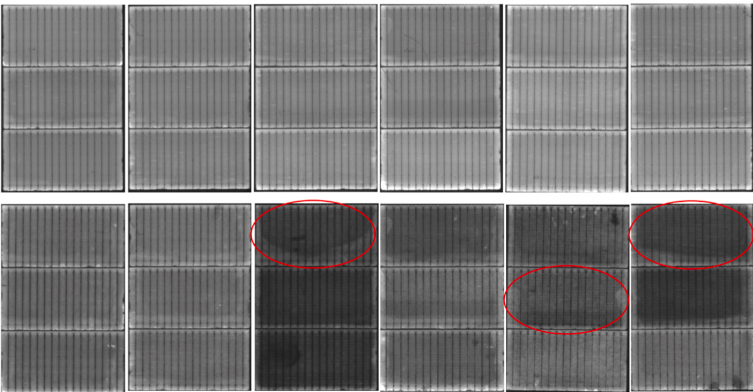
The tests showed that the maximum power losses ranged from 6% to 16%, with the difference between these values being highly dependent on the BOM of the encapsulation.
“The modules with POE on both sides were the most stable at around 8%, while those with white EVA on the back, especially in combination with EPE, showed the highest losses at around 16%,” Hoex said. “The main cause of the degradation was a reduction in open-circuit voltage rather than increased series resistance after DH testing, which differs from previous findings that primarily attribute DH-induced degradation to metallization corrosion.”
The research team explained that higher degradation levels were due to additives containing magnesium (Mg) in white EVA, which migrate under DH, hydrating and creating an alkaline microenvironment. “This alkaline chemistry corrodes the back SiNx passivation layer, increases the hydrogen concentration at the interface, causes local pinhole-like defects and increases the dark saturation current, ultimately reducing the open-circuit voltage,” Hoex points out.
The scientists also explained that while Mg in white EVA encapsulants and its role in acetic acid-induced degradation had been previously reported, the effect of MgO on performance degradation in TOPCon modules was not explicitly studied.
Their findings are available in the article “A novel moist heat induced failure mechanism in PV modules (with case study in TOPCon)”, published in Solar energy materials and solar cells.
“We hope this work helps refine encapsulant and BOM selection strategies for the next generation of TOPCon modules, especially for deployment in humid climates,” Hoex concluded. “It provides clear guidance for controlling Mg content in backside encapsulants and optimizing the robustness of backside passivation. The mechanistic insights from this study have already informed upstream design changes, significantly reducing risk in commercial modules.”
Other research by UNSW showed the impact of POE encapsulants on the corrosion of TOPCon modules, solder flux on the performance of TOPCon solar cells, degradation mechanisms of industrial TOPCon solar panels encapsulated with ethylene vinyl acetate (EVA) under accelerated moist heat conditionsas well as the vulnerability of TOPCon solar cells to contact corrosion and three types of defects in TOPCon solar modules that have never been detected in PERC panels.
In addition, UNSW scientists investigated the sodium-induced degradation of TOPCon solar cells under moist heat exposure, the role of ‘hidden contaminants’ in the degradation of both TOPCon and heterojunction devices, and the impact of electron irradiation on PERC, the performance of TOPCon solar cells.
More recently, another UNSW research team has developed an experimentally validated model that links UV-induced degradation in TOPCon solar cells to hydrogen transport, charge capture and permanent structural changes in the passivation stack.
This content is copyrighted and may not be reused. If you would like to collaborate with us and reuse some of our content, please contact: editors@pv-magazine.com.
Popular content

