

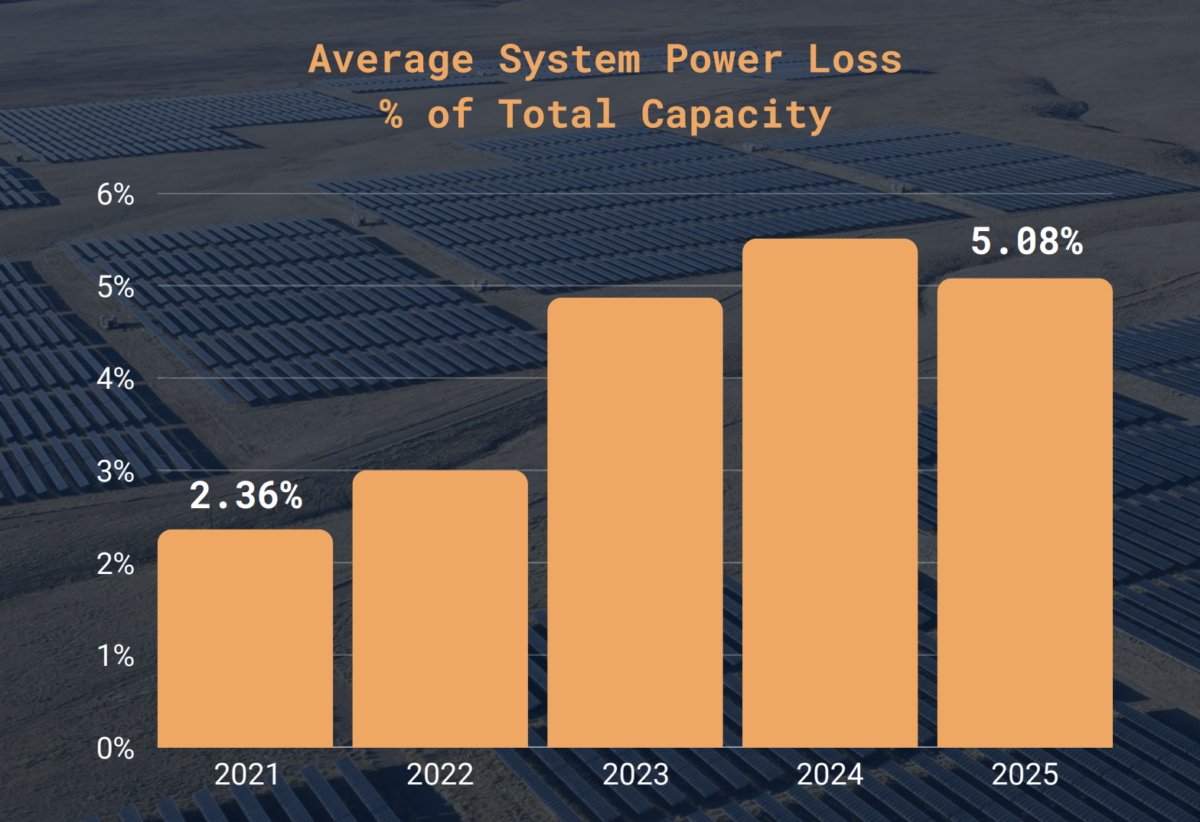
A new report calculates the average power loss of 373 GW of utility-scale solar and commercial and industrial solar in the US at 5.08%, more than double the level five years ago. The average power loss in projects where robotics and automation are used drops to 3%.
A U.S.-based solar company facing average power losses through 2025 could lose up to $5,070 per MW in annual revenue, according to a new report from a robotics analytics company. Raptor Cards.
Raptor Cards Global Solar Energy Report 2026 includes an analysis of power losses across 373 GW of large-scale and commercial and industrial solar PV sites in the US. It found in the dataset an average power loss for all solar installations of 5.08%, compared to 5.51% in 2024. The average remains more than double what it was five years ago and is also above the running five-year historical average for the period 2020-2024, which is 3.5%.
Raptor Maps says the slight reduction in average power loss was caused by a decrease in inverter-induced power loss. The number of inverter faults has decreased by almost 40% compared to 2024, and now accounts for less than a quarter of the total observed equipment-related losses.
In contrast, the dataset saw a 12.5% year-over-year increase in string problems and a 10.2% increase in combiner errors, which now account for 26.89% and 21.51% of the observed power loss. Average power loss from tracker issues increased 25% year-over-year and now contributes to just under 14% of the total loss profile.
“This shift from more centralized to more distributed power losses also speaks to the importance of more frequent data, as proactive identification of these anomalies now becomes essential to prevent them from compounding into larger production gaps,” the report says.
The number of minor module defects increased by 17.4% year-on-year. Raptor Maps says these smaller defects result in less immediate revenue loss than problems with inverters or combiners, but adds that their increasing prevalence remains notable because such defects can deteriorate over time and become fire hazards.
Image: Raptor Maps
The report also cites labor availability as another issue impacting energy losses, with the average technician responsible for 70% more MW than five years ago, as solar’s rapid expansion outpaces the labor market, leaving operations and maintenance teams scarce.
Power losses were found to impact locations in all US regions. Larger sites, with a capacity of more than 20 MW, perform slightly better than smaller ones, which Raptor Maps says points to differences in operational efficiency at newer, larger and better equipped sites.
While solar farms are expected to show reduced performance as they age, energy losses have also been discovered in brand new locations. The report highlights an average commissioning power loss of 4.46%, which Raptor Maps says highlights the importance of active involvement and QA/QC during the construction process.
The data set’s average power loss increased by 55% between years two and three of operation, the report adds, in line with the expiration of EPC warranty periods that often end after one to two years.
Sites with docked drones are inspecting their assets more frequently, the report continues, increasing the frequency of partial, circuit block-specific inspections and marking a move away from aerial thermography inspections, which traditionally take place once or twice a year.
Assets in the dataset that were inspected twice in 2025 showed a 7% improvement in average power loss compared to sites inspected only once, increasing to a 36% improvement over those sites assessed quarterly. The report also highlights that sites using autonomous drone technology have seen an average power loss of 3%, compared to the dataset average of 5.08%.
Raptor Maps says the most successful solar energy is the use of robotics and automation. “For asset owners, these technologies are a way to improve performance. Moving from largely once-a-year on-site inspections to high-frequency inspections using robotics has a clear, positive impact on power losses,” the report concludes.
This content is copyrighted and may not be reused. If you would like to collaborate with us and reuse some of our content, please contact: editors@pv-magazine.com.
Popular content

