

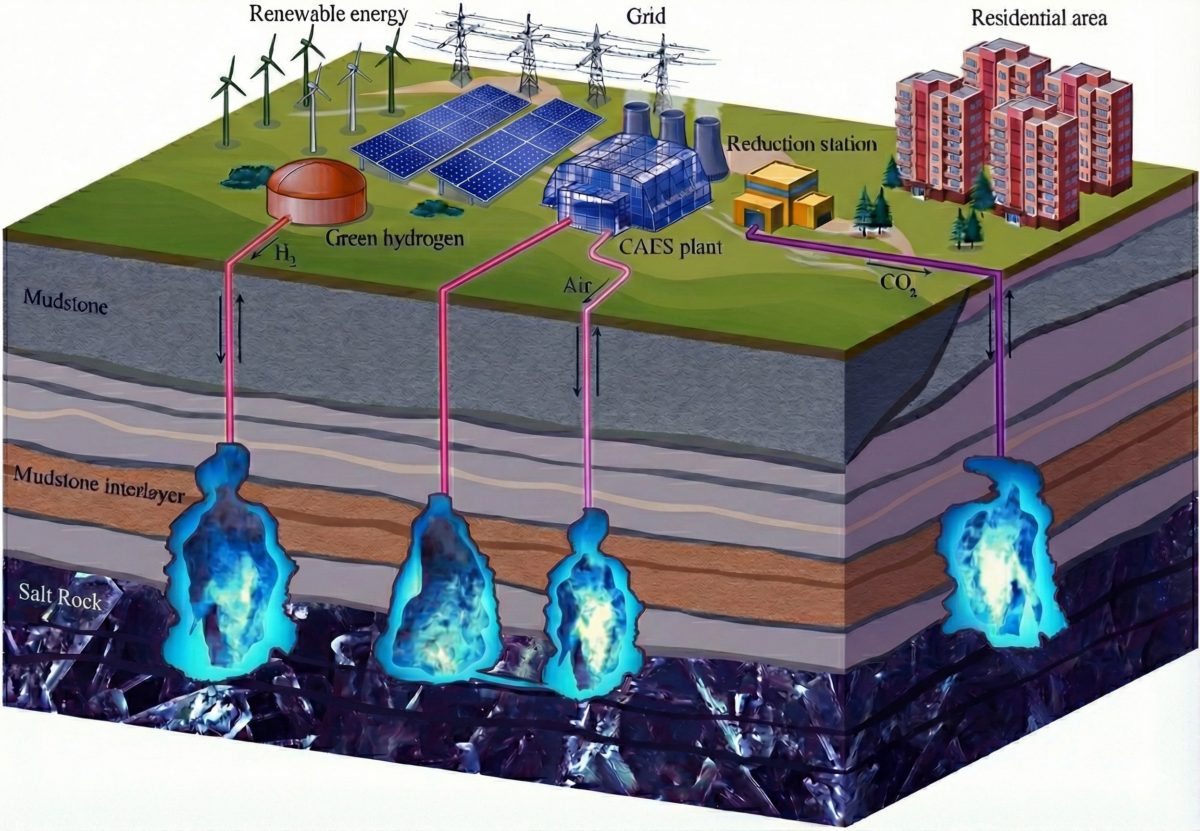
Researchers in China have investigated the long-term stability of horizontally connected salt caverns used for compressed air energy storage. They found that about 85% of existing salt caverns in their home country are suitable for this configuration.
A research group from China has investigated the long-term stability of using two-butted-well horizontal (TWH) located in low-grade, submerging salt layers for compressed air energy storage (CAES).
“According to statistical data, about 85% of existing salt caverns in China are composed of TWH,” the research team explains. “As salt cavern energy storage reservoirs expand, high-quality caverns with favorable geological conditions are becoming increasingly scarce. China is home to numerous TWH salt caverns with high sediment content, some of which reach up to 90% or are even completely buried. Therefore, research on low-grade TWH caverns with a sloping salt layer is of critical technical importance.”
The study is based on a simplified version of a TWH in Qianjiang city, located in the south-central region of Hubei province, China. The shape of the salt cave used for CAES was modeled as an ideal ellipsoid, with a length of 800 m, a width of 300 m and a thickness of 800 m. The radius of the major axis of the ellipsoid is 100 m, the radius of the minor axis is 40 m, the diameter of the connecting channel is 15 m and the height of the salt cavern is 200 m. The total thickness of the salt layers and intermediate layers amounts to 286 m, of which the salt layers make up 190 m.
Based on the characteristics of the Qianjiang Salt Mine, the academics examined the effects of burial depth at five different roof depths: 500 m, 800 m, 1,200 m, 1,600 m and 2,000 m. In addition, the group examined slope angles of 7.5°, 15°, 20°, 25° and 30°. The slope angle is the angle at which a rock layer is tilted relative to the horizontal. A greater slope angle means the layer is steeper, causing one side of a cavern to sit deeper and carry more weight than the other.
The CAES was simulated to operate for 30 years, with 8 hours of charging and 5 hours of discharging per day.
The group selected four evaluation criteria for the long-term stability of CAES salt caverns at different depths and angles: volume shrinkage rate (VSR), volume of plastic zone (PZV), maximum displacement of surrounding rock (Dis-Max), and safety factor (SF). VSR quantifies the relative loss of cavern volume over time due to salt creep, while PZV indicates the volume of surrounding rock that has undergone irreversible deformation. Dis-Max measures the maximum displacement of the surrounding rock at any point around the cave, while SF indicates the distance between the current stress state and the onset of failure in the salt.
“The results indicate that salt cavern VSR and Dis-Max increase exponentially with depth, with notable accelerated growth beyond 1,500 meters,” the team noted. “An increase in the formation dip angle worsens the asymmetry in the VSR and the displacement in the lower cave. For every 10° increase in the dip angle at 2000 m depth, the VSR and Dis-Max increase by 3.53% and 489 mm, respectively. The sediment body shows a significant buffering effect on the deformation of the surrounding rock, and the VSR is less affected by the dip angle.
In conclusion, they suggested that for deep salt caverns at depths of 1,500 m or more, priority should be given to controlling the slope angle to 20° or less, while for shallow salt caverns at depths less than 1,000 m, the allowable slope angle could be relaxed to 30°. They further stated that the study provides important reference guidelines for the construction of compressed air energy storage facilities in immersion salt layers widely spread across China.
Their findings appeared in “Stability evaluation of horizontally connected salt cavern energy storage with compressed air in low-grade immersion salt layers”, published in Earth Energy Sciences. Scientists from China’s Chongqing University, the SINOPEC Petroleum Exploration and Production Research Institute, the Key Laboratory of Unconventional Natural Gas Evaluation and Development in Complex Tectonic Areas of the Ministry of Natural Resources, and the Guizhou Engineering Research Institute of Oil & Gas Exploration and Development Engineering participated in the study.
This content is copyrighted and may not be reused. If you would like to collaborate with us and reuse some of our content, please contact: editors@pv-magazine.com.
