

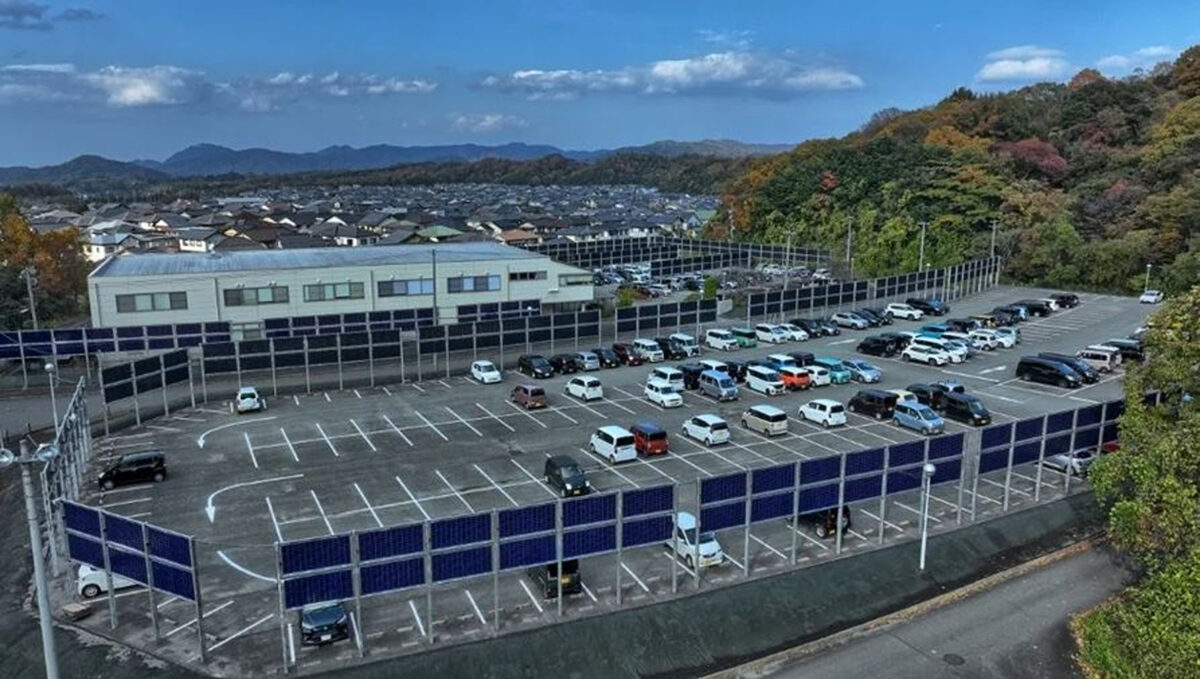
AirWater and Luxor Solar KK have launched a 178 kW vertical PV system in a Tottori car park, operating under an on-site PPA. The Verpa-based system, a first for the San’in region, maximizes space, avoids snow damage and is said to provide power equivalent to that of rooftop solar installations.
Japanese medical equipment supplier AirWater and Luxor Solar KK, the Japanese division of German solar panel manufacturer Luxor Solar GmbH, have announced the completion of a 178.5 kW vertical PV system on a parking lot owned by a Japanese telemarketing company JP Two-Way Contact Co., Ltd in Tottori, Chūgoku region in southern Japan.
The system, based on Luxor Solar’s proprietary Verpa design, includes vertical racks supplied by Germany’s Next2Sun and 525W bifacial heterojunction PV modules manufactured by Luxor Solar. It was commissioned on November 20 under an on-site power purchase agreement.
“All electricity generated by this system will be consumed by the center, which will cover approximately 25% of total energy consumption,” Luxor Solar said in a statement. “This is the first vertical solar energy generation system for parking lots in the San’in region and the largest in Japan.”
The company noted that the vertical configuration eliminates the risk of snow damage, requires minimal space and uses reflected and scattered light from the environment to generate power similar to rooftop systems.
“In addition, by installing the equipment more than 2 meters above ground level, the installation of protective fences, as required by the regulation of the Ministry of Economy, Trade and Industry (METI), is not necessary, allowing the land to be used for other purposes such as parking lots, material warehouses, walkways and green spaces,” the report said. “Verpa can be installed along property lines, in car parks, green spaces or along walkways, as long as there is a 2.5 m wide space.
Air Water recently announced that it plans to deploy Verpa systems totaling 1.3 MW in 14 of its facilities and approximately 10 MW in other locations in Japan by 2026.
Additionally, it said it is currently in development Verpa-Mova, a portable version of the system being tested in Nagano Prefecture. “This product has a laid type that does not require pile foundations, making it easy to install in locations where installation was previously difficult, such as on artificial ground or concrete structures,” the company said, without providing further details.
This content is copyrighted and may not be reused. If you would like to collaborate with us and reuse some of our content, please contact: editors@pv-magazine.com.
