

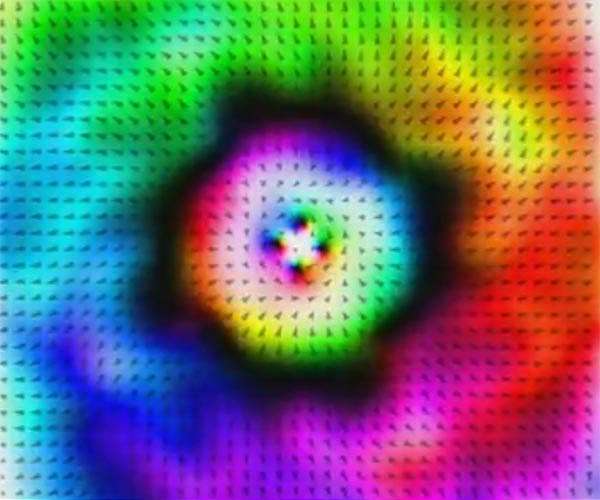
Vortex structures discovered in solar cell and lighting materials
Metal halide perovskites have developed rapidly over the past decade, showing superior performance over silicon in converting light into electrical current.
Simulations on TACC’s Frontera and Lonestar6 supercomputers have revealed unexpected vortex structures in quasiparticles called polarons, which play a role in generating electricity from sunlight.
This discovery is poised to help scientists develop new solar cells and environmentally friendly LED lighting, which is seen as a sustainable technology for future lighting.
“We discovered that electrons form localized, narrow wave packets, known as polarons. These ‘clumps of charge’ – the quasiparticle polarons – provide perovskites with special properties,” says Feliciano Giustino, professor of physics and WA ‘Tex’ Moncrief , Jr. chair of Quantum Materials Engineering in the College of Natural Sciences and core faculty of the Oden Institute for Computational Engineering and Sciences (Oden Institute) at UT Austin.
Giustino co-authored the study on polarons in halide perovskites, published in March 2024 in the Proceedings of the National Academy of Sciences.
“These polarons show very intriguing patterns. The atoms rotate around the electron, forming vortices that have never been observed before,” says Giustino, also director of the Oden Institute’s Center for Quantum Materials Engineering.
The vortex structures of polarons can help keep electrons in an excited state, a state achieved when a photon of light collides with the atomic bonds.
“We suspect that this strange vortex structure prevents the electron from returning to the unexcited energy level,” Giustino explains. “This vortex is a protected topological structure in the halide-perovskite lattice material that stays in place for a long time and allows the electrons to flow without losing energy.”
Perovskite structures have been known for more than a century since Gustav Rose discovered calcium titanium oxide perovskite CaTiO3 in 1839. More recently, in 2012, Giustino worked with Henry Snaith’s group at the University of Oxford, discovering halide perovskites, where halogens replace oxygen and form salts with metals. .
“It turns out that halide perovskites in solar cells exhibit exceptional energy conversion efficiency,” Giustino said.
Compared to silicon’s peak efficiency of about 25 percent, achieved after 70 years of development, halide perovskites achieved this efficiency in just 10 years.
“This is a revolutionary material,” said Giustino. “That explains why many research groups working on solar photovoltaics have switched to perovskites, as they show promise. Our contribution has looked at the fundamentals using computational methods to delve into the properties of these compounds at the level of individual atoms.”
For the research, Giustino used resources on the Lonestar6 and Frontera supercomputers awarded by the Texas Advanced Computing Center (TACC) and the U.S. Department of Energy (DOE) supercomputers at the National Energy Research Scientific Computing Center (NERSC).
“This research is part of a project sponsored by the Ministry of Energy and which has been running for several years with the support of TACC and in particular Frontera, where we have developed methodologies to study how electrons interact with the underlying atomic lattice, said Giustino. .
Giustino noted that studying large polarons in halide perovskites required simulation cells of about half a million atoms, a task unmanageable with standard methods.
To perform these calculations, Giustino and his collaborators in Austin and beyond developed EPW, an open-source Fortran and message-passing interface code that calculates properties related to electron-phonon interactions. This code, developed through an international collaboration led by Giustino, specializes in investigating how electrons interact with vibrations in the lattice, causing polaron formation.
“Our collaboration with TACC involves more than just the use of advanced computing resources,” said Giustino. “The most important part is interacting with the people. They have been essential in helping us profile the code and ensure we avoid bottlenecks by applying profiling tools that help us study the performance degradations. Much of the work that goes into the EPW code is done in collaboration with TACC experts who help us improve the scaling of the code to get optimal performance on the supercomputers.”
Giustino’s polaron research is part of TACC’s Characteristic Science Applications (CSA) program, funded by the National Science Foundation (NSF). About a dozen CSA projects will influence the design of the NSF Leadership-Class Computing Facility, Horizon, being developed at TACC.
“The CSA work between my group and TACC to optimize the EPW code allows us to push the boundaries of what can be explored in understanding and discovering new, important materials. It is a combination of theory, algorithms and high-performance computing with a lot back and working with our colleagues at TACC to ensure that we use the supercomputers in the most feasible way,” said Giustino.
Another possible application is the development of ferroelectric memory devices, which could lead to more compact computer memory. In these devices, information is encoded by the vibration of atoms in a crystal under an applied electric field.
“Investments in high-performance computing and future computing are essential for science,” Giustino concluded. “It requires major investments, such as those that maintain and expand facilities like TACC.”
Research report:Topological polarons in halide perovskites
