
Close Menu
  • News
  • Industry
  • Solar Panels
  • Commercial
  • Residential
  • Finance
  • Technology
  • Carbon Credit
  • More
    • Policy
    • Energy Storage
    • Utility
    • Cummunity
What's Hot

Fraunhofer ISE develops colored film technology for patterned solar panels

April 23, 2026

Thermoacoustic heat pumps are on the verge of commercial breakthrough – SPE

April 23, 2026

The federal court has halted Trump administration orders that hinder solar and wind energy development

April 23, 2026
Facebook X (Twitter) Instagram
Solar Energy News
Thursday, April 23
  • News
  • Industry
  • Solar Panels
  • Commercial
  • Residential
  • Finance
  • Technology
  • Carbon Credit
  • More
    • Policy
    • Energy Storage
    • Utility
    • Cummunity
Solar Energy News
Home - Solar Industry - What happens if a fire breaks out? PV systems on sloping roofs
Solar Industry

What happens if a fire breaks out? PV systems on sloping roofs

solarenergyBy solarenergyDecember 14, 2024No Comments4 Mins Read
Facebook Twitter Pinterest LinkedIn Tumblr Email
Share
Facebook Twitter LinkedIn Pinterest Email

An international research team has observed how fire spreads in PV systems installed on flat roofs and discovered that a certain amount of energy is required for a fire to start and spread in the cavity under the solar panels .

December 9, 2024
Emiliano Bellini

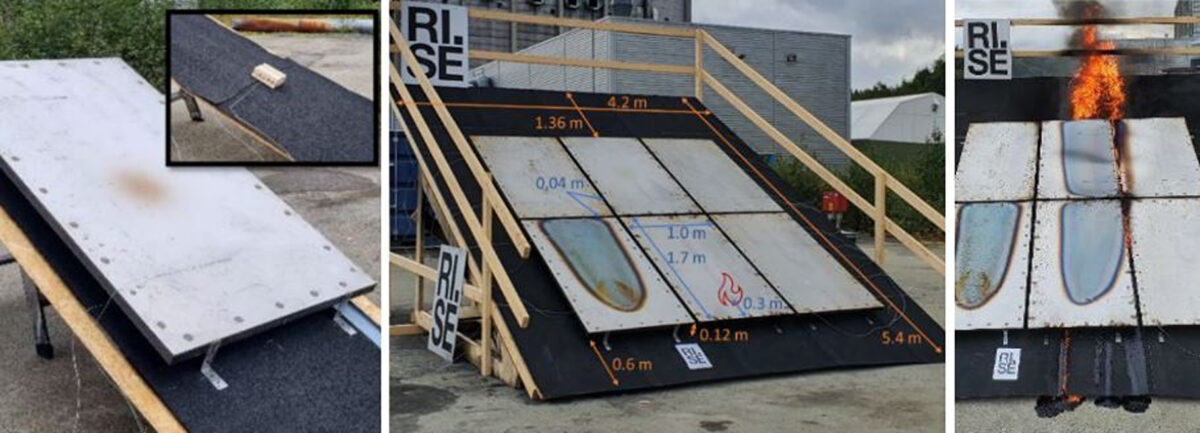
A Slovenian-Norwegian research group has investigated how fire can spread in flat roof PV systems and found that the gap distance between the panels and the roofs, as well as the size of the ignition source, are key factors.

“Our work builds on previous knowledge from experiments at Underwriters Laboratories (UL) more than a decade ago,” said the study’s lead author. Reidar Stolen, told pv magazine. “The main difference from their work is that we placed the ignition source under the PV modules to represent a fire caused by an electrical fault in the PV installation. The UL experiments studied larger external fires spreading to the PV on sloped roofs.”

The research group showed that a certain amount of energy is required for a fire to start and spread in the cavity under a PV installation. “This means that if the energy is released during an electrical fault and as a result of the ignition of nearby materials, the fire will not propagate.” Stolen went on to say. “The amount of energy required depends on the geometry, such as the cavity distance, but also on the materials in the cavity.”

The researchers varied the distance between the holes, but used the same slope and materials in all tests at different scales. In the experimental setting they used PV modules made of steel, without cabling or other material being placed in the cavity, and a bituminous roof membrane over a substrate of wood chipboard with a slope of 30 degrees. “Other structures will certainly require a different minimum initiating energy to start a propagating fire,” Stolen specified.

See also  Flexibility options are a central concept for research of highly renewable energy systems - PV Magazine International

With the available fuel load, the burning time per roof section was limited to approximately 20 minutes. According to the research team, the roof construction with a 22 mm chipboard had sufficient fire resistance to prevent fire from spreading to the attic. “This shows that a very robust construction is not needed to keep the fire outside the building.” Stolen said. “However, with more fuel in the structure, the fire duration and fire resistance should be longer.”

The scientists also observed another mechanism of fire spread via molten and burning bitumen. “Compared to previous research on flat roofs, we saw the same kind of effects with the cavity distance,” Stolen added. “The main difference would be that with the sloping roof we experienced much faster flame spread, because the plume was driven up the roof slope by the buoyancy. In the experiments with flat roofs, the fire spread in all directions and was more influenced by the wind.”

Their findings are available in the study “Experimental research into fire propagation on a sloping roof with photovoltaic solar energy used in construction”, published in the Journal of Physics. The research group consisted of academics from Norway’s RISE Fire Research AS and the Slovenian National Institute of Construction and Civil Engineering (ZAG).

The latter recently conducted a series of tests to assess the fire safety parameters of vertical rooftop PV systems and discovered that these installations offer better parameters compared to conventional roof arrays. The former conducted a series of experiments showing that the distance between solar panels and roof surfaces could be a crucial factor in fires in PV systems..

See also  T.Werk unveils new mounting systems for agrivoltaic systems

This content is copyrighted and may not be reused. If you would like to collaborate with us and reuse some of our content, please contact: editors@pv-magazine.com.

Popular content

Source link

breaks Fire roofs sloping systems
Share. Facebook Twitter Pinterest LinkedIn Tumblr Email
solarenergy
  • Website

Related Posts

Fraunhofer ISE develops colored film technology for patterned solar panels

April 23, 2026

Inside PV Manufacturing: Belga Solar’s module factory in Belgium

April 23, 2026

No evidence that PFAS leaks from solar panels, research shows

April 22, 2026
Leave A Reply Cancel Reply

Don't Miss
Policy

Storms In April, Eastern American radiation cuts like northwestern increases – PV Magazine International

By solarenergyMay 2, 20250

In a new weekly update for PV -MagazineSolcast, a DNV company, reports that strong jet…

Spontaneous glass breakage on solar panels is increasing

June 24, 2024

Leasing models could help German solar installers cope with falling panel prices

July 25, 2024

Specially designed ligands provide durable perovskite solar cells with high efficiency

January 14, 2026
Stay In Touch
  • Facebook
  • Twitter
  • Pinterest
  • Instagram
  • YouTube
  • Vimeo
Our Picks

Fraunhofer ISE develops colored film technology for patterned solar panels

April 23, 2026

Thermoacoustic heat pumps are on the verge of commercial breakthrough – SPE

April 23, 2026

The federal court has halted Trump administration orders that hinder solar and wind energy development

April 23, 2026

Zendure launches battery ranges for residential PV – SPE

April 23, 2026
Our Picks

Fraunhofer ISE develops colored film technology for patterned solar panels

April 23, 2026

Thermoacoustic heat pumps are on the verge of commercial breakthrough – SPE

April 23, 2026

The federal court has halted Trump administration orders that hinder solar and wind energy development

April 23, 2026
About
About

Stay updated with the latest in solar energy. Discover innovations, trends, policies, and market insights driving the future of sustainable power worldwide.

Subscribe to Updates

Get the latest creative news and updates about Solar industry directly in your inbox!

Facebook X (Twitter) Instagram Pinterest
  • Contact
  • Privacy Policy
  • Terms & Conditions
© 2026 Tsolarenergynews.co - All rights reserved.

Type above and press Enter to search. Press Esc to cancel.