

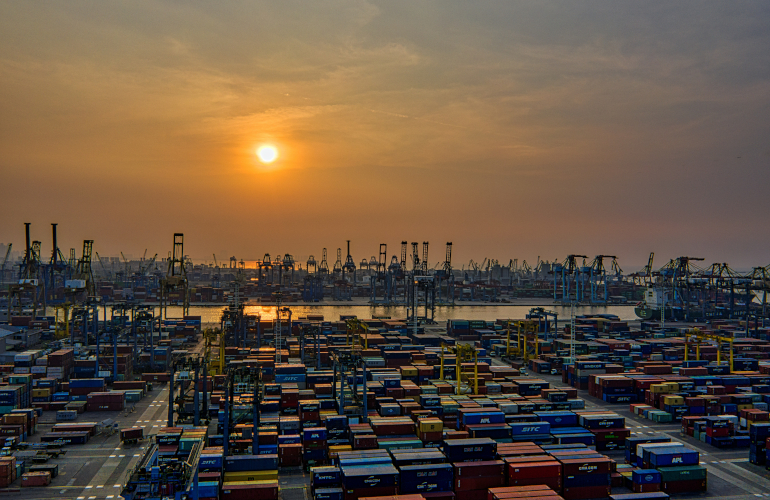
In recent years, the United States has seen a significant increase in foreign companies setting up manufacturing operations within its borders, especially in the solar and battery industries. A key enabler of this trend is the strategic use of foreign trade zones (FTZs). These zones offer numerous benefits and incentives that make them attractive to foreign manufacturers looking to locate in the United States, spurring growth and innovation in the clean energy sector while boosting local economies.
Check out our story about solar companies working in FTZs here.
 FTZs are explicitly selected, geographic areas within a country that are treated as if they are outside the “customs territory” to be used on behalf of companies that want to import materials, use U.S. labor for manufacturing and assembly, and then export those finished products . These zones offer significant benefits to companies engaged in international trade.
The first FTZs emerged in the 1930s when the United States passed the Foreign Trade Zone Act of 1934 (FTZA). After the sharp economic downturn the United States faced due to the Great Depression, the new law establishing free trade zones was written to increase and restore American competitiveness. In the beginning, free trade zones allowed American companies to defer or, in the case of exports of finished goods, eliminate customs duties on imported goods until they entered the domestic market.
Since the FTZA’s initial passage, Congress has expanded foreign trade zone authorities, and today FTZs exist in every U.S. state and vary in size, ranging from single buildings, such as warehouses and industrial parks, to areas encompassing entire counties . FTZs have also expanded in capabilities and scope from their original form and can now support a variety of industries including manufacturing, logistics and technology. These expansions now offer a range of benefits to businesses and corporations and raise the more important question: “What can happen within a free zone?”
- FTZs allow companies to import, store, process and re-export goods without immediate customs intervention.
- Companies can delay or even avoid customs duties and taxes until the imported goods reach the domestic market. In addition, products that are imported and then used in the manufacture of finished products for export may be exempt from all forms of import duties or taxes, as long as the imported or finished product does not enter U.S. markets or supply chains.
- Streamlined customs procedures in free zones reduce administrative burdens and speed up the movement of goods across borders.
Additionally, FTZs offer several other benefits:
Logistical efficiency: Because U.S. FTZs must be located near seaports, airports, or major transportation hubs, FTZs provide easy access to global markets, improving overall logistics efficiency and potentially reducing transportation costs for companies.
Inventory management: FTZs serve as inventory management hubs, enabling just-in-time deliveries to quickly meet customer demands, resulting in shorter lead times and faster transactions that positively impact trade between countries.
Global Business Excellence: Free trade zones typically improve cross-border logistics operations, resulting in improvements in cost-effectiveness, regulatory compliance and overall efficiency in the global marketplace.
From a global perspective, it is critical to recognize and understand that free trade areas, although created by the US, are no longer just an American tool. Other countries have now also established successful FTZ programs to boost their economic growth and international trade. Countries with a global trading relationship, including China, Singapore and the United Arab Emirates (UAE), have developed extensive FTZ networks that have led to success in attracting multinational companies and facilitating their own cross-border trade.
China has set up numerous FTZs in crucial logistics cities such as Guangzhou, Shanghai and Shenzhen. Singapore offers a strategic location at the intersections of major shipping and trade corridors and has become a key destination for companies looking to expand their presence in the Asia-Pacific region. In the Middle East, the UAE has also taken advantage of its strategic location and developed “world-class” FTZs in Jebel Ali and Dubai. These zones serve as important hubs for trade, logistics and manufacturing, attracting investment from multinational companies and encouraging economic diversification.
Although FTZs are a very American concept, their benefit to international trade and supply chains is both relevant and crucial to the successful import and export of manufactured goods. What are the conclusions regarding the activities and use of an FTZ for a US company?
- Tax exemption and deferral:
- Goods stored or processed within a free zone are not immediately subject to customs duties.
- Companies can postpone or even cancel customs payments until (and if) the goods enter the domestic market.
- This flexibility improves cash flow and reduces upfront costs, making products more competitive globally.
- Streamlined customs procedures:
- Free trade zones usually have efficient customs processes, which keep administrative burdens to a minimum.
- Faster customs clearance times for incoming and outgoing shipments lead to cost savings.
- Improved supply chain management improves overall efficiency.
- Logistical efficiency:
- FTZs are strategically located near ports, airports or major transportation hubs.
- Easy access to global markets reduces transportation costs for companies.
- Just-in-time delivery becomes feasible, allowing customer requirements to be met quickly.
- Customs compliance and security:
- FTZ operators adhere to strict customs regulations and security protocols.
- Goods within the zone maintain their integrity, reducing the risk of trade-related disruptions.
- Supply chain security is a priority.
- Promotion of economic development:
- Free trade zones attract foreign investment and promote innovation and growth.
- Employment opportunities arise in the host regions as a result of trade, production and distribution activities.
- They serve as vital hubs for local economic prosperity.
The most important thing to understand is that free trade zones are not a zone where we have to stop paying taxes, but are a tool designed by the federal government to stimulate trade and domestic production by providing financial benefits, streamlined processes and growth opportunities. offer. They incentivize companies to manufacture products in the United States specifically for export by eliminating the duties and tariffs that would normally be due on the materials imported from non-domestic sources. For companies planning to sell into the US market, the delay in payment of duties and tariffs until the sale of that product in the domestic market allows the company to use those funds elsewhere until the point of sale.
Countries continue to use and increase the number of free trade zones as they are a proven driver of economic development. American companies must seize the opportunities presented by these unique economic tools to unlock their full potential in both domestic and global markets.
 Jason Knapp, a retired Navy officer with a military career spanning more than 20 years and more than 15 years of government relations experience, leads strategic advocacy to advance the interests of the renewable energy sector as Director of Government Relations at Clean Energy Associates (CEA). energy sector at federal, provincial and local levels.
