

For centuries, leadership has been framed through a narrow, male-coded lens: rational over emotional, authoritative over collaborative, detached over empathetic. These binary concepts are deeply rooted in Western philosophy. For example, Aristotle positioned women as more ’emotional’, less capable of rational decision-making and therefore unsuitable for public leadership. Although outdated, these ideas still linger in workplace expectations today, creating stereotypes about how women “should” behave and what leadership “should” look like.
In a rapidly transforming energy sector that requires innovation, collaboration, resilience and adaptability, these inherited narratives no longer serve us. Rewriting the leadership narrative is not only necessary; it’s urgent. At the Women in Solar+ Europe – WiSEu Network workshop in Madrid during the Genera trade show, women from the solar and storage sectors came together to reflect on stereotypes, leadership experiences and the personal and collective work needed to change the culture.
The group investigated how inherited assumptions shape women’s self-image. “The stereotypes that have the most impact are the ones we carry within ourselves,” explains Sarah Albert, director of sustainability at NextPower, pointing to the internal work needed to redefine how leadership is understood: “Mindset determines how we act, how we show up, how we lead,” and unlearning these old stories must start from within.
This theme was echoed in discussions about stereotypical labels. Zoraida Bejarano, Head of Talent at NextEnergy Group, emphasized how the word “emotional” sparked a lively debate, noting that “some members thought it was negative, but others said it’s actually a good thing to be emotional and empathetic.” She added that stereotypes such as perfectionism, often misinterpreted as micromanagement, “could instead be approached as a strategic viewpoint,” with dedication and high standards reframed as professional strengths.
Recognizing this ability to reframe properties was central to the considerations of Carolina Nester, Head of Operations, Iberia at Sonnedix. For her group, qualities often attributed to women, including empathy, inclusivity and emotional intelligence, need to be embraced. “These are not negative words,” she said. “These are quite positive, and this makes our leadership different and necessary.” Her insight captured the transformative power of possessing characteristics traditionally undervalued in leadership conversations.
Another important element of the dialogue was self-confidence. Lucía Dólera explained how many women “work every day to get better” and often “put a lot of effort… to get things done,” but still struggle with “imposter syndrome” after achievements. She described how women sometimes ask others if they are ready for a role, even when they know they are prepared, and recognize that younger generations do not face these internal barriers: “Being our own best friend, recognizing our potential and accepting that learning comes from failure was a powerful message.”
The group also thought about how to respond when confronted with dismissive or gendered comments. Carmen Guadalupe Martin said women are often labeled as “unstable” or “too emotional” but tend to freeze and remain silent. Her group agreed that this silence needed to be broken. “We have to act in that situation,” she said, reminding others that “what you are saying is not fair.” She noted that speaking out is a critical part of rewriting the leadership narrative in real time.
These conversations naturally transitioned into a discussion about how such reflections contribute to the broader leadership discourse. Sarah Albert emphasized that inclusive leadership starts with inner work: “Only when we have self-awareness about our own position can we enrich our leadership to become truly inclusive.” She reminded the group that inclusivity starts with “self-love, self-respect, and self-care,” all of which strengthen a leader’s ability to empower others.
Zoraida Bejarano further underlined the importance of seeing leadership as a human quality, and not as a gendered quality. “We discovered that it is not about women or men,” she said. “It’s more about the person.” She described how participants had experienced excellent male leaders and challenged female leaders, allowing stereotypes to obscure individual realities. Her group also talked about the importance of vulnerability, and she recalled a moment when men joined the conversation and encouraged women “to invite them to become a little more human and emotional,” illustrating the reciprocal nature of inclusive leadership.
Carolina Nester reflected on how these insights help clarify the role of leaders in shaping culture. “These concepts are important to shape our thoughts and understand what we can do together,” she said, emphasizing the need to model the behavior we want to see and to help teams “believe what they can do on their own.” For her, leadership is as much about guiding others as it is about understanding one’s own influence.
Lucía Dólera contributed a complementary perspective on the evolution of leadership. She noted that leadership used to be seen “as a male position,” but is now clearly rooted in human qualities. A good leader, she explained, “must take soft skills… and turn them into hard skills,” which means identifying strengths within the team and helping people grow. She added that the combination of masculine and feminine qualities, “when we are more sensitive and they are more analytical,” creates the balance needed to achieve goals.
Finally, Carmen reflected on the sense of empowerment felt in the room. “We learned and grew,” she said, describing the workshop as “a step further in our professional development.” Her words captured the spirit of the day: growing through shared experiences, challenging outdated narratives and collectively shaping a new understanding of leadership, one that values emotional intelligence, authenticity, empathy and courage.
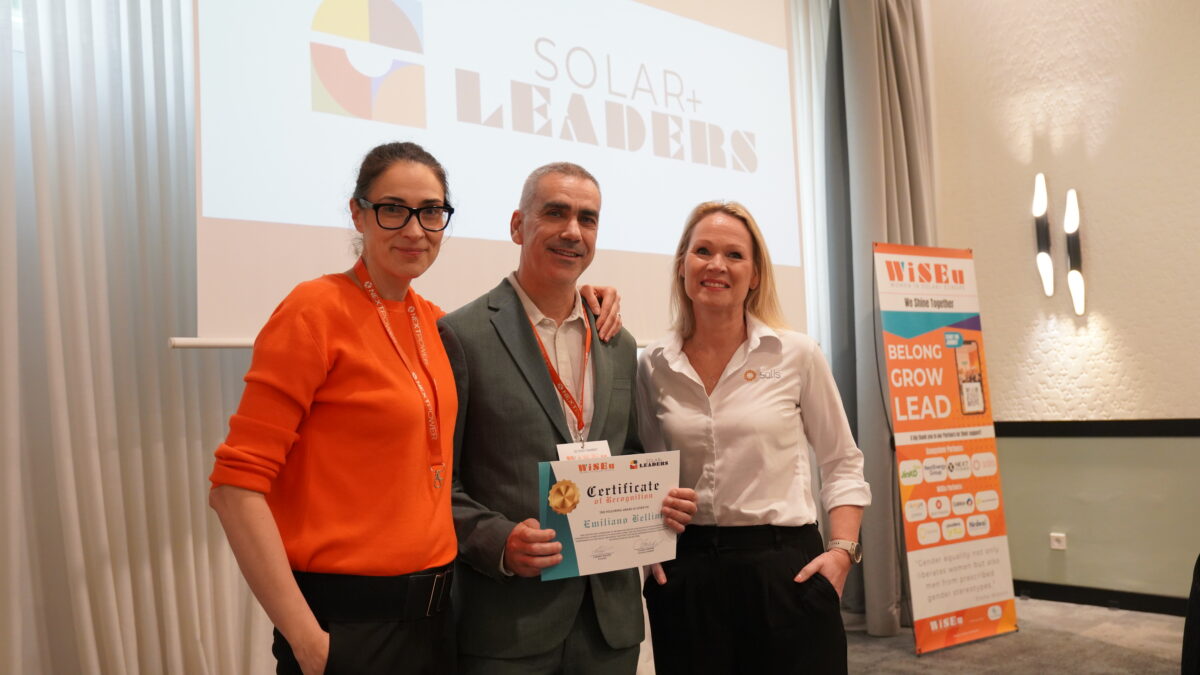
The event also provided a moment to recognize Emiliano Bellini pv magazine for their crucial role in reshaping the conversation about leadership. By consistently elevating diverse voices and highlighting the experiences that shape today’s workplaces, they provide a crucial platform for industry-wide learning about equality, diversity and inclusion. This partnership not only supports women, but also invites men to actively participate in these conversations, recognizing that inclusive leadership is a growth opportunity for everyone. When men engage, listen and contribute, the entire sector benefits, fostering a culture where new perspectives emerge and all professionals can develop stronger, more people-oriented ways of leading.
Image: Women in Solar+ Europe
Through these conversations, the WiSEu workshop during Genera in Madrid demonstrated that rewriting the leadership narrative is not an abstract work; it happens with every mindset shift, every stereotype reframed, and every moment a woman chooses to speak and lead on her own terms. And as men increasingly join these dialogues, joining women in listening, learning, and challenging outdated assumptions, the transformation will become deeper and more lasting, ensuring that leadership evolves as a shared effort rather than a lonely struggle.
Interested in participating female market leaders and experts at Women in Solar+ Europe? More information: www.wiseu.network
The views and opinions expressed in this article are those of the author and do not necessarily reflect those of the author pv magazine.
This content is copyrighted and may not be reused. If you would like to collaborate with us and reuse some of our content, please contact: editors@pv-magazine.com.
Popular content

