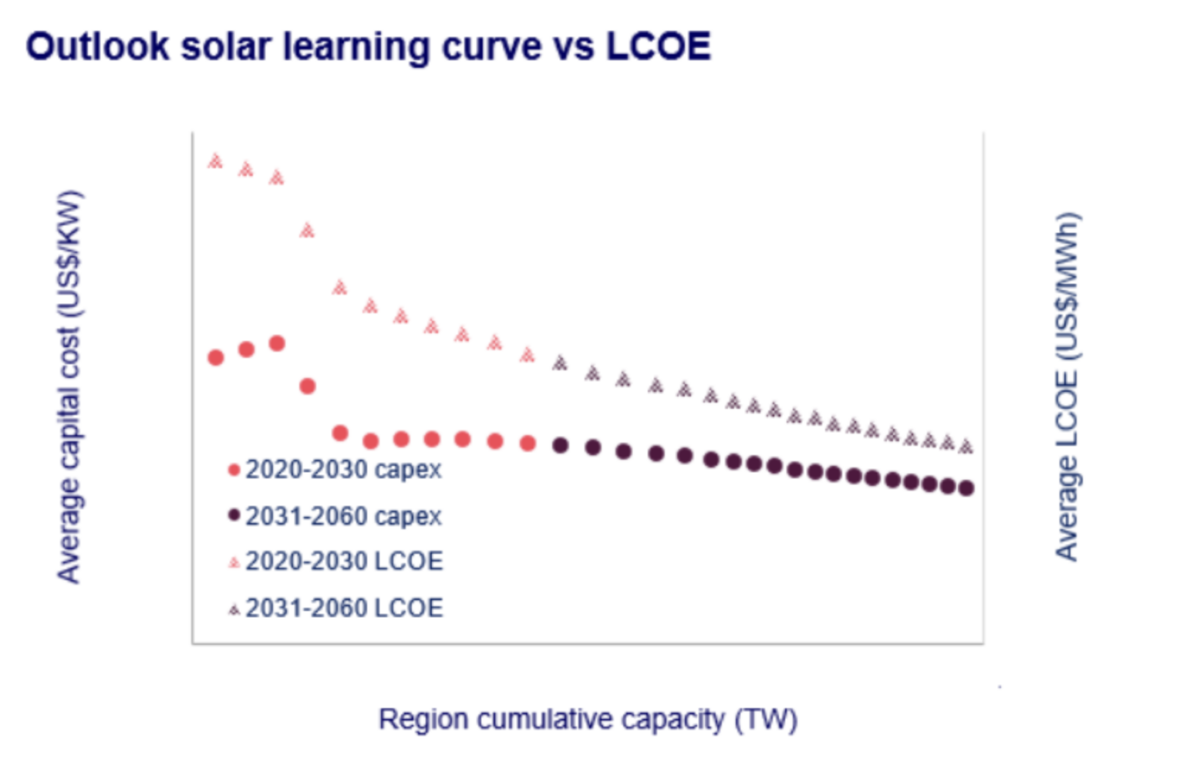
Researchers at Wood Mackenzie say single-axis PV offers the lowest utility-scale generation costs globally, with efficiency gains and stable supply chains expected to reduce the levelized cost of electricity (LCOE) of solar.
According to analysis by Wood Mackenzie, solar energy will maintain its position as the most cost-competitive energy generation source in the world until 2025.
The consultancy’s latest work assesses the LCOE for renewables in Europe, North America, Latin America, the Asia Pacific and the Middle East and Africa (MENA).
It found that single-axis tracker systems in the MENA region were the most cost-competitive energy generation source at $37/MWh. Wood Mackenzie said utility-scale solar continues to maintain its position as a price driver in the MENA region, with single-axis tracker technology consistently outperforming onshore wind. By 2060, PV costs for single-axis trackers are expected to converge to approximately $17/MWh.
The analysts added that tracker and fixed-tilt PV technologies will remain more cost-effective than onshore wind energy in the MENA region throughout the outlook period. Meanwhile, the cost of large-scale battery storage is expected to fall significantly, with average off-the-shelf prices in Saudi Arabia and the UAE expected to fall by 7% to 9% by 2034.
In Europe, LCOE from renewables fell 7% in 2025, while capital costs fell 8% from the 2020 to 2024 average. Utility-scale solar PV with single-axis tracking currently offers Europe’s lowest average LCOE, according to Wood Mackenzie, with declining module prices contributing 10% of the cost savings from 2024.
Wood Mackenzie said the LCOE of commercially distributed PV in Europe could fall by 49% by 2060 from current levels. Meanwhile, utility-scale battery storage costs are expected to fall below $100/MWh by 2026, before falling another 35% by 2060.
Commercial solar currently has the lowest average LCOE in all of Latin America, with single-axis PV delivering the most competitive utility-scale generation costs in 2025. The lowest prices are found in the region’s more mature markets, including Brazil, Chile and Mexico. According to Wood Mackenzie’s forecasts, LCOE for storage across Latin America is currently expected to decline by 24% by 2060.
In the Asia Pacific, utility-scale solar delivers the lowest generation costs across the region, with an LCOE of $27/MWh in China to $118/MWh in Japan. China also currently achieves the lowest storage LCOE in the world, which Wood Mackenzie attributes to intense competition between suppliers.
The analysts also said that while new U.S. tariffs have increased capital costs for solar in the United States in the short term, advancing solar panel, inverter and tracker technologies will drive price reductions in the long term.
Amhed Jameel Abdullah, senior research analyst at Wood Mackenzie, added that technological improvements, supply chain optimization and economies of scale will contribute to continued cost reductions for renewables, strengthening their position as the dominant energy generation technology globally.
“Our LCOE 2025 analysis shows that solar and onshore wind have become the dominant low-cost options globally, while hybrid systems and battery storage are rapidly closing the competitiveness gap,” Abdullah concluded.
This content is copyrighted and may not be reused. If you would like to collaborate with us and reuse some of our content, please contact: editors@pv-magazine.com.
Popular content