
Close Menu
  • News
  • Industry
  • Solar Panels
  • Commercial
  • Residential
  • Finance
  • Technology
  • Carbon Credit
  • More
    • Policy
    • Energy Storage
    • Utility
    • Cummunity
What's Hot

Tesla launches three-phase Powerwall 3P – SPE

April 23, 2026

Why the UK solar industry needs to own its safety story

April 23, 2026

Fraunhofer ISE develops colored film technology for patterned solar panels

April 23, 2026
Facebook X (Twitter) Instagram
Solar Energy News
Thursday, April 23
  • News
  • Industry
  • Solar Panels
  • Commercial
  • Residential
  • Finance
  • Technology
  • Carbon Credit
  • More
    • Policy
    • Energy Storage
    • Utility
    • Cummunity
Solar Energy News
Home - Solar Industry - Inverted perovskite solar cell based on self-assembled bilayer achieves an efficiency of 26.08%
Solar Industry

Inverted perovskite solar cell based on self-assembled bilayer achieves an efficiency of 26.08%

solarenergyBy solarenergyJanuary 14, 2025No Comments3 Mins Read
Facebook Twitter Pinterest LinkedIn Tumblr Email
Share
Facebook Twitter LinkedIn Pinterest Email

The proposed bilayer is used as a hole contact material that provides improved adhesive contact with the perovskite film. It consists of a self-assembling monolayer of phosphonic acid with an upper layer made of an organic compound known as triphenylamine.

January 14, 2025
Emiliano Bellini

Scientists from Xi’an Jiaotong University have fabricated an inverted perovskite solar cell that uses a self-assembled bilayer (SAB) as a hole-selective molecular contact.

Inverted perovskite cells have a device structure known as “pin”, where hole-selective contact p is at the bottom of the intrinsic perovskite layer “i” with electron transport layer n at the top. Conventional halide perovskite cells have the same structure, but in reverse: a ‘nip’ arrangement. In a nip architecture, the solar cell is illuminated via the electron transport layer (ETL) side; in the pin structure, it is illuminated by the hole transport surface (HTL).

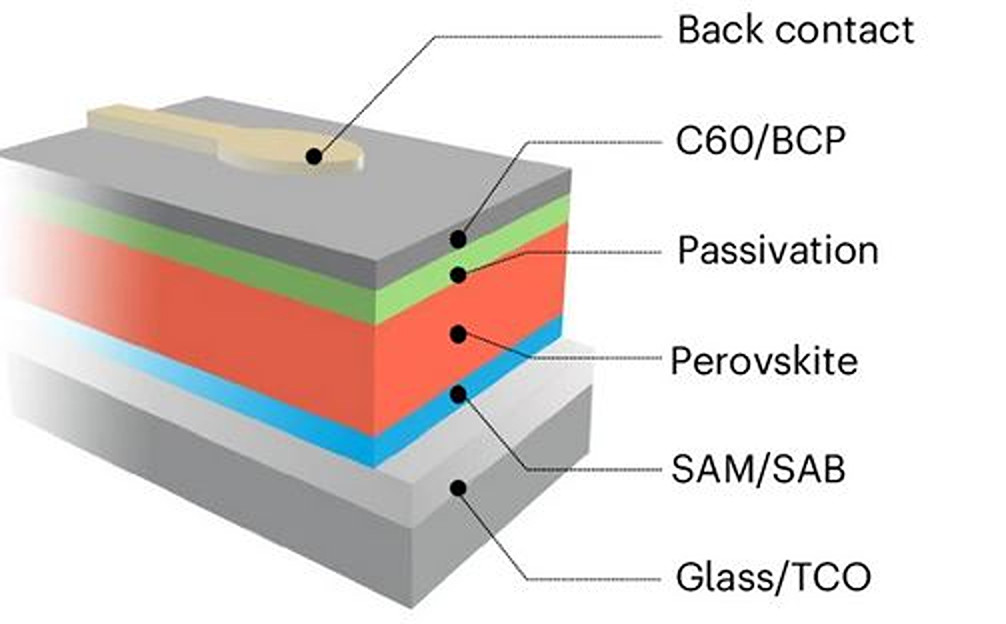
The proposed SAB consists of a self-assembling monolayer (SAM) of phosphonic acid with an upper layer made of an organic compound known as triphenylamine, which is intended to improve the adhesive contact with the perovskite film compared to a conventional SAM-perovskite interface. It also improves the thermal and mechanical robustness of the interface.

“SABs represent a basic form of self-assembled multilayers, consisting of separate monolayers with different constituents – interconnected via covalent or ionic bonds,” the researchers explained. “This layer-by-layer assembly stabilizes the labile monolayer by introducing rigid components and allows control over the termination of the film.”

The team built the cell with a substrate of glass and transparent conductive oxides (TCOs)the proposed double layer, the perovskite absorber, An ETL based on buckminsterfullerene (C60), a bathocuproin (BCP) buffer layer and a silver (Ag) metal contact.

See also  The scoop for solar policy: September 2024

The cell was tested under standard lighting conditions and found to achieve an energy conversion efficiency of 26.04%, an open-circuit voltage of 1.185 V and a short-circuit current density of 26.27 mA cm3.2and a fill factor of 83.84%. The cell was also able to maintain approximately 94% of its initial efficiency after 2000 hours of moist heat testing at 85°C.

“Notably, the best SAB device showed a relative efficiency loss of less than 4% over 2,000 hours, which is in line with the industry benchmark of a 5% loss over 1,000 hours for silicon photovoltaics,” the academics said, citing they noted that the result, which has been certified by the China National Accreditation Service, is among the most efficient inverted perovskite devices built to date.

The details of the cell technology can be found in the article “Self-assembled bilayer for perovskite solar cells with improved tolerance to thermal stresses”, published in nnatural energy.

This content is copyrighted and may not be reused. If you would like to collaborate with us and reuse some of our content, please contact: editors@pv-magazine.com.

Popular content

Source link

achieves based bilayer cell efficiency Inverted perovskite selfassembled solar
Share. Facebook Twitter Pinterest LinkedIn Tumblr Email
solarenergy
  • Website

Related Posts

Why the UK solar industry needs to own its safety story

April 23, 2026

Fraunhofer ISE develops colored film technology for patterned solar panels

April 23, 2026

The federal court has halted Trump administration orders that hinder solar and wind energy development

April 23, 2026
Leave A Reply Cancel Reply

Don't Miss
Technology

IRENA says $554 billion invested in solar technologies by 2024 – SPE

By solarenergyNovember 18, 20250

The International Renewable Energy Agency (IRENA) says solar is the only renewable energy technology where…

Comstock Metals approved as a licensed solar panel recycler in California

February 23, 2026

The global PV outlook is clouded by policy shifts and Chinese export risks

October 15, 2025

Indian Loom Solar unveils 261 kWh BESS for C&I applications – SPE

February 4, 2026
Stay In Touch
  • Facebook
  • Twitter
  • Pinterest
  • Instagram
  • YouTube
  • Vimeo
Our Picks

Tesla launches three-phase Powerwall 3P – SPE

April 23, 2026

Why the UK solar industry needs to own its safety story

April 23, 2026

Fraunhofer ISE develops colored film technology for patterned solar panels

April 23, 2026

Thermoacoustic heat pumps are on the verge of commercial breakthrough – SPE

April 23, 2026
Our Picks

Tesla launches three-phase Powerwall 3P – SPE

April 23, 2026

Why the UK solar industry needs to own its safety story

April 23, 2026

Fraunhofer ISE develops colored film technology for patterned solar panels

April 23, 2026
About
About

Stay updated with the latest in solar energy. Discover innovations, trends, policies, and market insights driving the future of sustainable power worldwide.

Subscribe to Updates

Get the latest creative news and updates about Solar industry directly in your inbox!

Facebook X (Twitter) Instagram Pinterest
  • Contact
  • Privacy Policy
  • Terms & Conditions
© 2026 Tsolarenergynews.co - All rights reserved.

Type above and press Enter to search. Press Esc to cancel.