

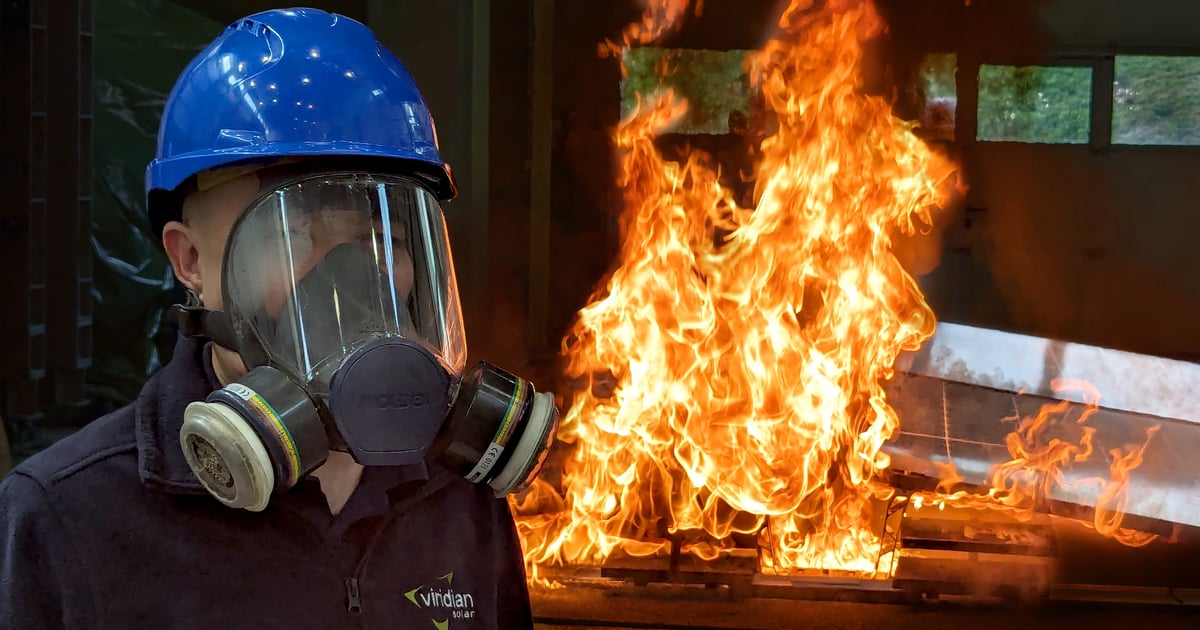
In this blog, Viridian Solar’s KT Tan examines the fire safety data gap in the UK solar sector and introduces BRE’s PV-FIN research project, which addresses outdated evidence.
The solar PV industry is currently experiencing a flurry of activity – a common feature of a fast-growing sector – but a clear theme is beginning to emerge.
Recognizing the crucial role of solar PV in achieving energy security and decarbonising the economy, the UK Government recently announced the Future Homes Standard, which makes solar PV mandatory for all new-build homes. At the same time, a revision of Approved Document B was launched to refine the fire safety requirements for these installations.
In anticipation of these changes, several initiatives have attempted to support the safe deployment of solar technology. The Building Safety Regulator commissioned the HSE to carry out experimental fire research, and the Department for Leveling Up, Housing and Communities (DLUHC) published a fire safety report written by OFR Consultants.
However, these efforts have limitations: the former relied on a limited number of experiments, while the latter mainly involved an academic literature review.
While this increased focus on fire safety is welcome, we must ask: how applicable is this research to the current state of PV fire in Britain? Both reports refer to the BREs Fire and solar PV systems report, a study now based on decade-old data. In the intervening years, technology and installation practices have evolved significantly.
We need to determine whether the industry’s historic response to that report has improved safety statistics, whether the quality of the UK workforce has matured and whether new risk mitigation products have effectively reduced risks. Are we making decisions for 2026 based on the reality of 2015?
Having served on various BSI, IEC and MCS committees, I have seen first-hand the efforts to address fire safety at national and international levels. But despite anecdotal feedback and some spectacular social media posts, we still lack the robust, contemporary data needed to accurately measure our progress.
PV-FIN: A new approach
To address this data gap, the BRE has launched a groundbreaking research project. This project builds on past lessons and includes expert input from trade organizations, insurance programs, fire professionals and leading manufacturers, collectively known as the PV Fire Intelligence Network (PV-FIN).
While PV-FIN continues to focus on UK-specific data, it employs a more comprehensive methodology than previous studies. Rather than investigating fire incidents in a “post-mortem” analysis, the scope has been expanded to include work practices and “near misses.”
Guided by the principle that ‘prevention is better than cure’, this proactive approach aims to identify and mitigate risks at their source, ensuring maximum impact on fire safety through targeted efforts. The sector will move from reactive crisis management to proactive risk mitigation.
PV-FIN is launching a national survey to gather these essential insights. Stakeholders are encouraged to confidentially report their experiences in three key areas:
-
Work Practices: General installation and maintenance trends across the industry.
-
Near misses: events that could have led to a fire, but were intercepted.
-
Fire incidents: detailed reports of all fire events related to solar energy.
The survey will remain open until July 30, 2026.
Why your input matters
This national survey is more than a data collection; it is an opportunity for the industry to self-regulate and lead from the front.
This project is not intended to cause alarm or confusion. Instead, the goal is to identify trends and understand failure mechanisms. By doing this, the industry can put fire risks into perspective and ensure that future industry actions remain proportionate and effective.
Your participation will directly shape the future of solar energy policy. The resulting statistics and recommendations will form the scientific basis for the way our sector deals with risks in the coming years.
The PV industry currently faces a paradox: fire risk receives significant attention from regulators, but there is a distinct lack of contemporary evidence to guide that attention.
As we deal with the challenges of the energy transition, many external factors remain beyond our control. However, the fire safety of our installations is a shared responsibility and our joint efforts can directly determine the outcome. By participating in this research, you will help the industry understand the problem so that together we can build a safer, more resilient solar future.
The data we collect today will form the basis of the policies we pursue tomorrow.
About the author
Dr. KT Tan is Technical Director at Viridian Solar, a UK-based manufacturer of roof-integrated solar panels. With a PhD in Engineering from the University of Cambridge, he is an expert in solar technology, specializing in areas such as roof integrated systems and advanced cell technologies.
