The TOPCon solar cells are manufactured with screen-printed, fire-through copper rear contacts and silver front contacts, using laser-enhanced contact optimization (LECO) to significantly reduce contact resistance. Optimized copper cells achieved 24.3% efficiency, comparable to Ag contact cells, with excellent stability.
A research team in the United States has fabricated TOPCon solar cells with screen-printed, fire-transmitting copper (Cu) contact on the back and a silver (Ag)-contacted boron emitter on the front via the laser-enhanced contact optimization (LECO) process.
The LECO process consists of using a very intense laser pulse at the front of the solar cell with a constant reverse voltage of more than 10 V, where the resulting current of several amperes significantly reduces the contact resistance between semiconductor and metal electrode.
“In this work, we show that the LECO treatment is highly effective in enabling screen-printed burn-through Cu contacts with n-TOPCon on the backside of a TOPCon cell,” the scientists explained. “We used a unique screen-printable, fire-penetrating Cu paste from Bert Thin Films, Inc. (BTF) that helps inhibit Cu diffusion by forming a thin Cu oxide around the Cu particles.”
Bert Thin Films launched its new copper paste in February, as reported by pv magazine. According to the manufacturer, the new paste can be screen printed and air baked, and can also be co-baked with commercial silver pastes for front metallization.
The cells were fabricated using standard 242.32 cm² n-type wafers that underwent saw damage, surface texturing and cleaning. TOPCon precursors were formed with a boron-diffused emitter passivated by an aluminum oxide/silicon nitride (Al₂O₃/SiNx) layer on the front, and a full-surface TOPCon stack on the back. Ag paste was screen printed on the front with 135 grid lines and baked at 700 C. Cu paste was then applied to the back and baked at a lower temperature of 500-600 C to prevent copper migration.
“All the tools and processes we used in this study are already used in the PV industry,” said corresponding author Young Woo Ok pv magazine. “All that is required is to replace the Ag paste with the Cu paste. The process can be a plug-and-play alternative to Ag contacts in production.”
The LECO treatment was performed with varying reverse voltages to improve cell performance. Fully silver contacted cells were prepared as a reference. Electrical properties, including metal-induced recombination current density and contact resistance, were characterized using the transfer length method (TLM) and electroluminescence (EL) imaging.
Image: Georgia Institute of Technology, Solar Energy and Solar Cell Materials, CC BY 4.0
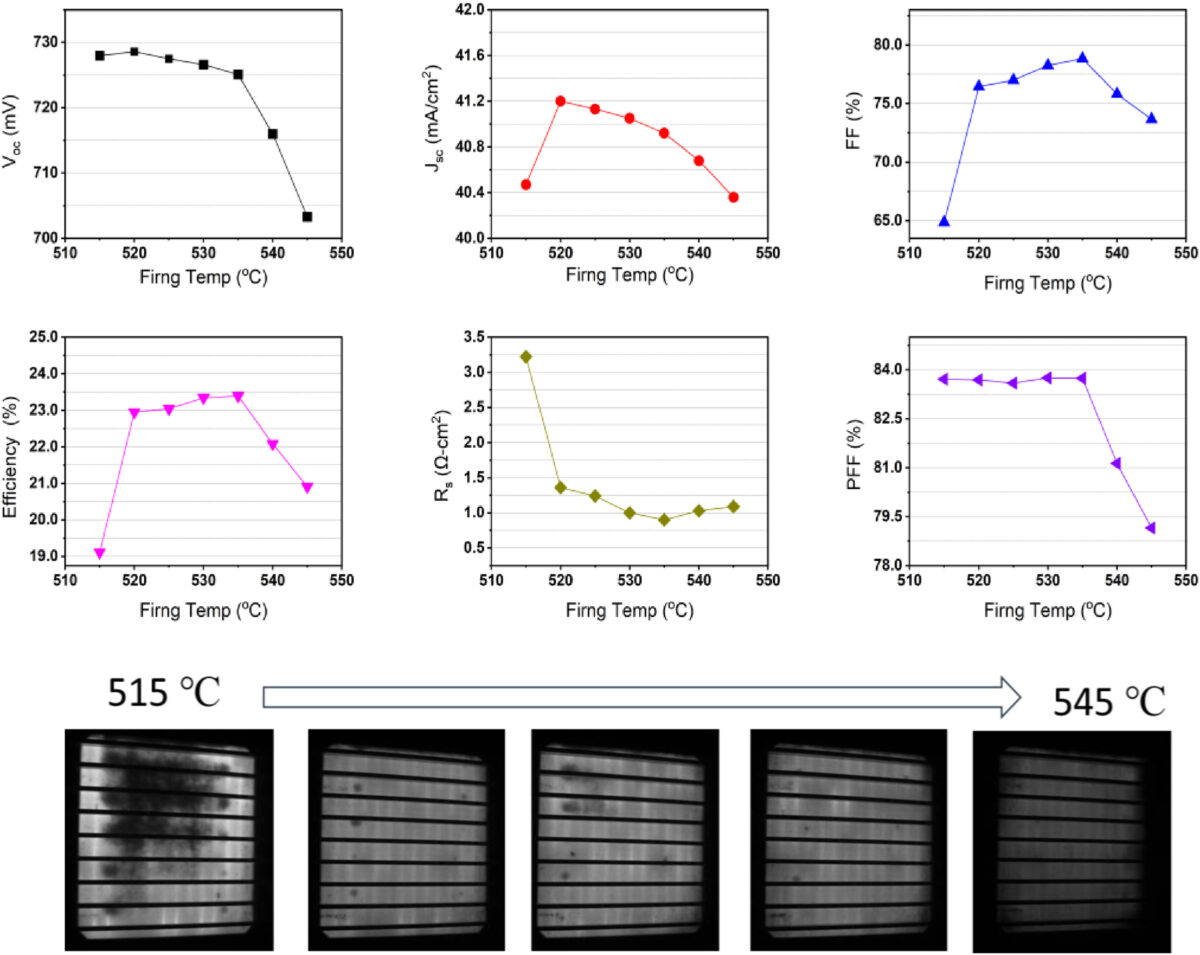
The researchers systematically optimized Cu printing and baking parameters, including screen design, baking temperature, belt speed and LECO settings. Cells fired at 500-550 C were found to achieve a stable open-circuit voltage and pseudo-fill factor up to 530 C, with degradation occurring at higher temperatures due to copper diffusion into the tunnel oxide. Moreover, the short-circuit current density was found to decrease slightly at higher temperatures, while the fill factor peaked around 530-535 C due to reduced series resistance (Rs). EL imaging confirmed improved contact quality when firing at 535 C, eliminating dark areas caused by poor contacts.
The LECO treatment is optimized for cells fired at 530 C, with reverse voltages of 17–19 V providing the best balance between Rs and pseudo-fill factor. The contact resistance decreased from approximately 300 mΩ·cm² to approximately 10 mΩ·cm² after LECO, indicating improved Cu contacts on the back side, while the laser power had minimal effect. Microstructural analysis showed increased Cu colloids and crystallites confined to the poly-Si layer, improving the contact properties without deteriorating the pseudo-fill factor and open-circuit voltage.
Comparisons with Ag-contacted cells revealed that the Cu-contacted cells achieved similar open-circuit voltage and pseudo-fill factor, with slightly lower short-circuit current and fill factor. Optimized Cu cells achieved an efficiency of 24.3%, only 0.2-0.3% lower than Ag-contacted cells. The contact resistance for Cu was higher than for Ag, but could be mitigated by increasing the back contact coverage. Stability tests under thermal stress at 200 C in nitrogen also showed negligible changes in open-circuit voltage and pseudo-fill factor over 1000 hours, reportedly demonstrating the reliability of Cu contacts.
“Such high-efficiency screen-printed Cu-contacted n-TOPCon cells offer a unique opportunity to replace very expensive Ag contacts on n-TOPCon with cheaper screen-printable Cu metal pastes,” the scientists pointed out.
The new cell concept was presented in “>24% screen printed Cu contacted n-TOPCon solar cells with successful implementation of LECO process”, published in Solar energy materials and solar cells. The research team included academics from the US Department of Energy’s National Laboratory of the Rockies, the Georgia Institute of Technology and US-based copper paste specialist Bert Thin Films Inc.
This content is copyrighted and may not be reused. If you would like to collaborate with us and reuse some of our content, please contact: editors@pv-magazine.com.
Popular content