


Solar photovoltaic (PV) power is becoming an increasingly prevalent energy source in the UK. In 2025, 6.3% of Great Britain’s power was supplied through solar, a 30% rise on 2024, and as of May 2026, over 22 GW of solar capacity has been installed around the UK. This capacity is spread between fields that house larger farms and over 1 million rooftops. While there’s a lot of focus on the panels themselves, each one relies on a solar PV inverter that converts the power generated into usable output for household appliances and for distribution to the grid.
Understanding solar PV inverters: Technology and UK market overview
A solar PV inverter is a critical part of any solar panel setup. No matter if solar panels are installed on a roof or in a large-scale farm, solar PV inverters are required to convert the direct current (DC) electricity generated by the panels into alternating current (AC). The conversion process is required because both the grid and household appliances run on AC; without a solar PV inverter, the power generated by solar panels wouldn’t be usable. In installations that contain battery storage systems, the inverter also manages and optimises the storing and discharging of the energy in and out of the battery.
Alongside this critical function, solar PV inverters bring a lot of other benefits to solar installations. The overall efficiency and power output of an installed PV system is significantly influenced by the quality and efficiency of the inverter. So, an efficient solar PV inverter benefits the installation and generation potential, but the opposite is also true if the wrong inverter is chosen. This is why it’s important to choose the right one―but more on that later.
The solar PV inverter is also responsible for communicating with the national grid, enabling energy from an installation to be exported to the grid, and many inverters have built-in anti-islanding safety features that protect the home and the grid during power outages. While not applicable to all inverters, some of the latest inverters maximise power output using maximum power point tracking (MPPT) algorithms and will track the performance (and give feedback) over time using advanced monitoring technology.
While these are the key features of any solar PV inverter, there are many different types which are suitable for different energy harvesting scenarios in the UK.
String inverter
String inverters are the most common type of solar PV inverter. In these systems, a number of solar panels are connected in series (known as a string) to a single inverter. String inverters work best when all panels are aligned and have the same power rating. For this reason, string inverters are commonly used in residential settings and are best utilised on open rooftops with minimal shading and consistent sun exposure.
While the need for uniformity can somewhat be restrictive, a lot of modern string inverters contain multiple MPPTs that allow different strings to be connected with different characteristics. String inverters are the cheapest option for UK homeowners, and can be easily mounted onto walls, but the major downside is that if one panel is disrupted (due to shading, for example, such as debris on the panel or an obstruction of the sun), it affects the performance of the entire string of panels. Because they require consistent sun and no shading, they are best installed on south-facing roofs in the UK.
Below is a list of some of the key advantages and disadvantages of string inverters:
Microinverter
Microinverters are another popular choice for residential PV systems in the UK, but they are more expensive than string inverters. These solar PV inverters are ideal for UK households that have solar installations which are likely to have a high/regular level of shading―be it from external obstructions, debris or a chimney casting shadows on some of the panels, depending on the position of the sun. This can include historic towns that have old buildings with complex and irregular roofs (multiple angles and chimney stack and dormer style houses).
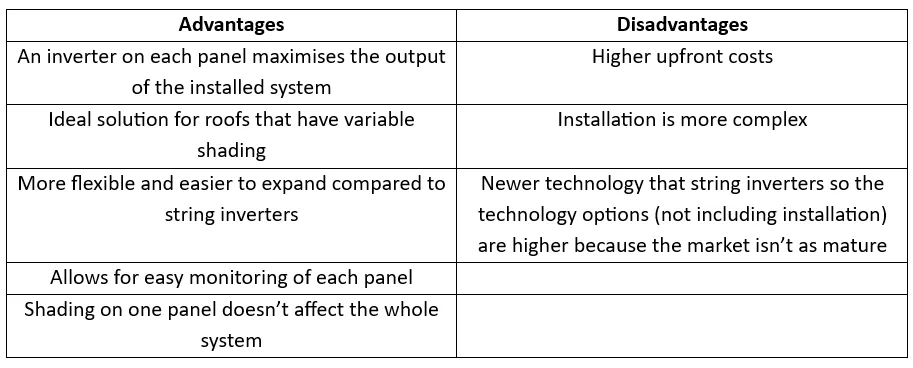
Unlike string inverters, microinverters are installed on individual panels, so if a shadow is cast on a panel, it affects that panel only and not the whole solar installation. The rest of the panels perform normally, unlike string inverters. Because a solar PV inverter is installed on each panel, the installation is more expensive. However, microinverters can improve the overall energy yield over time compared to string inverters, as the performance drop due to shading in string inverters can have a large cumulative effect over time. Because they are installed on each panel, the overall installation has a lot more flexibility and can be used on more complex roof layouts (such as complex angles) compared to string inverters. Unlike string inverters, each individual panel can also be monitored.
Below are the main advantages and disadvantages of microinverters:
Hybrid inverters
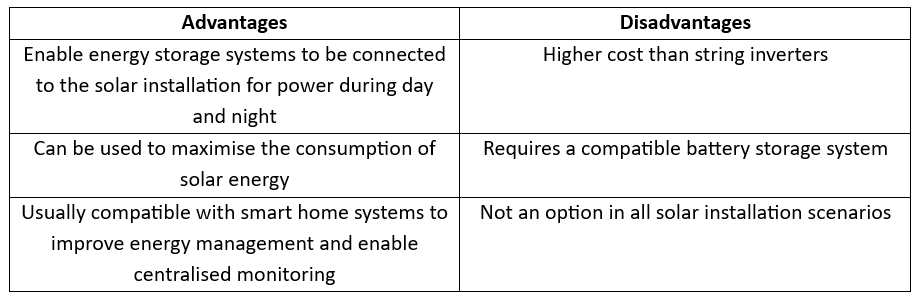
Hybrid inverters are solar PV inverter systems that handle solar conversion and battery management in one unit. These are ideal for systems with battery backup as they enable a seamless switch between solar generation, battery storage, and grid power. Hybrid inverters still convert DC electricity generated from the panels into AC electricity for use in the home, but they can also switch to store surplus power into battery systems, as well as send excess energy back to the grid.
Hybrid inverters are becoming more common in UK households seeking some level of energy resilience in the event of grid outages. Installing a hybrid inverter with the dual functionality of AC-DC conversion and battery management can be a cheaper option for households who are looking to install battery capacity (either at the point of installation or later down the line) than it is to retrofit an AC coupled battery to an existing installation. Hybrid inverters are ideal for those planning to install any level of battery storage, those looking for energy independence, and they are more widely used in South England on south-facing roofs (with no shading) as they benefit the most from longer bouts of sunshine.
Here are some of the main advantages and disadvantages of hybrid inverters:
Power optimisers
Power optimisers are not technically solar PV inverters; they are a DC-DC converter that improves the performance of solar installations. A power optimiser is added to a panel to monitor and adjust the voltage and current to ensure it operates at its maximum power point (MPP) — the point at which the panel produces the most electricity.
Power optimisers are added to each panel and use MPPT (the same as you get in string inverters, but for each panel rather than the whole string) to optimise the DC voltage before it passes through the solar PV inverter and is converted to AC. The AC conversion is handled by a string inverter. Using a power optimiser is cheaper than installing microinverters but improves the efficiency of solar panels installed on houses that experience shading. They are useful in the same situations as microinverters because the output of each individual panel can be optimised. These installation situations include shaded houses, complex roofs, and the northern reaches of the UK with greater cloud cover. They are also useful for installations that require a balance between cost-efficiency and panel-level optimisation.
Smart inverters
A lot of solar PV inverters today are smart inverters that provide advanced real-time monitoring features and self-diagnostic capabilities. These monitoring features provide data-driven insights and the ability to optimise the conversion process, leading to improved energy efficiency, enhanced grid stability, and the ability to produce maximum energy under different harvesting conditions.
Smart inverters contain a range of advanced technological features that include MPPT algorithms, real-time system performance updates via apps, the ability to better stabilise the grid over traditional inverters through smarter management of voltage fluctuations and reactive power, the ability to work with battery storage systems and smart home systems, and self-healing capabilities that identify and fix minor issues to reduce inverter downtime and reduce service costs.
Central inverters
Central inverters are non-residential inverters and are used in large-scale commercial systems. They are used on commercial solar farms to centralise the power in one place. Central inverters are used on commercial solar installations above 5 MW, as small-scale commercial installations below this tend to benefit more from string inverters.
These inverters range from 100kW to 4MW. On larger scales, central inverters are a much more cost-effective solution because fewer inverters are required per installation site. For example, a 20MW solar farm will only use 5-10 central inverters, whereas several hundred string inverters might be needed for the same installation. However, with central inverters, if an inverter goes down, many more panels will be out of action than with a string inverter, so they have to be used in the right installations. Central inverters are also a lot more expensive to replace than string inverters, and fixing/troubleshooting them is more specialist than repairing and replacing string inverters.
Solar PV inverter cost UK: 2026 pricing and ROI analysis
Solar PV inverter cost varies a lot depending on the type and quality of the inverter. The inverter itself accounts for 8-15% of the total cost of a solar PV inverter installation. Other cost factors involved include the installation itself, whether power optimisers are used, and whether export limiting is installed in the system. On average, solar PV inverter costs for string inverter installations range from £500-£2600, microinverter installations range from £600-£3900, while hybrid inverter installations range from £1100-£3200. Here we look at how these differ based on pricing data collected by Solar Panels Funded.
String inverters

Table 1: Comparing the average solar PV string inverter cost against string inverter installation cost.

Table 2: Comparing string inverter quality and cost.

Table 3: Comparing different total installation costs of string inverter qualities against inverter efficiency and warranties.
Microinverters

Table 4: Comparing average microinverter cost against microinverter installation cost.

Table 5: Comparing Total installation cost against string inverter installation.
Hybrid inverters

Table 6: Comparing average hybrid inverter unit cost against hybrid inverter installation cost.

Table 7: Comparing Total installation cost against string inverter installation.

Table 8: Comparing Total installation cost against microinverter installation.

Table 9: Comparing All 3 average total installation costs.
Other cost factors to consider
While the above tables compare the different inverter units and their installation costs, other factors need to be considered for the overall cost. There are some differences depending on the installation. The above figures cover the average installation, but additional complexity will incur more costs. For example, ground floor installations average £200-£400 (£400-£700 for hybrid inverters due to the extra wiring and configuration time), but loft installations with restricted spaces could add an extra £100-£200 on top. Tall properties (3 stories or more) that require scaffolding for the installation will also incur extra costs of £300-£500 because of the extra equipment required.
Other costs include an extra £300-800 if upgrading a unit that lacks capacity for AC connections, whereas district network operator (DNO) G99 applications will add £150-£300 to the total cost for systems above 3.68kW. This is to cover administrative and electrical certification costs. On the components side, adding power optimisers to the installation will add £40-£150 per panel to the total cost, while the need for export limitation will add 10% extra cost to a domestic system and 5% to a commercial system. Oversizing and undersizing the inverter against the panel capacity can also affect the overall installation cost. Oversizing by 10-20% can save up to £100-300 in equipment costs and opens the system to being expanded in the future. Undersized inverters can save £200-£400 upfront, but it limits peak production on sunny days, making them less efficient over time.
Considerations for Smart Export Guarantee
Alongside the solar PV inverter cost, owners can maximise Smart Export Guarantee (SEG) payments with smart inverters that are optimised for export, because these advanced control features can maximise payment eligibility while preventing grid saturation. Homes with inverters that are focused on exports can earn up to £400 annually and pay back the inverter cost in as little as three years (depending on the inverter and export income), but often anywhere between three and six years.
The SEG is a government scheme that requires large energy suppliers to pay small scale generators when they send energy back to the grid. Suppliers need to be on an SEG tariff with an energy company and have 5MW or less of installed solar capacity that is Microgeneration Certification Scheme (MCS) certified. Owners of these installations also need to have a smart meter installed.
The top SEG tariffs are from Octopus Energy, provided you are with them for solar export and energy supply and have a solar battery, with tariff rates of 21-29p/kWh. For those without a battery but with the same company for solar export and energy supply, the top tariffs are Ecotricity’s Smart Export Tariff (16 p/kWh), British Gas’ Export and Earn Plus (15.1p/kWh), EDF’s Export 12m (15p/kWh), Good Energy’s Solar Savings (15p/kWh), and E.ON Next’s Export Exclusive (13p/kWh). For owners looking to export without having an energy supply with the same company, the SEG rates are much lower, but the top ones in this category include E.ON Next’s Export (6p/kWh), Scottish Power’s SmartGen (6p/kWh), Pozitive Energy’s SEG tariff (5p/kWh), So Energy’s So Export Flex (4.5p/kwh), and Octopus’ SEG Tariff (4.1p/kWh).
UK solar inverter compliance: G98, G99 and MCS requirements
Any solar PV inverter installed in UK solar systems must meet specific standards (depending on the type) to be safe for use. The three main compliance requirements for any grid-tied inverter installed in the UK are:
G98
G98 is a regulation that governs small-scale renewable energy systems under 3.68kW. It outlines specific requirements for inverter compliance, alongside ensuring that the solar system is properly integrated to the grid, adheres to the correct technical standards, and has undergone the necessary testing to ensure system reliability. These regulations ensure that small-scale solar systems are safe to connect to DNO networks for exporting electricity to the grid while maintaining grid stability. For inverters under 3.68kW, DNO permission doesn’t need to be obtained in advance; it can be obtained retroactively.
G99
G99 regulations are similar to G98 in that they dictate the technical requirements for connecting a solar installation to grid. However, the difference is that the G99 is for larger inverter systems above 3.68kW.
Unlike the G98, DNO permission does need to be applied for beforehand, and it can take up to 3 months for the permission to be granted. If permission is not granted, then export limitation can be used instead to reduce exported power. Batteries on larger scale systems can also complicate the permission process, because the backup supply also needs DNO permission in these systems.
MCS certification
MCS certification is required for exporting energy back to the grid via an energy supplier through SEG payments. MCS certificates are issued after an eligible solar installation has been completed by an MCS-certified installer and it is evident that the system has been installed in line with the UK Microgeneration Certification Scheme standards. For the certification, roof suitability, inverter sizing, cable routes, protection devices, expected return on investment (ROI), and generation expectations are all assessed.
Export limitation
Export limitation helps to keep the grid safe from being overloaded (and energy bottlenecks occurring) when too much localised energy is tried to push through the distribution and transmission networks. Solar PV systems are usually matched to the demand of the property they are installed at with excess energy flowing into the grid. However, there are cases―especially commercial systems―where the generated electricity is hardly used (such as on a weekend for some businesses) but the excess energy generated is far too much to send all of it to the grid without destabilising local infrastructure. On the other hand, some residential properties may have very high energy requirements (such as those with heat pumps) and install larger-than-average systems. To stop too much energy being sold back to the grid, DNOs can put export limitations on these residential dwellings and commercial properties to protect the grid during pea generation scenarios.
In these cases, and if there is no backup storage in the form of a battery, export limitation in the inverter can be implemented if the electricity surpasses a threshold, and any excess energy is lost. This prevents some of the electricity reaching the gird, protecting it in the process. The majority of solar PV inverters sold today have in-built export limitation functionality, so the only main requirement is to install a smart meter that can help to better manage the flow of energy and adjust the power output accordingly.
Anti-islanding capabilities of inverters
Keeping solar installations, households, and the grid safe is a key part of inverter function that is facilitated by anti-islanding protection. When the grid fails, all grid-connected inverters are legally required to shut down within milliseconds to protect the grid and households. Anti-islanding is mandated by G98/G99 regulation in the UK and is a critical safety mechanism for any solar PV inverter system that is connected to the grid.
Anti-islanding protection is enabled by an inverter with Emergency Power Supply (EPS) functionality. If an inverter doesn’t have this, once the grid fails and the inverter detects a loss of grid voltage (below 207V or above 253V) or frequency (below 47.5Hz and above 52Hz), anti-islanding activates and the inverter shuts down. Batteries sit idle and the house has no power until the grid is up and running again.
If an inverter has EPS, once the anti-islanding disconnects the inverter from the grid, the EPS circuit activates, and the inverter enters island mode. In island mode, the solar PV circuits become physically isolated from the grid (no electrical path back to the grid), and the inverter becomes a grid-forming device that creates its own 230V 50Hz AC supply from the stored charge inside any backup batteries. This enables any battery to power protected/backup circuits and solar panels can continue to charge the battery.
For most solar PV installations, EPS is sufficient to keep the system and household appliances safe, and the functionalities are often included in the inverter capabilities. However, if the system/house has devices or appliances that require true zero-interruption power (as there is a 20ms delay before the EPS kicks in), then an extra uninterruptible power supply (UPS) can be installed. They are also more common in data centres and hospitals. These don’t come as standard and cost an extra £200–£500 to protect a few critical devices (but whole household is a lot more expensive). UPS ensures that there is zero switchover time during grid failure by ensuring that power is always flowing through the battery.
Selecting the right solar inverter for UK Projects
Choosing the right solar PV inverter for UK installations involves many factors. One of the main considerations is matching up how much power your panels produce and choosing an appropriate inverter. For example, a 5kW solar installation should have a 5kW inverter. However, it doesn’t necessarily always need to be an exact match, as energy loss from the panels mean that you don’t get the full stated capacity.
So, for the majority of installations, the inverter size, as a rule of thumb, should be between 80-100% of the total panel capacity. In regularly cloudy environments, like many parts of the UK, installing an inverter slightly below the panel capacity can be a benefit because the inverter will work closer to its operational ‘sweet spot’ and be more efficient. However, if there are plans to upgrade the size of the solar installation in the future, installing a bigger solar PV inverter upfront can save time and money without needing to upgrade it down the line. If the inverter is too big to start with, though, it may not work on days with low energy harvesting because they take more power to start up than smaller inverters.
The other main factor is what type of inverter you need: string inverter, microinverter or a hybrid inverter. The two major considerations are budget and the environment in which the solar installation is located (roof type, shading, etc.). String inverters are the cheaper option, are good for larger installations and houses that get a lot of sun and minimal shading. Microinverters are more expensive because they’re installed on each panel, but they are the ideal solution (if budget allows) for complex roofs and roofs that get a lot of shade. For anyone looking to install battery storage alongside a solar installation (which is another consideration that needs to be decided), then hybrid inverters are the best option, but like microinverters, they are on the more expensive end.
Outside these key considerations, a number of other considerations should be factored into the decision-making process. These include:
-
Deciding if you want inverters with advanced technology features, such as Bluetooth, Wi-Fi, smart energy management, or app monitoring capabilities
-
Ensuring that you choose a compliant inverter for the UK, including either being G98 or G99 compliant
-
Deciding on whether you plan to sell energy back to the grid through SEG, as MCS certification would therefore be crucial
-
Are you looking to place the inverter inside or outside the house? A fanless design that is quieter is ideal for inside, whereas a cold and weather-resistant inverter that is IP65 or IP66 rated is best for outside placement in the UK
-
What level of experience do you want your installer to have? While cheaper labour may be fine for simpler installations, you’ll likely need an experienced installer for hybrid inverters and microinverters
-
How many MPPTs you’d like your inverter(s) to have, as they vary from product to product
-
Determining what inverter efficiency you want for your budget, and if any tradeoffs in other functionalities need to be made to get the desired efficiency
-
What level of warranty you want and whether you just want to go with the manufacturer’s standard warranty (often 5-10 years), or whether you want to pay extra to take out an extended warranty (up to 20-25 years)
-
What level of support do you want from an inverter manufacturer, and do you want them to have a UK address for ease of contacting?
Overall, there are a number of different factors that should be considered when buying a solar PV inverter for your installation, but the choice varies widely.
Solar Media Market Research’s PV InverterTech Bankability Ratings report offers the PV industry’s most authoritative insight into the leading inverter suppliers serving the global utility scale market today. Book a free demo.
