

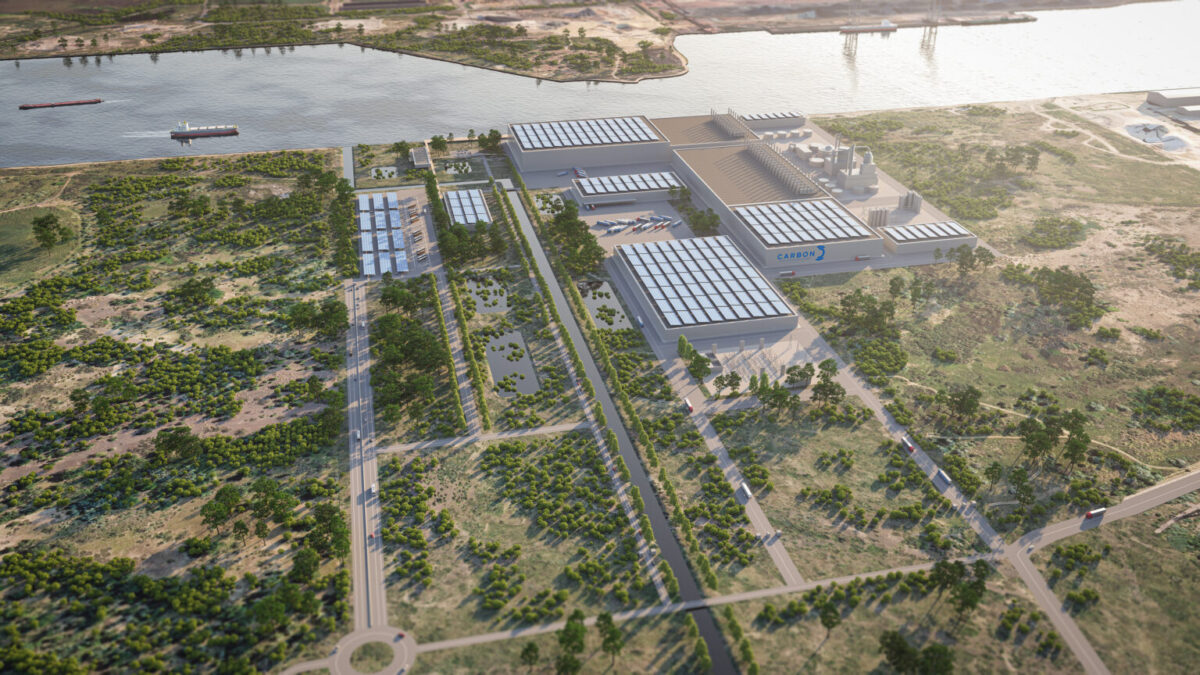
Carbon’s giant project in Fos-sur-Mer, designed to build a 5 GW integrated solar production chain in France, has been halted due to insufficient regulatory visibility and insufficient investor guarantees. Despite efforts to scale down the project and build partnerships, including with Chinese manufacturer Longi, the project collapsed due to uncertainty over EU industrial policy and market preference mechanisms.
“The story ends here, but our beliefs remain.” With these words, the founders of the French startup Carbon announced the termination of their gigafactory project.
The module giant, which was designated a “Project of Major National Interest” (PINM), embodied France’s ambition to repurpose part of the photovoltaic value chain, from solar cells to finished modules. Located in Fos-sur-Mer, in the Bouches-du-Rhône department in southern France, the production facility was planned for an annual capacity of 5 GW, representing an estimated investment of €1.5 billion ($1.74 billion).
“This ambition revolved around the construction of a factory with a large industrial scale, an indispensable condition for achieving globally competitive cost levels,” the founders said in a press release. However, such a project also presupposed the existence of a protected European market, supported by the EU Member States, to support the industrial start-up phase and absorb the additional costs associated with the initial start-up period.
According to the founders, the European regulatory framework has never offered this level of predictability.
“The purpose of the Net-Zero Industry Act (NZIA), passed in June 2024, was limited to diversifying supply chains without establishing any preferential treatment for European-made products,” the statement reads.
The founders further state that the Industry Acceleration Act of March 2026 expands the scope of Made in Europe to all countries with free trade agreements with the EU, potentially including Turkey, Vietnam and India, while delaying the introduction of a European preference until 2030.
As a result, they said, “there is currently no visibility into the emergence of such a market – neither the timeline, the scope, nor the rules.” Yet investors needed clear legal guarantees to finance the project.
Before reaching this impasse, the project developers had tried to adapt their strategy: first by considering a smaller facility for the assembly of photovoltaic modules using cells imported from China, and later by exploring industrial partnerships, including with Chinese manufacturer Longi. However, these efforts proved insufficient to save the Carbon project.
This content is copyrighted and may not be reused. If you would like to collaborate with us and reuse some of our content, please contact: editors@pv-magazine.com.
