

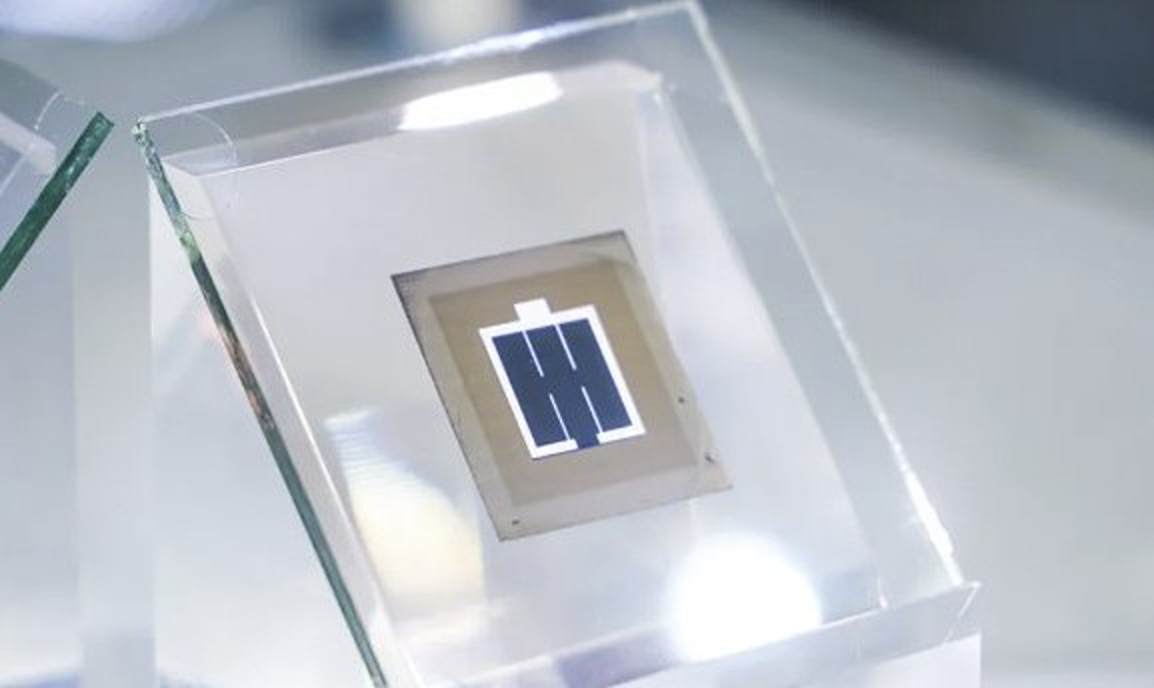
The result was certified by the Chinese National Photovoltaic Industry Metrology Test Center (NPVM). The cell uses a perovskite top device with MBT ligand-controlled crystallization on a TOPCon silicon bottom cell, achieving a cavity-free, highly efficient tandem structure.
Researchers from the National University of Singapore (NUS), the Solar Energy Research Institute of Singapore (SERIS) and Chinese solar panel manufacturer JinkoSolar have achieved an energy conversion efficiency of 32.76% for a perovskite-silicon tandem solar cell based on a TOPCon bottom device.
The result was certified by the Chinese National Photovoltaic Industry Metrology Test Center (NPVM).
The research team noted that current industry standard TOPCon silicon wafers, with a thickness of approximately 130 µm, have reduced thermal mass and higher thermal conductivity. “During the perovskite annealing process, the rapid heat transfer causes the perovskite layer to crystallize too quickly and uncontrollably, leading to voids and serious defects in the film, which compromise the performance of the tandem,” JinkoSolar researcher Menglei Xu said. pv magazine. “To overcome this bottleneck, we established a joint research effort with NUS and SERIS, innovatively developing a new crystallization control strategy for the best perovskite cell.”
The team moved away from traditional strategies focused on inorganic lead ions and developed an approach specifically targeting the organic components. They introduced a 2-mercaptobenzothiazole (MBT) ligand into the precursor solution used for the perovksite film.
“The MBT ligand has a dual-mode binding ability – specifically the heterocyclic N atom and the thiol group (-SH) – which enable simultaneous hydrogen bonding and electrostatic interaction with FA cations,” explains Xu. “This dual-mode interaction effectively stabilizes the intermediate phases, slowing the crystallization process to form a compact, void-free and uniform high-quality perovskite film on industrial silicon wafers.”
The top perovskite cell was fabricated with a substrate made of indium tin oxide (ITO), a hole transport layer (HTL) based on nickel oxide (NiOₓ), a self-assembling monolayer (SAM), a perovskite absorber, the proposed surface treatment, an electron transport layer (ETL) made of thermally evaporated buckminsterfullerene (C60)a tin oxide layer (SnO2) and another ITO layer.
The bottom silicon cell was entirely fabricated using industrially feasible TOPCon processes on commercial Czochralski monocrystalline silicon wafers measuring approximately 182.3 mm x 183.75 mm with a thickness of 130 µm.
Tested under standard lighting conditions, the 0.925 cm² tandem device achieved a power conversion efficiency of 33.62% and an open-circuit voltage as high as 1.97 V. Furthermore, the cell retained 91% of its initial efficiency after 1,700 hours of continuous use under maximum power point tracking (MPPT) at room temperature and 85% relative humidity.
“This is one of the highest reported certified stabilized efficiencies for monolithic perovskite/TOPCon tandem solar cells,” the research group emphasizes.
In terms of commercial compatibility, the study highlights the potential for seamless integration with existing industrial production lines. The researchers pointed out that this organic control strategy, introducing the MBT ligand, can be directly applied to large-scale, high-throughput solution processing workflows, paving the way for the integration of highly efficient perovskite technology into mainstream silicon production lines.
The solar cell was introduced in “Additive-assisted perovskite crystallization on industrial TOPCon silicon for tandem solar cells with improved efficiency”, published in nature energy.
“This work exposes a previously overlooked perovskite crystallization problem on industrial silicon wafers, providing critical insights for the integration of perovskite solar cells into mainstream TOPCon technology,” concluded Xu. “In particular, the strategy outlined in the article offers significant potential for direct application in industrial production. Its compatibility with scalable, high-throughput processing methods paves the way for translating this research into practical industrial use.”
This content is copyrighted and may not be reused. If you would like to collaborate with us and reuse some of our content, please contact: editors@pv-magazine.com.
