

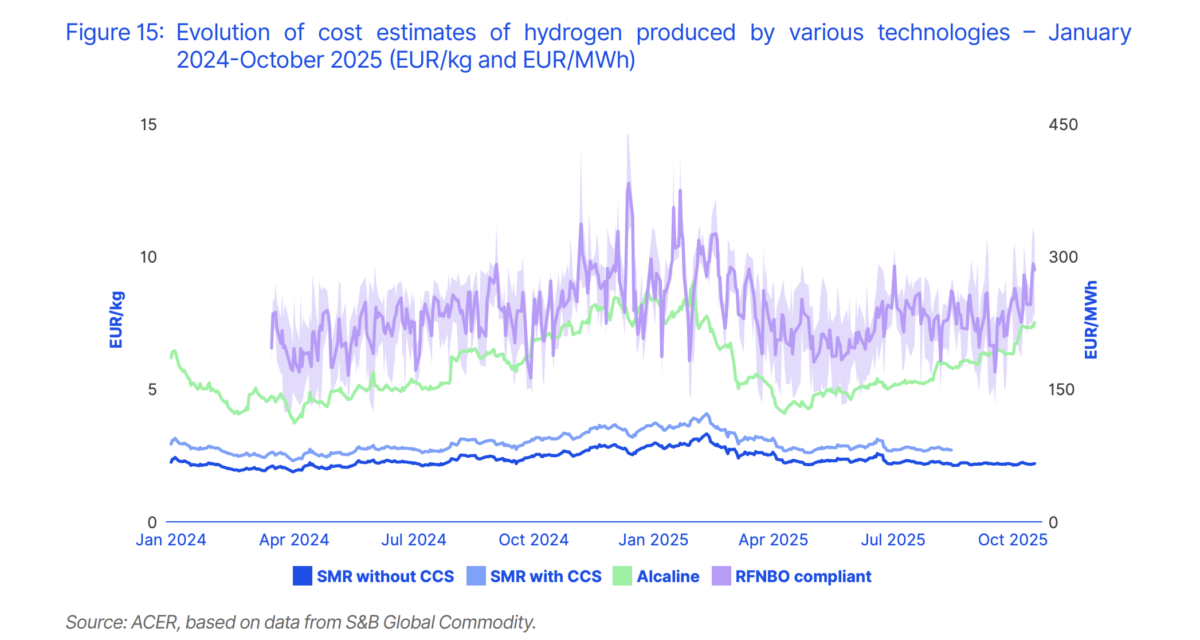
A report from the European Union Agency for the Cooperation of Energy Regulators shows that the average cost of renewable hydrogen remains around €8 ($9.33)/kg, about four times higher than that of conventional hydrogen from natural gas. A drop in natural gas prices has widened the price gap since the agency’s last hydrogen market report.
Renewable hydrogen remains four times more expensive than conventional hydrogen produced from natural gas, according to a report by the EU Agency for the Cooperation of Energy Regulators (ACER).
That of the intergovernmental organization Monitoring report European hydrogen market 2025 says a decline in natural gas prices has further reduced the cost of producing hydrogen from steam methane reform (SMR) since the agency’s 2024 report, widening the price gap with renewable hydrogen.
The average price of conventional hydrogen produced via SMR was just over €2.00 per kg between January and October this year, while carbon capture brought the average cost of reduced hydrogen to €2.80 per kg over the same period, excluding the costs of transport and storage of CO2.
The average cost of renewable fuels from non-biological origin (RFNBO) hydrogen, depending on the country of origin, ranged between €7.00/kg and €10.00/kg. The market-based HYDRIX index, issued by the European Energy Exchange for renewable energy, has shown a slight increase in 2025, averaging around €8.20/kg.
ACER’s report explains that the key cost components of renewable hydrogen production can be broken down into capital costs, including electrolyzer stacks, balance-of-plants and other upfront costs, and operational expenses, including the costs of electricity supply, network tariffs, maintenance and labor. The weight of these components varies widely from project to project, with capital expenditure being the dominant cost component for hydrogen produced from solar energy due to its relatively lower electricity costs compared to other sources and lower capacity factor.
The report adds that the prospects for cost reductions from renewable hydrogen appear “uncertain” in the near term. Expectations for liquefied natural gas (LNG) price levels and CO2 emissions currently favor fossil fuel hydrogen, the report points out, while slower deployment of electrolyzers limits economies of scale, delaying expected reductions in associated capital costs.
To scale up and mature the European renewable hydrogen market, the report recommends facilitating the technology through faster permitting and connection to the electricity grid. It also calls on EU Member States to accelerate the transposition of renewable hydrogen elements of the Renewable Energy Directive (RED) III into national law, set clear demand targets for RFNBO hydrogen and combine them with incentive policies.
Elsewhere in the report, ACER adds that low-carbon hydrogen produced from natural gas using CCS could support market development and accelerate decarbonisation in some sectors, with some current production costs estimated at just under €3.00/kg. While the report acknowledges that low-carbon hydrogen appears to be more cost-competitive than renewable hydrogen, the report warns that current cost estimates are largely dependent on assumptions about the transport and storage costs of CO2 and highlights that the phase-out of CO2 poses additional challenges.
“Assessing these cost uncertainties is essential for charting the path to the most appropriate hydrogen production options,” the report recommends. “It is therefore important to maintain the sector’s momentum by focusing on supporting demand creation in sectors with the greatest willingness to pay for renewable and low-carbon hydrogen.”
Key figures from the report add that EU electrolyzer capacity increased by 51% year-on-year to an installed capacity of 308 MW by 2024, with a further 1.8 GW under construction. However, it adds that this is “far away” from a realistic trajectory towards the EU’s 2030 target of 40 GW.
“Significantly accelerated expansion is needed to achieve the necessary scale, gain operational experience and ultimately drive innovation to reduce costs,” the report said. “To achieve this, early movers need adequate support and regulatory certainty.”
This content is copyrighted and may not be reused. If you would like to collaborate with us and reuse some of our content, please contact: editors@pv-magazine.com.
