

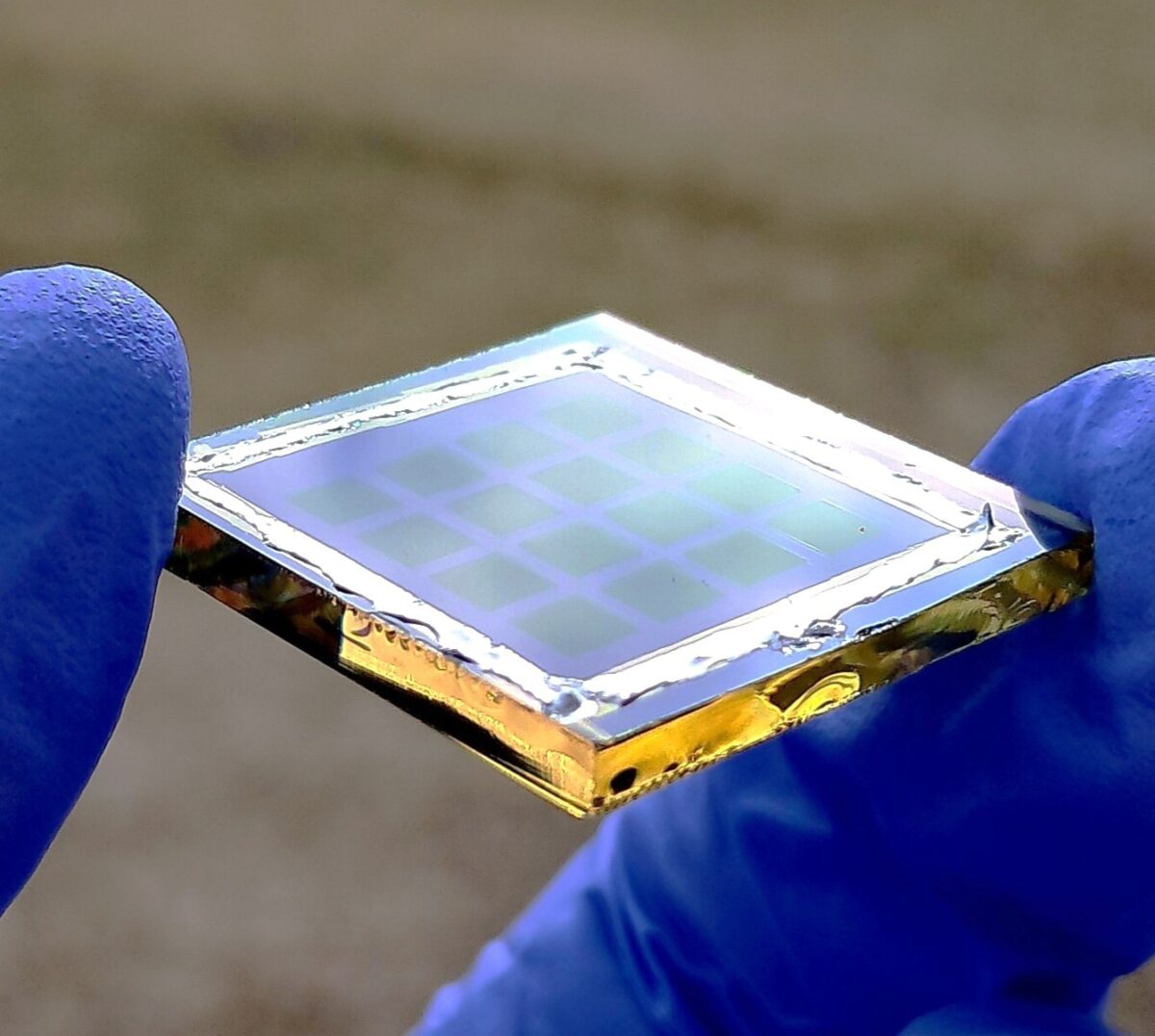
Researchers in Sweden developed a bifacial chalcoprite solar cell using a titanium-doped indium oxide (ITiO) back contact, achieving a bifaciality of 68%. The device can maintain strong front-side performance with an efficiency of approximately 15%, an open-circuit voltage of 595 mV and a fill factor of 75%.”
Researchers from Sweden’s Uppsala University have fabricated a bifacial chalcoprite (ACIGS) solar cell that can reportedly achieve an energy conversion efficiency of 15.1% and a bifaciality factor of 68%.
The key technical feature of the cell is the use of a titanium-doped indium oxide (ITiO) back contact, specifically designed to reduce optical losses typically associated with conventional, highly doped transparent back contact (TBC) materials. These traditional materials tend to absorb a significant portion of the incoming near-infrared (NIR) light, reducing the overall efficiency of the device.
ITiO, on the other hand, offers high electrical conductivity combined with superior transparency in the NIR region, allowing more effective light transmission to the active layers of the cell, while maintaining efficient charge collection. “This is not the first attempt to investigate ITiO as a back contact for chalcopyrite solar cells,” said the study’s lead author Jan Keller. pv magazine.
ITiO was preferred over simple indium tin oxide (ITO) as a back contact because its higher thermal and chemical stability during ACIGS deposition, combined with slightly better near-infrared transparency, allows for improved back light output and overall solar cell efficiency.
The cell was constructed with a soda lime glass (SLG) substrate, the ITiO-based TBC, a sodium fluoride (NaF) precursor layer, a 1 µm thick ACIGS absorber, a cadmium sulfide (CdS) buffer layer, and a zinc oxide (ZnO) window layer stack.
Through Hall effect measurements, the scientists found that ITiO exhibits significantly higher mobility and lower carrier density than conventional ITO, with the TBC retaining its electrical properties after high-temperature ACIGS deposition. Optical characterization also showed that ITiO has lower free carrier absorption than ITO, shifting parasitic losses far into the infrared and resulting in only 5% absorption at the ACIGS band gap of 1.1 eV, compared to 25% for ITO.
As a result, the short-circuit current density at backlighting is significantly higher for ITiO (22.7 mA/cm²) than for ITO (19.7 mA/cm²), while the open-circuit voltage remains comparable at approximately 595 mV. Under front illumination, the best cells show a similar efficiency of 15.1% for ITiO and 15.4% for ITO, demonstrating that the new TBC supports excellent device performance. However, the rear illumination efficiency benefits significantly from ITiO, reaching 10.2% versus 8.8% for ITO, mainly due to reduced optical losses and lower free carrier absorption (FCA).
Internal quantum efficiency (IQE) analysis confirmed that the remaining losses mainly arise from recombination and incomplete absorption in the ACIGS absorber rather than in the TBC.
“Our work shows that ITiO can replace opaque molybdenum (Mo) as transparent back contact in bifacial ACIGS cells,” said Keller. “The new primary challenge now lies in minimizing electrical losses at the back of the contact patch, which becomes the critical factor limiting performance. Future improvements should also focus on further improving collection at the back of the wearer and reducing parasitic absorption in the front contacts.”
The device was presented in “Titanium doped2O3: A thermally stable back contact with high mobility for bifacial Chalcopyrite solar cells”, published in RRL solar energy. The research team also included academics from the Loughborough University in the United Kingdom.
This content is copyrighted and may not be reused. If you would like to collaborate with us and reuse some of our content, please contact: editors@pv-magazine.com.
