

UNSW researchers developed a chemically selective, nitrate-based, single-sided accelerated aging method for TOPCon solar cells that replicates the mildly acidic environment in EVA-encapsulated modules. The proposed approach enables rapid, physically meaningful screening of front-end metallization stability, reliably predicting module-level degradation and reducing development time and costs, according to its creators.
A research team from the University of New South Wales (UNSW) has developed a new accelerated cell-level aging method for TOPCon solar technologies.
“Conventional solution-based accelerated tests such as acetic acid soak impose chemically unrealistic conditions and often fail to reproduce degradation trends at the module level,” said the study’s lead author, Bram Hoex. pv magazine. “We have introduced a chemically selective, pH-controlled, nitrate-based cell-level aging method that mimics the mildly acidic environment in EVA-encapsulated modules.”
The scientists explained that to accelerate the assessment of the stability of TOPCon cells and modules, solution-based aging methods, especially immersion in acetic acid (CH₃COOH), are widely used. Although these approaches provide valuable mechanistic insights, they have limitations because both sides of the cell are exposed simultaneously and the chemical conditions are often harsher than the mildly acidic environment that develops in EVA-encapsulated modules.
Alternative methods, such as spraying salts such as sodium chloride (NaCl) or sodium bicarbonate (NaHCO₃) onto cell surfaces, fail to replicate these realistic conditions. However, nitrate species occur naturally and can produce tunable acidic environments depending on the cation used, making them well suited for chemically relevant accelerated aging.
“Building on these insights, we are developing a nitrate-based, single-sided aging method in which contaminants are applied to the front surface at controlled pH before exposure to moist heat,” Hoex said. “This approach enables targeted evaluation of front-end metallization stability and reliably reproduces degradation trends at the panel level, providing a framework for chemically realistic accelerated testing of TOPCon solar cells.”
The research team conducted the tests on TOPCon solar cells measuring 182 mm x 183.75 mm and based on n-type Czochralski silicon wafers with two front contact variants: conventional silver/aluminum (Ag/Al) paste and a low-Al Ag paste processed using a laser-assisted baking technique (Ag/LAF). All cells were half-cut to form 144-cell modules, encapsulated with EVA (UV blocking on the front and UV transparent on the back) and completed with a transparent back plate with a white grid.
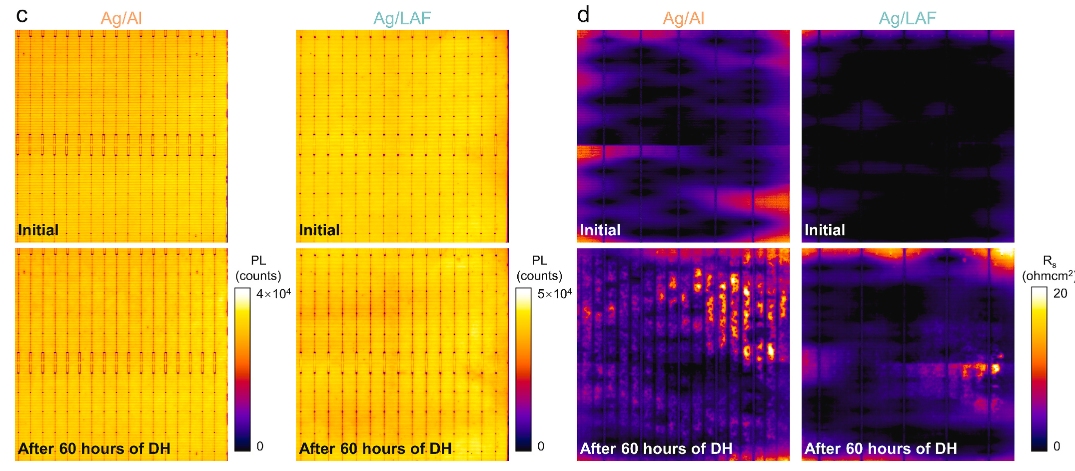
Module-level moisture-heat testing was performed according to the IEC TS 62782 standard, measuring electrical power and using electroluminescence imaging to identify degradation. At the cellular level, accelerated stress tests include immersion in 0.1 M CH₃COOH or CH₃COONa at 85 C, as well as spraying saline solutions with controlled pH, followed by moist heat testing at 85 C and 85% relative humidity (DH85). The pH of the solution was determined at 25°C and the relative acidity trends were maintained during high temperature aging.
Electrical performance was measured before and after the tests using a LOANA system, while photoluminescence and series resistance maps were acquired using a BT Imaging R3 system. All experiments included multiple replicates to ensure reproducibility, allowing a comprehensive assessment of front-end metallization stability and degradation fingerprints at the module level.
The tests showed that the Ag/Al and Ag/LAF cells exhibited different degradation behavior, with Ag/LAF contacts showing higher sensitivity to acidic conditions and pronounced losses in efficiency and fill factor due to front delamination.
Scanning electron microscopy (SEM) and focused ion beam scanning electron microscopy (FIB-SEM) analyzes revealed that Ag/Al contacts depend on Al spikes and high glass frit content, which provide mechanical robustness and slower degradation, while Ag/LAF contacts depend on silver nanoparticles (AgNPs) with thin lead oxide (PbO)-rich glass frit layers that dissolve under acid or chloride-rich conditions.
Furthermore, single-sided salt treatments highlighted the role of solution pH and specific ions in front contact corrosion, demonstrating severe degradation under aluminum nitrate (Al(NO₃)₃) and chloride (Cl⁻) salts. Neutral salts were found to cause minor effects, while acidic nitrate solutions accelerated the dissolution of PbO glass frit. Furthermore, cell-level DH85 with zinc nitrate (Zn(NO₃)₂) showed consistent trends with panel-level performance, with loss of fill factor being the dominant factor.
“Our approach provides a rapid and physically meaningful screening tool to identify reliability risks at the solar cell stage, before committing to full module assembly and long-term moisture-heat testing of more than 1,000 hours,” said Hoex. “It enables rapid optimization of metallization and bill of materials (BOM) choices, reducing development time and costs while avoiding misleading conclusions that can arise from overly aggressive or unrepresentative accelerated testing. By establishing a clear link between cell-level testing and actual module degradation mechanisms, this method improves predictive power for long-term performance.”
The new methodology was presented in “Bridging accelerated degradation at the cell level to module-relevant failure mechanisms in TOPCon solar cells and modules,” published in the Journal of Chemical Technology. “In essence, this work demonstrates that well-designed, chemically relevant tests at the cell level can significantly accelerate reliability assessment, while still capturing the key degradation pathways observed at the module level,” concludes Hoex.
This content is copyrighted and may not be reused. If you would like to collaborate with us and reuse some of our content, please contact: editors@pv-magazine.com.
