

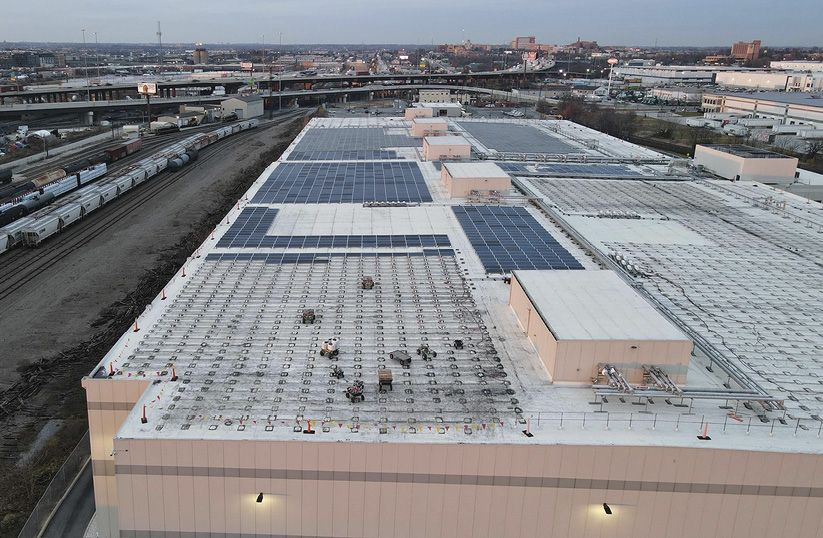
The practical issue of taking apart a dead PV system and moving the components to their next destination has received less attention than recycling and second life applications. In the United States, Decom Solar offers dismantling for commercial and industrial (C&I) solar projects. pv magazine spoke to Decom Solar co-founder Stephen Burns for an update.
pv magazine: Can you tell me something about Decom Solar and its work?
Stephen Burns: Before I started Decom Solar, I worked in the solar energy sector for a project developer for 10 years. At that time, we started seeing clients requesting end-of-life management. We didn’t have an end-of-life solution and there weren’t many partners offering that service. My business partner and I saw this as an opportunity. We started Decom Solar with a focus on providing turnkey end-of-life PV services to C&I and small utilities, including full decommissioning, re-supply and what we call ‘de/re’, de-installation and reinstallation where a system needs to be temporarily removed so that work can be done on the roof.
We are currently working on 17 projects across the United States for asset owners and developers [and] TO [operations and maintenance] and roofing companies. Our corporate goal is to ensure that dismantling is sustainable and to ensure that no material from these systems ends up in landfill. We have found that approximately 85% of the components we encounter still have life in them and in these cases we work with equipment resellers and vetted non-profits to resell or donate them, which can have a major positive impact have on disadvantaged communities.
How do you deal with the tests required to decide whether something should go to recycling or to a second life?
We can usually get an idea of whether a part can be reused based on the age and type of material. We come across a lot of old material, such as Solyndra modules or frameless modules, that we know need to be recycled. For modules over 250W, we perform tests such as IV curve tracking, infrared imaging, backsheet inspection, connector assessments, etc., to determine their suitability for reuse.
A challenge for us is that customers often have zero capital reserved for decommissioning. Even when I was on the developer side of the industry, there was no line item in the financial modeling of end-of-life costs. For most clients, the goal is to do this sustainably, but at the lowest possible costs. In those cases, reselling usable equipment can help offset some of the labor costs.
You mentioned that Decom Solar is one of the first in this field. What other options do clients have when it comes to dismantling?
What we want to avoid is dumping. We have lost project bids based on price because we include the cost of recycling when necessary. Currently, recycling can range from $12 to $18 per module, which quickly adds up for larger systems. There are a few other companies that offer decommissioning services and many consultants that provide advice on how to decommission a project, but there are not many that focus exclusively on end-of-life services.
We are gaining a lot of positive traction and are becoming recognizable as the ones people can go to for a complete turnkey offering. We do everything from permitting and handling utilities, to removing the actual system and making sure it’s handled properly. At the end of the project, we provide documentation proving that all materials have been properly disposed of, or details of the transfer of ownership in the event of resale or donation.
Are there any rules for this space? And what should asset owners do when it comes to end-of-life management?
There are very few here in the US. Generally, it is administered on a state-by-state basis. If there were federal regulations it would certainly help the industry move forward, but for now the system location determines how the material should be processed. Only a few states have any formal regulations, most notably California and Washington, but several are actively exploring legislation. We notice that solar panels are lumped in with universal or electronic waste. Some are considered hazardous waste that requires careful handling and strict compliance with regulations. We do things the right way and ensure that this equipment is put back into the supply chain through reuse or recycling.
How often does it happen that end-of-life treatment is not included in a project contract at all?
We usually notice that no thought has been given in advance to how much it will cost. In the case of larger land-based or utility-scale permits, authorities typically require developers and asset owners to come up with a decommissioning plan. This is essentially non-existent in the roof space, where authorities required no forethought. In projects being built today, it is more common for decommissioning to be considered. We often speak with developers who are starting to make plans and work directly with us to get an idea of what it will cost to remove a system. This allows them to include decommissioning in the overall project financing so that when the project reaches end of life, they can quickly move forward with planned costs.
What is the recycling landscape like in the United States? Do you have options with whom you can collaborate?
There are a handful of companies offering this, and the Department of Energy (DOE) is pushing hard to encourage innovation in recycling. We see these efforts taking root. Companies focused on recycling PV modules are developing large recycling plants throughout the country. There are also many legacy recyclers from various industries, whether electronics, aluminum or glass, who are starting to innovate their processes to handle large volumes of PV modules. The DOE has a plan to bring the cost of recycling more in line with the cost of landfilling, which is about $3 per module. The DOE’s Solar Energies Technology Office (SETO) recently stated that they are aiming to bring the cost of recycling PV panels to $5 per module. This would help enormously in getting companies to accept those costs. There are tried and trusted recyclers in the US supporting our efforts, and SEIA [trade body the Solar Energy Industries Association] has done an excellent job establishing the SEIA National PV Recycling Program. As part of this program, they visit recycling plants to monitor their operations and ensure they are doing things right.
In addition to modules, are other components, such as racks or inverters, easier to access at recycling companies?
This is certainly the case with racks, we generally deal with steel and there is a healthy market for steel recycling. On the inverter side, things are a little more nuanced. We work with systems from the past, so we are forced to deal with older equipment, mainly large central inverters. We work with a network of asset owners and O&M companies who are interested in purchasing inverters, so they have spare equipment on hand. When entire units are not salable, we work with partners who remove the valuable components from those inverters to reuse them in their operations and maintenance efforts. In all cases, the steel frame of these inverters is easily recyclable. There is a healthy market that we are tapping into and we ensure that what can be reused is reused.
This content is copyrighted and may not be reused. If you would like to collaborate with us and reuse some of our content, please contact: editors@pv-magazine.com.
