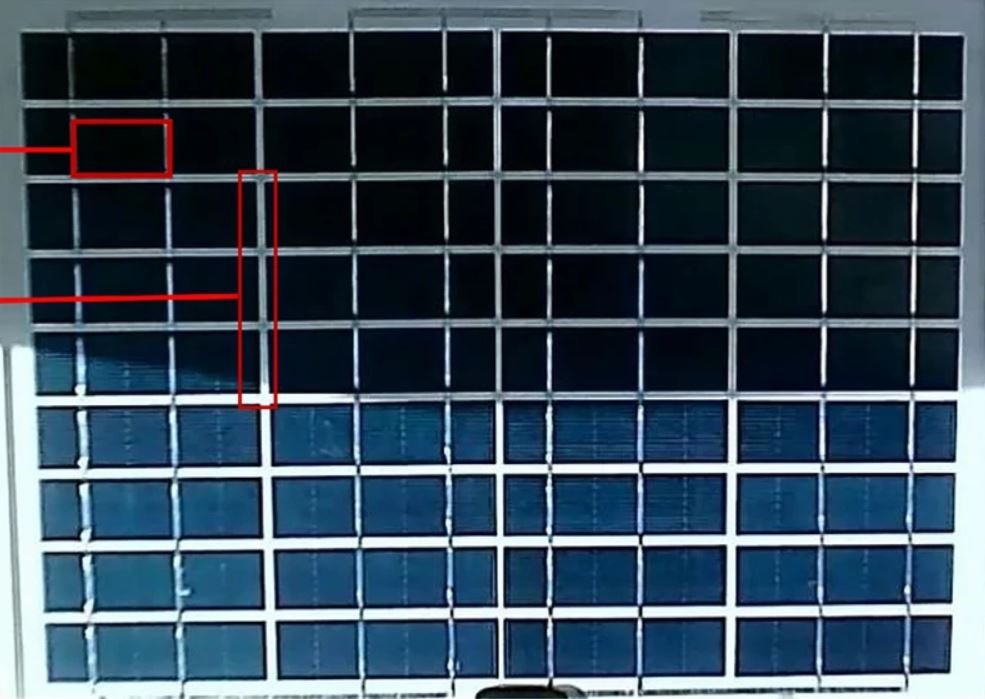
Scientists have developed a new method that uses live video images to detect shadows on solar panels. It uses computer vision techniques such as gamma transform and histogram matching, resulting in performance that is said to be better than conventional techniques, especially in large arrays.
A research team in China has developed a new real-time shadow detection method for PV modules. It uses computer vision for this task, with techniques that enhance the information from the live feed to identify the shadow in changing lighting conditions.
“This method has a significant reference value for shadow monitoring of large PV arrays. It provides new technical means for intelligent and precise operation and maintenance of PV systems,” the researchers said. “We believe this work has the potential to monitor the shading of PV arrays in real time, and we look forward to further research to extend it to more application scenarios.”
Starting with a live video feed, the new method analyzes each frame, first by extracting the area of the PV module. To address the problem of illumination variation, the technique then uses gamma transform, a computer vision method based on an algorithm that corrects the brightness of the image without any reference.
In the next step, image contrast is improved with histogram matching, another computer vision technique that brightens an image by looking at the histogram of a reference image. Gray level slicing is then used to segment the shaded part of the PV modules, from which the actual shade output is obtained.
Image: Northeast Agricultural University, Scientific Reports, CC BY 4.0
“To better simulate the real working environment, the validation experiment in this paper is designed as a fixed-position camera, with the environment around the PV module,” the group said. “The image capture device consists of a mechanical bracket, a camera with a frame rate of 30 FPS and an adjustment device. The PV module consists of 36 solar cells of 220 mm x 770 mm, arranged in 4 columns and 9 rows, glued on the white back plate and covered with tempered glass.”
The experimental setup was located in Harbin, China, for all of August 2023, recording 90 videos of one hour each. A total of 4,815 minutes of video were recorded, representing different lighting conditions and occlusion levels. About half of the recorded time was used to analyze and train the model, while the rest was used for testing it. It was also compared with four other shadow detection models, namely the Canny edge detection, multilevel thresholding, random forest and convolutional neural network (CNN).
“The average recognition accuracy (ACC) of this method is verified to be 0.98 by the test set, which is higher than the existing Canny edge detection recognition method,” the results show. “The F0.5 and F2 values of the method are 0.87 and 0.85 respectively, which is good in terms of accuracy and recall. Furthermore, the average time the method takes to process an image frame is 0.721 s, providing good real-time performance.”
For compression, the Canny method had an ACC of 0.95, F0.5 of 0.76, and F2 of 0.79, and a frame processing time of 0.684 s. Multilevel thresholding performed with an ACC of 0.94, F0.5 of 0.75 and F2 of 0.77, and a frame processing time of 0.934 s, while random forest had an ACC of 0.89, F0.5 of 0, 31 and F2 of 0.35 and a frame processing time of 1.067 s. Finally, CNN had an ACC of 0.82, F0.5 of 0.38, and F2 of 0.62, and a frame processing time of 0.603 s.
Their findings were presented in “The real-time shadow detection of the PV module through computer vision based on histogram matching and gamma transform method”, published in Scientific reports. The research team included academics from China’s Northeast Agricultural University and Shenzhen University.
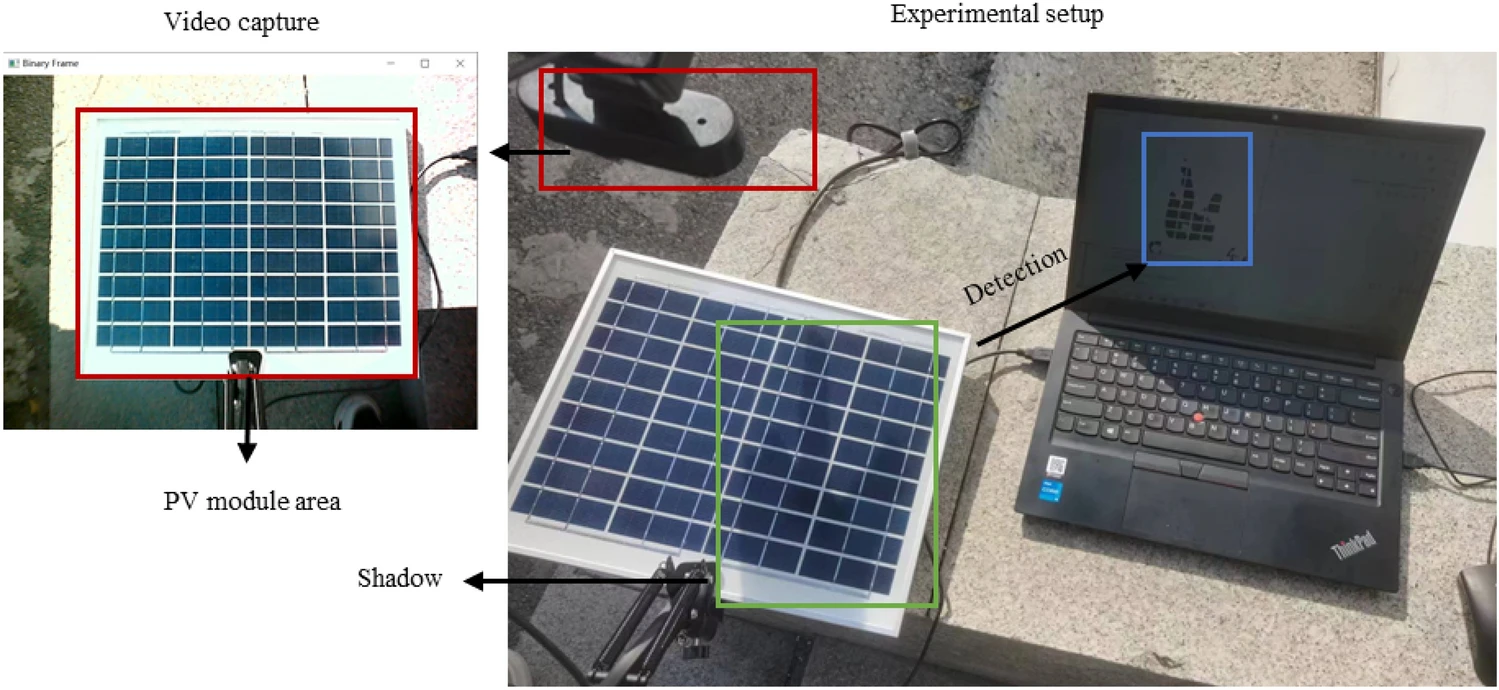
Image: Northeast Agricultural University, Scientific Reports, CC BY 4.0
This content is copyrighted and may not be reused. If you would like to collaborate with us and reuse some of our content, please contact: editors@pv-magazine.com.
Popular content