

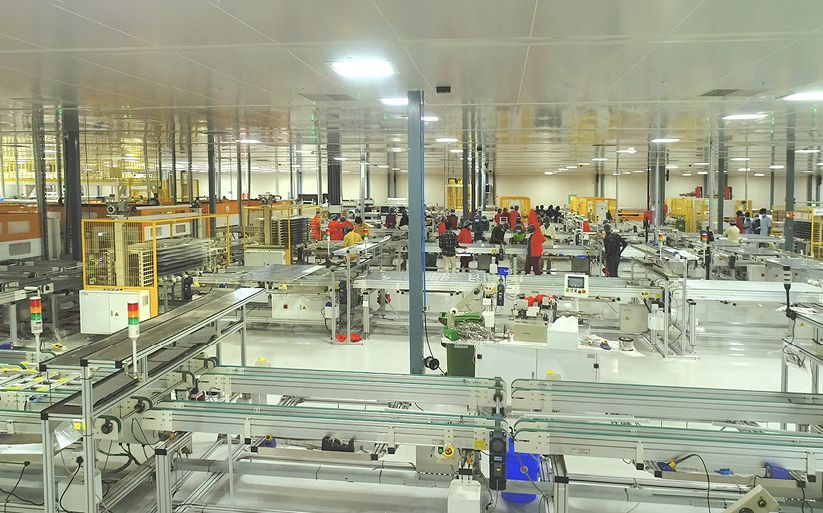
Most PV manufacturers in India have migrated their module production from passivated emitter back contact (PERC) to n-type TOPCon technology. TOPCon is now the preferred option for those transitioning to regular, large-scale cell production or expanding production capacity.
Even as TOPCon takes over the Indian solar industry, some observers expect interdigitated back contact (IBC) and other BC-type solar devices – which offer higher conversion efficiency – to become a part of TOPCon by 2030 market will be wiped out.
There are currently a limited number of PV manufacturers worldwide making commercial moves in the BC space, although large-scale solar companies such as Aiko, Longi and Maxeon could quickly bring this new technology into mainstream production.
BC cells represent a range of cell architectures, in some cases combined with other technologies such as TOPCon or heterojunction (HJT) solar. In BC devices, all contacts and other structures necessary to transport charge out of the cell are placed on the back side, eliminating front shadow losses and providing high efficiency. Manufacturing BC technology requires investments in new tooling and mastering more complex and delicate processes than required in TOPCon production.
Indian manufacturers, operating on tight margins, plan to continue with TOPCon in the short term and continue to explore improvements to that technology, rather than investing in BC solar, which is still challenges faced in large-scale production. Reliance Industries is currently the only manufacturer in India with firm plans for BC production. Reliance plans to commercialize HJT-IBC solar by 2026. The group’s new energy activities are currently developing first-generation bifacial panels with an efficiency of 26%, using HJT technology.
TOPCon at the top
Since 2021, TOPCon has become the favorite successor to PERC among manufacturers, including in India. TOPCon offers an easier and less cost-intensive transition, with currently comparable performance prospects to HJT, its main rival. Although BC is seen as the next evolutionary step in solar energy – due to its potentially higher performance than other silicon cell technologies – shifting large-scale production to any BC technology would be a much more complex undertaking than an upgrade to TOPCon.
“B.C [cells] It involves back-end contacts, eliminating front rails, improving efficiency, but requiring specialized tools and processes,” said Vikas Singh, general manager for global operations at Chinese solar production equipment supplier Yingkou Jinchen Machinery. “The transition will require heavy capital expenditure to convert production lines, purchase new equipment and retrain staff. For Indian manufacturers, especially those operating on tight margins, this can be a challenge. The high initial cost could deter some players, especially smaller or recently upgraded players.
BC structures can be implemented on various cell architectures, including TOPCon and HJT, to improve cell efficiency. BC solar cells have the potential to achieve an efficiency of up to 29.1% – a figure recognized as the highest performance potential of all silicon solar technologies. However, it is more challenging to make cells two-sided. The higher yield of IBC on the front end may still not justify the higher costs compared to TOPCon.
Balachander Krishnan, chief operating officer of the ingot-to-module plant at Indosol Solar, said BC solar may not capture at least 10% market share until 2028. He noted several key barriers to IBC adoption. These include high capital expenditures, non-standardized processes with many different routes and higher operating costs. Reliability issues, lower yields and higher electrical outages and breakages due to manufacturing complexity also pose challenges. The lower bifaciality factor of 70% compared to TOPCon’s 80% also contributes to the difficulty in adoption.
Gyanesh Chaudhary, chairman and managing director of Vikram Solar, said the cost sensitivity of the Indian market means that the total cost of solar energy, in dollars per watt peak of panel generation capacity, is crucial. BC technology currently involves complex processes and higher investments. It is currently in the development phase and further progress is expected in 2025.
Preparing for the transition
Until BC is a more viable option, manufacturers prefer to focus on processes in their existing lines to increase cell efficiency. However, many solar manufacturers have BC on their technology roadmaps, as several leading module manufacturers in India have shared pv magazine.
“For Tier-1 cell suppliers, TOPCon has already achieved 26% efficiency in their production lines by introducing the LECO [laser-enhanced contact opening] process and edge passivation as a standard process in their production lines,” says Krishnan from Indosol.
In that scenario, Krishnan believes that TOPCon still has greater potential to achieve cell efficiency of more than 28% by applying a series of innovations, including double-sided TOPCon, optimization of the interface design between the many cell layers, a new cell structure to improve carrier selectivity, polyfinger technology, new silver pastes and more.
“With this clear roadmap in mind, manufacturers are more likely to focus on harnessing the maximum potential of existing TOPCon lines [than] focusing on a newer technology that has yet to prove itself in mass production in terms of cost, yield and reliability,” he added.
While others may start BC adoption sooner, realizing some of the above-mentioned TOPCon capabilities should keep the technology competitive in the medium term. “As back-contact routes promise even higher efficiency than TOPCon, Indian manufacturers must focus on integrating advanced techniques such as selective doping, light trapping and surface passivation,” said Juhi Marwadi, director of module maker Pixon. “This will help them remain competitive in the global market as other manufacturers also move to high-efficiency cells.”
As for the transition to BC, government incentives, technological cooperation and workforce training are necessary to ease the transition.
“Manufacturers need to assess their existing production lines and understand the level of compatibility for future BC production,” Marwadi said. She explained that this includes process optimization for contact printing, passivation and module assembly. To ease the transition to BC, Marwadi said she expects Indian manufacturers will seek partnerships with international technology companies and research institutes specializing in BC solar technology. Such collaborations could accelerate the process of technology transfer and shorten the learning curve for new approaches. “Manufacturers will have to invest in upskilling their workforce to handle the more advanced IBC processes,” Marwadi said. “Government of India’s PLI [production-linked incentive] This program and other incentives for the solar industry could provide financial support to manufacturers transitioning to next-generation technologies such as IBC.”
Hardip Singh, Chief Operating Officer at Grew Energy, said the rapid pace of technological advancement in the solar industry poses a major challenge for Indian manufacturers. The return on investments in production technology often lags behind these developments. Singh said he expects this trend to continue, requiring manufacturers to adapt or find innovative solutions. He noted that manufacturers have already sought government support to address this issue.
“With the transition to BC panels expected as early as 2025, we are closely monitoring advancements in BC technologies,” said Suhas Donthi, president and CEO of Emmvee Group. “We are preparing to introduce these advanced solutions to the Indian market when they reach the right stage for large-scale commercial deployment.”
This content is copyrighted and may not be reused. If you would like to collaborate with us and reuse some of our content, please contact: editors@pv-magazine.com.
