
Close Menu
  • News
  • Industry
  • Solar Panels
  • Commercial
  • Residential
  • Finance
  • Technology
  • Carbon Credit
  • More
    • Policy
    • Energy Storage
    • Utility
    • Cummunity
What's Hot

Fraunhofer ISE develops colored film technology for patterned solar panels

April 23, 2026

Thermoacoustic heat pumps are on the verge of commercial breakthrough – SPE

April 23, 2026

The federal court has halted Trump administration orders that hinder solar and wind energy development

April 23, 2026
Facebook X (Twitter) Instagram
Solar Energy News
Thursday, April 23
  • News
  • Industry
  • Solar Panels
  • Commercial
  • Residential
  • Finance
  • Technology
  • Carbon Credit
  • More
    • Policy
    • Energy Storage
    • Utility
    • Cummunity
Solar Energy News
Home - News - DGIST’s research team promotes the environmentally friendly efficiency of solar cells using rapid temperature control
News

DGIST’s research team promotes the environmentally friendly efficiency of solar cells using rapid temperature control

solarenergyBy solarenergyOctober 28, 2025No Comments2 Mins Read
Facebook Twitter Pinterest LinkedIn Tumblr Email
Share
Facebook Twitter LinkedIn Pinterest Email

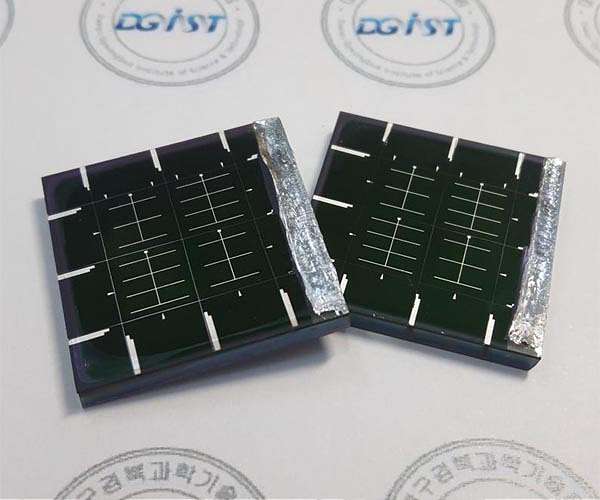
DGIST’s research team promotes the environmentally friendly efficiency of solar cells using rapid temperature control


Research led by Dae-Hwan Kim and Kee-Jeong Yang of DGIST, in collaboration with Junho Kim of Incheon National University, has developed a technique to improve the efficiency of antimony selenide (Sb2Se3) solar cells. The method involves increasing the heating rate during thermal processing of materials, producing more uniformly aligned crystals and promoting efficient charge transport.

Antimony selenide is composed of antimony and selenium, making it an environmentally safe choice for solar cell production. Traditional devices using this material face efficiency limitations due to defects and uneven crystal orientation, which limit the movement of electrons and holes.

The team found that faster thermal processing supports orderly crystal growth and reduces defects. Analytical methods, such as scanning electron microscopy (SEM), X-ray diffraction (XRD), ultraviolet photoelectron spectroscopy (UPS), access spectroscopy and STEM-EDS, confirmed that gradual increases in temperature result in defective, randomly oriented crystals. In contrast, rapid heating produces evenly grown crystals, allowing smoother electron flow.

Kee-Jeong Yang announced: “This study provides a clue to addressing one of the key limitations of antimony selenide solar cells, namely the issues of crystal orientation and structural defects. By simply controlling the crystal growth rate early in the manufacturing process, we can maximize the material’s potential. This is expected to greatly contribute to future commercialization and development of large surface area modules. “

The study was conducted with Jaebaek Lee and Bashiru Kadiri-English as co-first authors. The work received support from several Korean government programs and was published in the Journal of Materials Chemistry A, with selection as Inside Front Cover.

See also  Atmoce introduces a micro-inverter that connects two solar panels

Research report:Effect of crystal growth rate on crystal direction, defect formation and photovoltaic performance of Sb2Se3 thin film solar cells


Source link

cells control DGISTs efficiency Environmentally friendly promotes Rapid Research solar team temperature
Share. Facebook Twitter Pinterest LinkedIn Tumblr Email
solarenergy
  • Website

Related Posts

Fraunhofer ISE develops colored film technology for patterned solar panels

April 23, 2026

The federal court has halted Trump administration orders that hinder solar and wind energy development

April 23, 2026

Solar energy’s rebound effect could increase European electricity demand by 5% by 2050 – SPE

April 23, 2026
Leave A Reply Cancel Reply

Don't Miss
Solar Industry

New coating prevents plant growth on underwater solar cells

By solarenergyAugust 27, 20240

The US Navy has funded Danish research into preventing biofouling while maintaining visible light transmission…

Long-term issues found in storage panels-PV Magazine International

March 27, 2025

US government doubles tariffs on imports of PV cells from China to 50%

May 15, 2024

EPFL and CSEM achieve world record efficiency of 30.02% in perovskite-silicon triple-junction solar cell – SPE

March 19, 2026
Stay In Touch
  • Facebook
  • Twitter
  • Pinterest
  • Instagram
  • YouTube
  • Vimeo
Our Picks

Fraunhofer ISE develops colored film technology for patterned solar panels

April 23, 2026

Thermoacoustic heat pumps are on the verge of commercial breakthrough – SPE

April 23, 2026

The federal court has halted Trump administration orders that hinder solar and wind energy development

April 23, 2026

Zendure launches battery ranges for residential PV – SPE

April 23, 2026
Our Picks

Fraunhofer ISE develops colored film technology for patterned solar panels

April 23, 2026

Thermoacoustic heat pumps are on the verge of commercial breakthrough – SPE

April 23, 2026

The federal court has halted Trump administration orders that hinder solar and wind energy development

April 23, 2026
About
About

Stay updated with the latest in solar energy. Discover innovations, trends, policies, and market insights driving the future of sustainable power worldwide.

Subscribe to Updates

Get the latest creative news and updates about Solar industry directly in your inbox!

Facebook X (Twitter) Instagram Pinterest
  • Contact
  • Privacy Policy
  • Terms & Conditions
© 2026 Tsolarenergynews.co - All rights reserved.

Type above and press Enter to search. Press Esc to cancel.